

Published by AgamiSoft | Reading time: ~14 minutes
|
Featured Snippet / AEO Answer : Agent-to-Agent (A2A) AI communication enables multiple specialized AI agents to exchange information, delegate sub-tasks, and coordinate execution across complex multi-step workflows where a single general-purpose AI agent would be insufficient in capability, too slow in execution, or too broad in tool access to handle the full task reliably. Multi-agent architectures improve scalability by allowing specialized AI agents to collaborate, delegate tasks, and share contextual information across complex enterprise workflows, producing outcomes that no single agent could achieve with equivalent efficiency or accuracy.
|
Agent to Agent AI: The Complete Guide to Building Collaborative Multi-Agent Systems in 2026
|
Quick Answer / TL;DR : Agent-to-Agent (A2A) AI is the architecture through which multiple specialized AI agents communicate, delegate work, and coordinate execution enabling enterprise AI systems to handle tasks of a complexity, duration, and scope that a single AI agent cannot manage reliably. The design principle is the same as organizational design: specialized teams with defined responsibilities, clear communication protocols, and coordinated handoffs outperform a single generalist attempting to do everything. A2A AI extends this principle to autonomous AI systems, building multi-agent architectures where each agent does what it's specifically designed for and hands off what it isn't.
|
Why Agent-to-Agent AI Has Become the Dominant Architecture for Complex Enterprise Automation in 2026
Single-agent AI systems one AI that plans and executes everything hit a predictable ceiling as task complexity scales. The ceiling has three dimensions: context window limits (a single agent handling a weeks-long research project accumulates more context than any context window can hold), tool access complexity (an agent with access to every tool in the enterprise is an agent with poorly governed permissions), and reliability degradation (error rates compound as task chains grow longer, and a single agent's error has no recovery path except restarting from the beginning).
Multi-agent architectures address all three dimensions by distributing work. A research task that would overflow a single agent's context window becomes a series of bounded sub-tasks delegated to specialized subagents, each operating within its own context. A data processing pipeline that requires access to a database, an API, and a code execution environment assigns each access to the agent specifically designed for it. A workflow that would fail if a single agent's step 15 produces an error becomes a recoverable workflow where the failed subagent retries or escalates independently.
Three developments have made Agent-to-Agent AI the 2026 architecture of choice for enterprise AI teams building production systems:
Google's A2A Protocol has established an open standard for inter-agent communication. Google released the Agent-to-Agent (A2A) Protocol specification in April 2025 an open standard for how AI agents communicate with each other regardless of the underlying model or framework. A2A Protocol defines message format, capability declaration, task delegation, and result return in a standardized way that enables agents built on different AI stacks to interoperate. The combination of A2A Protocol and Anthropic's Model Context Protocol (MCP) for tool access has created the interoperability foundation that production multi-agent systems require.
Agentic frameworks have matured to production quality for multi-agent orchestration. LangGraph's stateful multi-agent graph execution, AutoGen's conversational agent collaboration, and CrewAI's role-based multi-agent framework have all reached production maturity with the state management, error handling, and human-in-the-loop integration that pilot demos don't require but production enterprise systems do.
Enterprise AI tasks have grown complex enough to require specialization. The AI automation tasks enterprises are tackling in 2026 multi-week research programs, end-to-end procurement workflows, complex customer support resolutions that require access to CRM, ERP, and communication systems simultaneously are structurally too complex for single-agent execution at production reliability. Multi-agent architecture is not an optimization for these tasks; it is the necessary condition for reliable execution.
What Is Agent-to-Agent AI, Exactly and What Are the Four Communication Patterns?
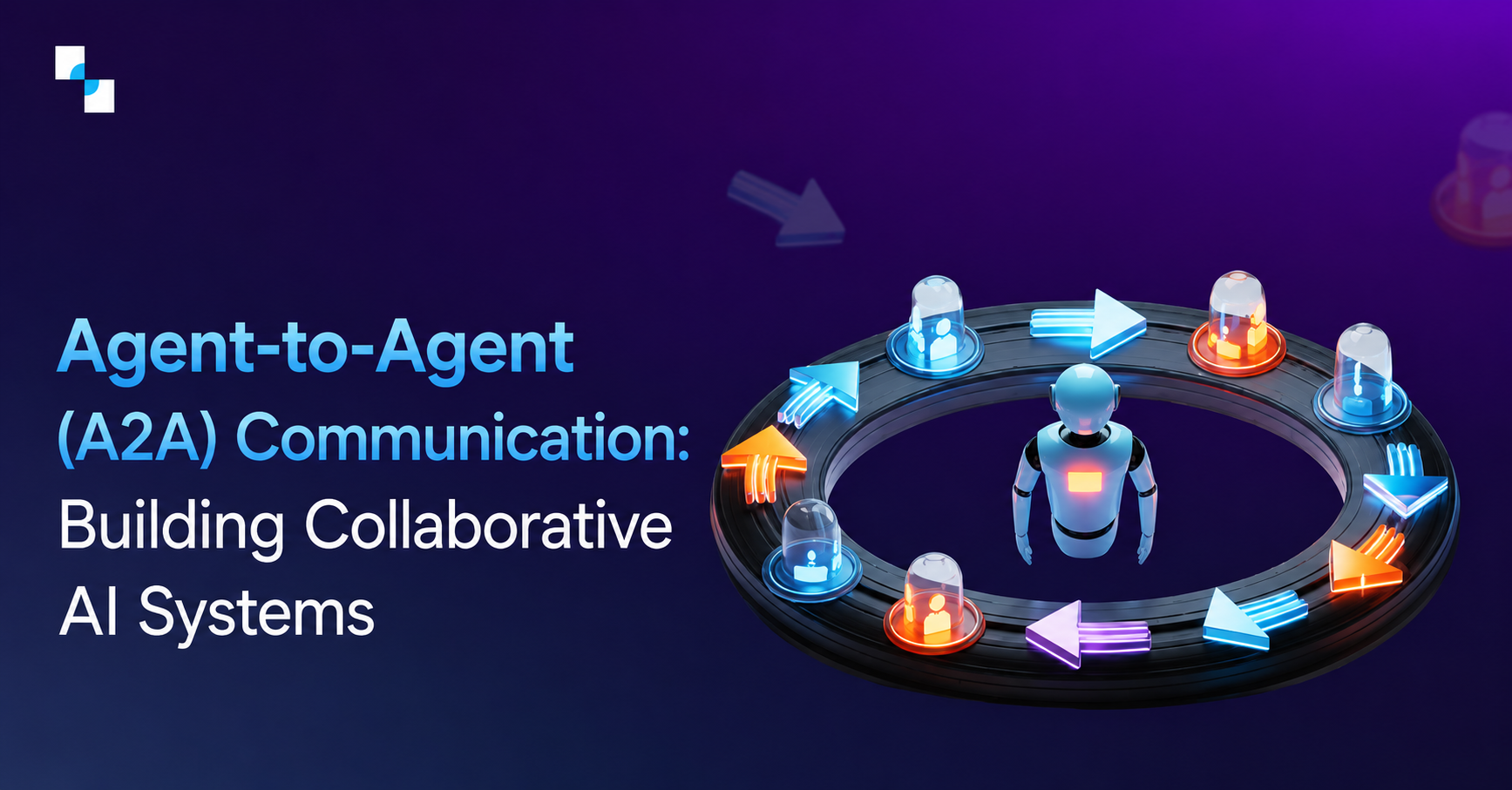
Agent-to-Agent (A2A) AI is the architecture and communication protocol through which multiple AI agents exchange information, delegate sub-tasks, return results, and coordinate execution to complete complex workflows that no single agent handles end-to-end.
Each agent in a multi-agent system has a defined role, a specific set of tools, and a bounded scope of responsibility analogous to the role definition from our AI employees framework. The difference from a single AI employee is that A2A architecture defines how multiple AI employees communicate and hand off work to each other.
Four communication patterns define how agents interact:
Pattern 1 Orchestrator-Subagent (hierarchical delegation)
An orchestrator agent receives a high-level task, decomposes it into sub-tasks, delegates each sub-task to a specialized subagent, collects results, and synthesizes a final output. The orchestrator doesn't execute tasks itself it plans, delegates, and synthesizes. Subagents execute but don't plan the overall workflow.
Example: a market research orchestrator delegates to three subagents one that searches for competitor information, one that analyzes financial data, and one that synthesizes findings into a formatted report. The orchestrator provides the brief to each subagent and combines their outputs.
Pattern 2 Peer-to-Peer Sequential (pipeline delegation)
Agents pass work sequentially Agent A completes its task and hands the output to Agent B, which processes it and hands to Agent C, in a defined pipeline. Each agent receives only what the previous agent produced, not the full task context.
Example: a content production pipeline where Agent A researches and outlines, Agent B drafts based on the outline, Agent C edits and formats, and Agent D publishes via the CMS API.
Pattern 3 Peer-to-Peer Collaborative (debate/refinement)
Multiple agents work on the same problem in parallel or in dialogue each producing an output, reviewing other agents' outputs, and iterating until convergence. Used for tasks where diverse perspectives or adversarial review improves output quality.
Example: a code review multi-agent system where Agent A writes code, Agent B reviews for correctness, Agent C reviews for security vulnerabilities, and Agent D reviews for performance each flagging issues that the others resolve.
Pattern 4 Event-Driven (reactive coordination)
Agents subscribe to event streams and activate when relevant events arrive, without a central orchestrator directing each action. Used for monitoring and response workflows where agents must react to external events asynchronously.
Example: a security operations multi-agent system where a monitoring agent publishes a threat event, a triage agent evaluates severity, an investigation agent gathers related signals, and a response agent initiates the appropriate containment action all triggered by event rather than by orchestrator instruction.
The Performance and Architecture Data Behind Multi-Agent AI Systems
Single-Agent vs Multi-Agent Performance Comparison
|
Task Dimension |
Single-Agent Architecture |
Multi-Agent Architecture |
Advantage |
|
Maximum reliable task chain length |
5–10 steps (reliability degrades) |
20–50+ steps (modular reliability) |
Multi-agent scales reliably |
|
Context management for long tasks |
Context overflow risk |
Bounded per-agent context |
Multi-agent handles indefinitely |
|
Tool access governance |
All tools in one agent |
Least-privilege per-agent |
Multi-agent more secure |
|
Failure recovery |
Full restart on any error |
Subagent retry/escalate |
Multi-agent more resilient |
|
Parallelization |
Sequential only |
Parallel subagent execution |
Multi-agent faster for parallelizable tasks |
|
Specialization quality |
Generalist performance on all tasks |
Expert performance on domain tasks |
Multi-agent higher quality |
Sources: Microsoft AutoGen Research 2025; Anthropic Multi-Agent Systems Technical Report 2025; LangChain State of AI Agents 2025.
Enterprise Multi-Agent Adoption Data
-
Multi-agent architectures improve scalability by allowing specialized AI agents to collaborate, delegate tasks, and share contextual information organizations deploying multi-agent architectures report 3–5x improvement in complex task completion rates versus single-agent approaches for tasks involving more than 15 sequential steps (Microsoft AutoGen benchmarks, 2025)
-
Parallel subagent execution reduces elapsed time for parallelizable tasks by 60–80% versus sequential single-agent execution a research task that requires independent analysis of six data sources takes 1/6 the calendar time when six specialized subagents execute simultaneously (LangChain, 2025)
-
Failure rate for enterprise AI workflows drops by approximately 40–60% when using isolated subagent architecture versus single-agent chains because subagent failures trigger retry or escalation rather than requiring full workflow restart (Anthropic, 2025)
How to Build an Agent-to-Agent AI System: A 6-Step Framework
Step 1: Define the Task Decomposition Before Designing Any Agent
The most important Agent-to-Agent AI design decision happens before a single agent is specified decomposing the overall workflow into the sub-tasks that agents will handle:
-
Map the full workflow from trigger event to final output documenting every step, every data source accessed, every action taken, and every decision made in the current manual or single-agent implementation of the task
-
Identify natural decomposition boundaries steps that require different tool access, steps that can be parallelized, steps that require different levels of accuracy or oversight, and steps where one failure shouldn't cascade to all others
-
Define the information that must pass between steps the output of Step A that becomes the input of Step B determines the message format and context requirements for the agent handoff
-
Identify which decomposed sub-tasks benefit from specialization not every sub-task justifies a dedicated agent. Sub-tasks that repeat frequently, require specialized tool access, or have high quality requirements where domain-specific tuning helps are the strongest candidates for dedicated subagent design
Step 2: Design Each Agent's Role, Scope, and Tool Access
With decomposition complete, specify each agent following the role design principles from our AI employees framework:
-
Define the agent's single responsibility: each agent should own one well-defined sub-task not "help with research" but "search the web for competitive pricing data on defined product categories and return structured results in this format"
-
Apply least-privilege tool access: each agent receives access only to the tools its specific sub-task requires a research agent gets web search and document retrieval; it does not get database write access or payment system access
-
Define the agent's input contract: what information does this agent receive from the calling agent or orchestrator? What format, what completeness requirements, what maximum size?
-
Define the agent's output contract: what does this agent return when successful? What does it return when it encounters an error or uncertainty requiring escalation? Defining output contracts before building enables the receiving agent to be built in parallel
Step 3: Design the Communication Protocol and Message Format
Agent communication quality depends on the structure of the messages agents exchange:
-
Implement Google A2A Protocol as the inter-agent message format where your agent framework supports it A2A defines standardized task objects, message envelopes, capability declarations, and result formats that enable interoperability between agents built on different underlying models or frameworks
-
Define task context propagation: decide what context from the original request each subagent needs some subagents need the full original task context to understand why they're performing their sub-task; others need only their specific input. Over-propagating context wastes context window; under-propagating context produces subagent outputs that don't fit the parent task
-
Define error and uncertainty signaling: agents that encounter ambiguous inputs, out-of-scope requests, or execution failures must return structured error signals that the orchestrator or calling agent can act on not just fail silently or return a poorly-formed output that the downstream agent can't process
-
Implement message logging: every inter-agent message should be logged with sending agent, receiving agent, timestamp, message content, and response this audit trail is the observability infrastructure that makes debugging and governance of multi-agent systems possible
Step 4: Implement the Orchestrator With Explicit State Management
The orchestrator agent responsible for overall workflow coordination in hierarchical multi-agent architectures requires state management capabilities that subagents don't:
-
Maintain workflow state persistently: the orchestrator must track which sub-tasks have completed, which are in progress, and which are pending in durable storage that survives the orchestrator's own context window limits for long-running workflows
-
Handle partial failure explicitly: when a subagent returns an error, the orchestrator must have defined behavior retry the same subagent with modified input, route to an alternative subagent, escalate to human review, or abort the workflow with a specific error state. Undefined orchestrator behavior in partial failure scenarios is the most common production multi-agent system failure mode
-
Implement conditional routing: the orchestrator should route based on subagent output content, not just on success/failure a research subagent that returns "insufficient information found" triggers a different orchestrator path than one that returns structured research results
-
Implement parallel execution management: for parallelizable sub-tasks, the orchestrator launches multiple subagents simultaneously and waits for all to complete (or fail) before proceeding to the synthesis step with defined timeout behavior for subagents that don't return within expected windows
Step 5: Implement Cross-Agent Context and Memory Management
One of the most challenging aspects of A2A AI architecture is managing what information is shared between agents and how long-running workflows maintain relevant context:
-
Implement shared memory for cross-agent context: for multi-agent workflows that span multiple sessions or where multiple agents need access to the same accumulating context, deploy a shared vector memory store (covered in our AI agent memory guide) that all agents in the workflow can read from and write to
-
Define information boundaries: specify which information is agent-private (the subagent's working memory for its specific task) versus workflow-shared (the research findings that all downstream agents need) versus human-accessible (the final output and key intermediate results available for human review)
-
Implement context summarization between agents: when a long output from Agent A needs to be passed to Agent B, implement a summarization step that extracts the information B specifically needs rather than passing the full Agent A output reducing context consumption in downstream agents and improving their accuracy by reducing noise
-
Handle context versioning for long-running workflows: for workflows that span days or weeks, the context from early workflow steps should be versioned and retrievable but not automatically included in every agent's context by default, since stale early context can confuse later agents working on evolved task states
Step 6: Implement Multi-Agent Observability and Governance
Multi-agent systems are significantly harder to debug and govern than single-agent systems because failures and unexpected behaviors can originate anywhere in the agent graph:
-
Implement distributed tracing across agent boundaries: trace IDs that propagate through every inter-agent message enable you to reconstruct the full execution path of any workflow which agents executed which steps, what messages passed between them, and where errors originated
-
Define escalation paths at every agent level: every agent should have a defined escalation path for inputs it can't handle routing to the orchestrator, to a human reviewer, or to a fallback agent so that the system fails gracefully rather than silently
-
Implement output validation between agent handoffs: before passing Agent A's output to Agent B as input, validate that the output meets the format and completeness requirements Agent B expects catching format mismatches at handoff rather than propagating them through the workflow
-
Define human-in-the-loop checkpoints at workflow level: for high-risk multi-agent workflows, implement human review points at key milestones after research is complete, before any external action is taken, before final output is delivered maintaining the human oversight architecture from our HITL guide at the workflow level, not just the individual agent level
Which Tools and Frameworks Deliver Best Results for Agent-to-Agent AI in 2026?
For multi-agent orchestration framework:
LangGraph (LangChain) provides the most production-mature stateful multi-agent orchestration defining agent graphs with typed state, conditional routing, parallel execution branches, and persistent state management. Its native support for human-in-the-loop interruption at graph nodes makes it the strongest framework for enterprise multi-agent workflows requiring governance checkpoints. Microsoft AutoGen provides strong multi-agent conversation and collaboration patterns with particularly good support for the peer-to-peer collaborative (debate/refinement) pattern.
For agent communication protocol:
Google A2A Protocol (open source, released April 2025) provides the standardized inter-agent message format for agent interoperability across different models and frameworks. Anthropic's Model Context Protocol (MCP) provides the complementary standard for agent-to-tool communication A2A handles agent-to-agent, MCP handles agent-to-tool. Combining both produces the interoperability foundation that production multi-agent enterprise systems require.
For specialized subagent deployment:
CrewAI provides the simplest path to role-based multi-agent deployment defining agents by role with associated tools and deploying crews of agents against defined tasks. Strong for organizations new to multi-agent architecture who want a higher-level abstraction than LangGraph's graph definition approach.
For multi-agent observability:
LangSmith provides multi-agent trace visualization that reconstructs agent conversation trees, showing which agents communicated what and in what sequence essential for debugging multi-agent workflows where failure propagates through agent chains. Langfuse provides comparable open-source observability for organizations requiring self-hosted tracing infrastructure.
For shared agent memory in multi-agent workflows:
Mem0 provides multi-user, multi-agent memory with agent-level isolation enabling agents in the same workflow to share relevant context through a managed memory layer without accessing each other's private working memory. Zep provides similar shared conversational memory appropriate for multi-agent customer-facing workflows.
Explore our Multi-Agent AI Development and AI Workflow Automation capabilities for AI engineers and enterprise architects building Agent-to-Agent AI systems that scale complex enterprise workflows beyond single-agent limitations.
What Goes Wrong With Agent-to-Agent AI Implementations and How to Prevent Each Failure
Failure 1: Building Multi-Agent Architecture Before the Single-Agent Version Fails
Organizations that build multi-agent systems as the first deployment attracted by the architectural sophistication consistently over-engineer for tasks that a well-designed single agent would handle reliably and at lower operational complexity. Multi-agent architecture adds orchestration overhead, inter-agent communication latency, and debugging complexity that only pays off when the task genuinely exceeds single-agent capability. Build and test a single-agent implementation first; upgrade to multi-agent specifically when you encounter the context, reliability, or specialization ceiling that multi-agent architecture solves.
Failure 2: Not Defining Output Contracts Between Agents Before Building
Multi-agent systems where agents are built independently without precisely specified input and output contracts between them consistently produce integration failures when assembled Agent A returns a JSON structure that Agent B's prompt wasn't designed to parse, or Agent A returns a verbose narrative that Agent B needs in a structured table. Define the exact format, required fields, and size constraints of every inter-agent message before building any agent, and validate contract compliance as part of every agent's unit testing.
Failure 3: No Defined Behavior for Subagent Failure in the Orchestrator
Orchestrators built without explicit handling for subagent failure consistently produce the same failure mode: a subagent returns an error or a malformed output, the orchestrator has no defined behavior for this case, and the workflow either hangs waiting for a result that won't arrive or crashes with an unhandled exception. Define and test the orchestrator's response to every failure mode of every subagent before deployment partial failure handling is not an edge case for production multi-agent systems; it is the normal operating condition at scale.
Failure 4: Insufficient Observability to Debug Inter-Agent Failures
Multi-agent systems without distributed tracing that crosses agent boundaries consistently produce debugging experiences where an output error visible at the workflow level cannot be traced to the specific agent interaction that produced it because individual agent logs exist but the inter-agent message sequence that led to the failure is not reconstructable. Implement distributed trace IDs that propagate through every inter-agent message from day one of deployment retrofitting tracing to an existing multi-agent system is significantly more expensive than building it in from the start.
Frequently Asked Questions
What Is Agent-to-Agent Communication?
Agent-to-Agent (A2A) communication is the protocol and architecture through which multiple AI agents exchange information, delegate sub-tasks, and coordinate execution in a multi-agent AI system. In A2A architecture, individual agents are specialized for specific functions research, data analysis, code generation, external API interaction and communicate through defined message protocols that specify what information passes between them, in what format, and under what conditions. Google's open A2A Protocol (released 2025) provides the standardized message format for inter-agent communication across different AI models and frameworks, enabling interoperability that proprietary agent communication approaches don't provide.
How Do AI Agents Collaborate?
AI agents collaborate through four primary patterns. Hierarchical delegation: an orchestrator agent decomposes a task and delegates sub-tasks to specialized subagents, collecting their outputs and synthesizing a final result. Sequential pipeline: agents pass work sequentially each agent completes its step and hands output to the next agent in the pipeline. Collaborative peer review: multiple agents work on the same problem and critique each other's outputs, iterating to improve quality through AI-to-AI feedback. Event-driven reaction: agents subscribe to event streams and activate when relevant events occur, without requiring a central orchestrator to direct each action. Enterprise multi-agent systems typically combine multiple patterns using hierarchical delegation for overall workflow coordination and sequential pipeline for step-by-step task execution within each delegated sub-workflow.
Which Industries Benefit Most From Multi-Agent AI Systems?
Industries with the highest A2A AI ROI share characteristics of complex, multi-step workflows requiring specialized knowledge and diverse tool access. Financial services: multi-agent systems handling complex research, compliance checking, and report generation workflows that require access to market data, regulatory databases, and document generation tools simultaneously tasks too complex for single-agent reliable execution. Healthcare: multi-agent diagnostic support systems that coordinate patient history analysis, clinical literature search, drug interaction checking, and treatment recommendation generation through specialized agents, each accessing domain-specific knowledge sources. Software engineering: multi-agent development systems where planning, coding, testing, security review, and documentation agents collaborate sequentially and in review cycles to produce higher-quality software than any single coding agent produces alone. Legal services: multi-agent research, contract review, and document drafting workflows where specialized agents handle case law research, compliance checking, and document generation in coordinated sequence.
Decompose the Task Before Designing Any Agent. Define Output Contracts Between Agents Before Building Either. Implement Distributed Tracing Before the First Multi-Agent Workflow Goes Live.
Agent-to-Agent AI delivers its 3–5x improvement in complex task completion rates, 60–80% parallel execution speed improvement, and 40–60% failure rate reduction when the architecture is designed correctly from the start task decomposition before agent design, output contracts before agent building, and distributed tracing before production deployment.
The AI engineers and enterprise architects building the most reliable multi-agent systems in 2026 share one sequencing discipline: they built a single-agent implementation and ran it against the target task until they hit the specific limitation context overflow, reliability degradation, or specialization ceiling that multi-agent architecture solves. That constraint-first approach produced multi-agent designs that address the actual bottleneck rather than adding orchestration complexity to tasks that didn't need it.
Map your most complex current AI workflow against the four agent communication patterns in this guide this week identifying which pattern fits its natural decomposition. Define the input and output contracts for each agent boundary before writing a single agent prompt. Instrument your first multi-agent prototype with LangSmith or Langfuse trace logging before any integration testing begins.
To build Agent-to-Agent AI systems that scale complex enterprise workflows reliably across specialized agent architectures, explore our Multi-Agent AI Development and AI Workflow Automation capabilities structured for AI engineers and enterprise architects who need multi-agent AI delivered as a production-grade, observable, and governable system, not a prototype that can't survive its first production failure.