
AI Infrastructure Cost 2026
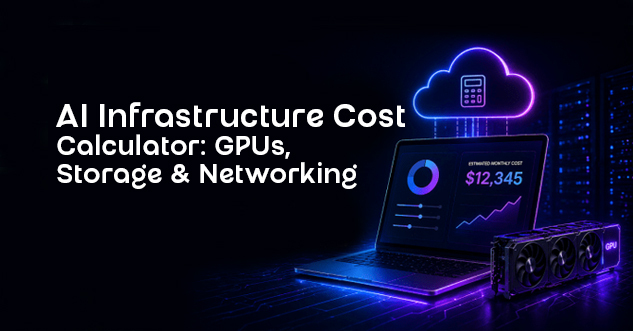
AI Infrastructure Cost 2026
Published by AgamiSoft | Reading time: ~14 minutes
|
Featured Snippet AI infrastructure costs depend on GPU requirements, storage systems, networking, inference traffic, security, and operational management with GPU compute typically representing 50–70% of total spend for training-heavy workloads and inference serving costs dominating for production-deployed applications at scale. Estimating total cost of ownership helps organizations plan scalable and cost-effective AI deployments by modeling each cost category explicitly rather than budgeting from GPU pricing alone, which consistently understates true enterprise AI infrastructure cost by 30–50%.
|
|
TLDR ; AI infrastructure cost spans five categories that most budget estimates account for incompletely: GPU compute (training and inference), storage (training data, model weights, vector databases, checkpoints), networking (inter-GPU bandwidth, data transfer, egress), inference serving overhead (API gateway, caching, load balancing), and operational management (MLOps tooling, monitoring, staffing). Enterprise AI infrastructure costs are primarily driven by GPU compute, storage architecture, networking, inference workloads, and model lifecycle management and organizations that budget from GPU pricing alone consistently underestimate total cost by 30–50% because the supporting infrastructure categories accumulate cost that compounds with scale in ways initial estimates rarely capture. |
Why AI Infrastructure Cost Modeling Has Become a Board-Level Budget Discipline in 2026
AI infrastructure spending has moved from experimental line item to material budget category at most enterprises and the organizations that modeled costs accurately before committing are running very different budget conversations in 2026 than those that modeled from GPU sticker price alone.
The gap between initial AI infrastructure estimates and actual spend has become a recurring CFO concern. A team that budgets a training run based on published GPU hourly rates frequently discovers that data storage, network egress, checkpoint storage, and the engineering time required to actually get the training pipeline running efficiently add 40–60% to the number that originally justified the project. A team that budgets an inference deployment based on per-token API pricing frequently discovers that caching infrastructure, request routing, monitoring, and the API gateway layer covered in our AI gateway architecture guide add operational costs that dwarf the raw model API spend once the application reaches production scale.
Three developments have made accurate AI infrastructure cost modeling a 2026 budget discipline rather than a nice-to-have estimation exercise:
AI budgets have reached the scale where estimation errors are material to the P&L. The average enterprise AI infrastructure budget has grown to a size where a 30–50% estimation gap represents millions of dollars a variance that finance teams now scrutinize with the same rigor applied to any other major capital or operating expense category, rather than treating AI spend as an experimental budget with loose accountability.
The cost structure of AI workloads has diversified beyond simple GPU-hour calculations. Early AI infrastructure cost models assumed training was the dominant cost. In 2026, most enterprises run a mix of training, fine-tuning, and for the majority of production applications inference at scale, each with distinct cost drivers that a single GPU-hour estimate cannot capture accurately.
Build-versus-rent infrastructure decisions require accurate TCO comparison. As covered in our GPU as a service cost comparison, the decision between cloud GPU access and owned infrastructure depends entirely on accurate utilization and total cost modeling a decision that gets made badly when the underlying cost model is incomplete.
What Determines AI Infrastructure Cost, Exactly and What Are the Five Cost Categories?
AI infrastructure cost is the total spend required to build, train, deploy, and operate AI systems spanning compute, storage, networking, serving infrastructure, and the operational overhead of managing all of it reliably at production scale.
A complete AI infrastructure cost model covers five categories, each with distinct cost drivers:
Category 1 GPU compute
The largest and most visible cost category, covering training (initial model development and fine-tuning) and inference (running the trained model to serve predictions). Training cost scales with model size, dataset size, and number of training epochs. Inference cost scales with request volume, model size, and the efficiency of your serving infrastructure covered in detail in our GPU as a service cost comparison guide.
Category 2 Storage
Multiple distinct storage needs with different cost profiles: training data storage (often the largest raw volume, typically in cost-efficient object storage), model checkpoint storage (frequent writes during training, requiring higher-performance storage), model weight storage (the final trained model, requiring fast-access storage for deployment), and vector database storage (for RAG applications, storing embeddings with specific query performance requirements).
Category 3 Networking
Inter-GPU networking for distributed training (InfiniBand or high-bandwidth Ethernet, a significant cost factor for multi-node training clusters), data transfer between storage and compute (particularly costly when storage and compute are in different cloud regions or providers), and API egress for inference serving (data transferred out to end users or calling applications).
Category 4 Inference serving infrastructure
The operational layer between raw model compute and production application traffic API gateways (covered in our AI gateway architecture guide), load balancing, semantic caching, request queuing, and the observability infrastructure required to monitor inference quality and cost at scale.
Category 5 Operational management
MLOps tooling (experiment tracking, model registries, deployment pipelines covered in our MLOps pipeline guide), monitoring and alerting infrastructure, and the engineering and platform staff time required to operate AI infrastructure reliably a cost category budget estimates most consistently omit or underestimate.
Total cost of ownership (TCO) for AI infrastructure is the sum of all five categories across the full lifecycle of an AI system or program not just the GPU compute line item that most initial budget conversations focus on almost exclusively.
The Numbers: What Enterprise AI Infrastructure Actually Costs in 2026
Cost Distribution by Category for a Representative Enterprise AI Program
|
Cost Category |
% of Total Infrastructure Spend (Training-Heavy Program) |
% of Total Infrastructure Spend (Inference-Heavy Program) |
|
GPU compute |
55–70% |
35–50% |
|
Storage |
8–15% |
5–10% |
|
Networking |
5–12% |
8–15% |
|
Inference serving infrastructure |
3–8% |
15–25% |
|
Operational management (staffing, tooling) |
12–20% |
15–25% |
Sources: Andreessen Horowitz "The Cost of Cloud" AI Infrastructure Analysis 2025; McKinsey Enterprise AI Cost Report 2025; a16z GPU cost benchmarks 2025.
Representative Cost Ranges by Deployment Scale
|
Deployment Scale |
Monthly GPU Spend |
Monthly Storage |
Monthly Networking |
Monthly Operational |
Total Monthly TCO |
|
Pilot / small team (1–2 fine-tuning projects) |
$3,000–$15,000 |
$500–$2,000 |
$300–$1,500 |
$2,000–$5,000 (0.25–0.5 FTE) |
$6,000–$24,000 |
|
Mid-scale production (1–3 deployed applications) |
$25,000–$100,000 |
$3,000–$10,000 |
$2,000–$8,000 |
$10,000–$25,000 (1–2 FTE) |
$40,000–$143,000 |
|
Enterprise-scale (10+ applications, significant training) |
$150,000–$800,000+ |
$15,000–$60,000 |
$10,000–$50,000 |
$40,000–$120,000 (3–6 FTE) |
$215,000–$1,030,000+ |
Sources: Andreessen Horowitz AI Infrastructure Cost Analysis 2025; Menlo Ventures State of Generative AI in the Enterprise 2025; internal engagement benchmarking, 2025.
The Specific Cost Line Items Budget Estimates Most Frequently Miss
-
Checkpoint storage during training: a large model training run can generate checkpoint storage requirements of 500GB–5TB per checkpoint, saved every few hours across a multi-week training run accumulating storage costs of $5,000–$30,000 for a single training run that a GPU-hour-only estimate omits entirely (a16z, 2025)
-
Cross-region data transfer: organizations training on data stored in a different cloud region than their GPU compute pay egress fees of $0.02–$0.12/GB that accumulate significantly at the terabyte-to-petabyte training data volumes common in enterprise AI programs
-
Vector database costs at RAG scale: a production RAG application indexing 10 million documents typically requires $2,000–$15,000/month in vector database costs (Pinecone, Weaviate managed) depending on embedding dimensionality and query volume a cost category entirely absent from GPU-centric budget models
-
Semantic caching infrastructure: while caching reduces LLM API costs by 20–40%, the caching infrastructure itself (vector similarity search, cache storage, cache management logic) adds $1,000–$8,000/month in infrastructure cost that must be weighed against the API cost savings it produces
Inference Cost at Production Scale
-
A production customer-facing chatbot handling 100,000 conversations/month at an average of 8 turns per conversation, using a mid-tier model (Claude Sonnet, GPT-4o class), costs approximately $8,000–$25,000/month in raw API costs before adding the gateway, caching, and monitoring infrastructure covered in Category 4
-
The same workload run on self-hosted open-weight models (Llama 3.3 70B) on owned or reserved GPU infrastructure at high utilization can reduce this to $3,000–$10,000/month but requires the GPU infrastructure investment and MLOps capability to operate reliably, shifting cost from Category 1 (API spend) to Categories 1 and 5 (owned compute plus operational staffing) combined
How to Build an Accurate AI Infrastructure Cost Model: A 6-Step Framework
Step 1: Classify Your AI Workload Type Before Modeling Any Cost Category
Cost modeling accuracy starts with correctly classifying what you're actually building, because training, fine-tuning, and inference workloads have fundamentally different cost structures:
-
Training from scratch: rare for most enterprises (extremely GPU-intensive, typically only pursued by AI-native companies), but if applicable, dominates the GPU compute category by a wide margin
-
Fine-tuning existing models: the more common enterprise workload using LoRA/QLoRA (covered in our LLM fine-tuning guide) dramatically reduces GPU cost compared to full fine-tuning, a distinction that must be reflected in the compute estimate
-
Inference-only (using commercial APIs or deploying pre-trained/fine-tuned models): the dominant workload type for most enterprise AI applications, where inference serving infrastructure and API costs at production volume not training compute represent the majority of ongoing spend
-
RAG-based applications: adds vector database and embedding generation costs on top of base inference costs, requiring explicit modeling of the retrieval infrastructure layer
Step 2: Model GPU Compute Cost Based on Your Specific Workload Profile
With workload type classified, model compute cost using the specific pricing and utilization patterns relevant to your workload:
-
For fine-tuning workloads, estimate using LoRA/QLoRA compute requirements (typically $50–$300 per training run on a single GPU, per our LLM fine-tuning guide) rather than full fine-tuning compute requirements, unless your specific accuracy requirements demand full fine-tuning
-
For inference workloads, model cost using your projected request volume, average tokens per request, and your chosen provider's per-token pricing building a monthly cost projection that scales with your adoption curve, not a single point-in-time estimate
-
For self-hosted inference, model GPU utilization explicitly using the framework from our GPU as a service cost comparison the cost-per-inference calculation depends entirely on sustained utilization rate, which most initial estimates assume optimistically
-
Include a capacity buffer of 20–30% above projected average load to account for traffic spikes, without which production inference infrastructure consistently under-provisions and creates reliability issues at peak demand
Step 3: Model Storage Cost Across All Four Storage Categories
Storage cost modeling requires accounting for each distinct storage need separately, since they have different volume profiles and performance requirements:
-
Training data storage: calculate raw dataset size and apply object storage pricing ($0.015–$0.023/GB/month for standard cloud object storage) typically the largest volume but lowest per-GB cost category
-
Checkpoint storage: estimate checkpoint frequency (typically every 1–4 hours during training) and checkpoint size (proportional to model parameter count) this category is frequently omitted from initial estimates and can represent a meaningful line item for extended training runs
-
Model weight storage: calculate final model size × number of model versions you retain smaller than checkpoint storage but requiring higher-performance access for deployment
-
Vector database storage: for RAG applications, calculate embedding count × embedding dimensionality × per-vector storage cost of your chosen vector database provider, plus query cost if your provider charges per-query rather than flat storage pricing
Step 4: Model Networking Cost Including Cross-Region and Egress Charges
Networking costs are the most commonly underestimated category because they don't appear as a distinct line item until the first invoice arrives:
-
Calculate inter-GPU networking requirements for any multi-node training InfiniBand-networked GPU clusters (required for large-scale training) carry meaningfully higher per-hour pricing than standard networked instances, a cost that must be included in the compute estimate, not treated as separate
-
Model data transfer costs between storage and compute if training data resides in a different cloud region or provider than your GPU compute, calculate egress fees at $0.02–$0.12/GB against your actual data volume, not a rounding-error assumption
-
Model inference-time egress API responses transferred to calling applications, particularly significant for applications returning large structured outputs or processing high request volumes
-
For hybrid or multi-cloud architectures, explicitly model cross-provider data transfer costs, which are frequently the specific line item that makes a theoretically cheaper multi-provider architecture more expensive in practice
Step 5: Model Inference Serving Infrastructure and Operational Overhead Explicitly
The infrastructure layer between raw model access and reliable production service is where many initial budget estimates stop short:
-
Gateway and routing infrastructure: estimate the cost of your AI gateway deployment (covered in our AI gateway architecture guide) whether open-source self-hosted (primarily engineering time) or a managed product (licensing cost)
-
Caching infrastructure: model the cost of semantic caching infrastructure against the API cost savings it produces typically net-positive at meaningful request volume, but requiring explicit modeling rather than assumption
-
Monitoring and observability: estimate LLM observability tooling costs (Langfuse, Arize, or equivalent) typically priced per trace or per token processed, scaling with your inference volume
-
Operational staffing: the most consistently underestimated category model the FTE requirement for platform engineering, MLOps, and AI infrastructure reliability at your program's scale, using the 0.25–6 FTE benchmarks from the deployment scale table as a starting reference point, then validate against your specific team's actual capacity and hiring plan
Step 6: Build a Scaling Model, Not a Point-in-Time Estimate
AI infrastructure cost estimates that model only current-state requirements consistently become inaccurate within 2–3 quarters as usage grows. Build your cost model against a projected growth trajectory:
-
Project your workload volume (training runs per quarter, inference requests per month) across a 12–18 month horizon based on your product or program roadmap
-
Model how each cost category scales with that growth GPU compute and inference serving infrastructure typically scale linearly or slightly sub-linearly with volume (due to efficiency gains at scale); storage scales linearly with data accumulation; operational staffing scales in step-function increments as complexity crosses defined thresholds, not smoothly
-
Identify the specific volume thresholds where your cost structure should shift for example, the utilization level at which self-hosted inference becomes cheaper than API-based inference, informing a planned transition point rather than a reactive one
-
Build quarterly cost model reviews into your AI program governance validating actual spend against projections and adjusting the model as real usage data replaces initial estimates
Which Tools and Approaches Deliver Best Results for AI Infrastructure Cost Management in 2026?
For cost estimation and TCO modeling:
a16z's "Cost of Cloud" and AI infrastructure cost frameworks (published analysis, not a tool) provide the most widely referenced methodology for AI infrastructure TCO modeling the reference framework this guide's cost categories are built from. Custom spreadsheet models incorporating your specific provider pricing, workload projections, and organizational cost structure remain the standard approach, since no single SaaS tool captures the full cross-category modeling this guide describes.
For GPU cost tracking and optimization:
CloudZero and Vantage provide cloud cost management with AI/GPU-specific cost attribution, tracking spend by model, application, and team the visibility layer that validates your cost model against actual spend. Weights & Biases and MLflow provide experiment-level cost tracking that ties GPU spend directly to specific training runs and model versions.
For inference cost optimization:
LiteLLM and Portkey.ai, covered in our AI gateway architecture guide, provide cost attribution and semantic caching that directly reduce Category 4 (inference serving) costs while providing the observability data that validates cost projections against actual usage patterns.
For storage cost optimization:
AWS S3 Intelligent-Tiering, Azure Blob Storage lifecycle policies, and equivalent automated tiering tools reduce training data and checkpoint storage costs by automatically moving infrequently accessed data to lower-cost storage tiers directly addressing Category 2 cost optimization without manual intervention.
For GPU utilization monitoring:
NVIDIA DCGM, covered in our sustainable AI infrastructure guide, provides the utilization data required to validate whether your GPU compute estimate assumptions (particularly utilization rate) match actual production behavior the single most impactful input to accurate compute cost modeling.
For build-vs-rent decision support:
The GPU as a service cost comparison framework and specialist provider benchmarking (CoreWeave, Lambda Labs) covered in our dedicated GPU cost guide provide the specific pricing data required to model the crossover point between cloud GPU rental and owned infrastructure for your specific utilization profile.
Explore our GPU-as-a-Service Guide and Enterprise AI Infrastructure Services capabilities for CIOs and AI infrastructure managers building accurate cost models and infrastructure architecture for enterprise AI programs.
What Goes Wrong With AI Infrastructure Cost Estimates and How to Prevent Each Failure
Failure 1: Budgeting From GPU Hourly Rate Alone Without Modeling Supporting Infrastructure
The single most common AI infrastructure budgeting failure is calculating cost as GPU hours × hourly rate and presenting that figure as the program's infrastructure budget. This estimate consistently misses 30–50% of actual total cost of ownership storage, networking, serving infrastructure, and operational staffing accumulate cost that the GPU-hour calculation never captures. Build the full five-category model from the start, even at the earliest budget approval stage, rather than presenting an incomplete estimate that generates budget overrun surprises later in the program.
Failure 2: Modeling Fixed Utilization Assumptions That Don't Reflect Actual Production Patterns
Cost estimates that assume 100% GPU utilization, or that assume steady inference request volume without accounting for traffic variability, consistently underestimate actual cost. Production AI workloads rarely achieve the utilization efficiency that theoretical cost models assume data pipeline bottlenecks, traffic spikes requiring capacity buffer, and the operational reality of maintenance windows and deployment cycles all reduce effective utilization below theoretical maximums. Model utilization using measured data from pilot deployments where available, and apply conservative utilization assumptions (60–70% rather than 90%+) for pre-production estimates.
Failure 3: Treating the Initial Cost Estimate as Fixed Rather Than a Living Model
AI infrastructure programs that build a cost estimate at project approval and never revisit it against actual spend data consistently discover significant variance only when finance flags a budget overrun at a point where course correction is more disruptive than if the model had been validated quarterly against real usage. Build quarterly cost model reviews into program governance, comparing projected versus actual spend by category, and use the variance to refine both the current program's forecast and future program estimation accuracy.
Failure 4: Underestimating Operational Staffing as a Cost Category
Organizations that model GPU, storage, and networking costs carefully but treat operational staffing as an existing team's responsibility absorbed into general engineering headcount consistently understaff AI infrastructure operations leading to reliability issues, slower incident response, and the accumulated technical debt that under-resourced platform teams produce. Model AI infrastructure operational staffing explicitly as a program cost, using the FTE benchmarks in this guide's deployment scale table as a starting reference, and validate against your specific program's operational complexity rather than assuming existing team capacity will absorb the additional workload.
Frequently Asked Questions
How Much Does Enterprise AI Infrastructure Cost?
Enterprise AI infrastructure cost varies significantly by deployment scale: a pilot program running 1–2 fine-tuning projects typically costs $6,000–$24,000/month in total infrastructure spend; a mid-scale production deployment with 1–3 applications typically costs $40,000–$143,000/month; and enterprise-scale programs running 10+ applications with significant training workloads typically cost $215,000–$1,030,000+/month. GPU compute represents 55–70% of total cost for training-heavy programs and 35–50% for inference-heavy programs, with the remainder distributed across storage, networking, inference serving infrastructure, and operational staffing categories that budget estimates based on GPU pricing alone consistently miss, understating true total cost of ownership by 30–50%.
What Factors Affect AI Deployment Costs?
AI deployment costs are affected by five primary factors: GPU compute requirements (determined by model size, training approach full fine-tuning versus LoRA/QLoRA and inference request volume), storage architecture (training data volume, checkpoint frequency during training, and vector database requirements for RAG applications), networking (inter-GPU bandwidth for distributed training, cross-region data transfer, and inference-time egress), inference serving infrastructure (API gateway, semantic caching, and monitoring tooling that scale with production request volume), and operational management (the platform engineering and MLOps staffing required to operate AI infrastructure reliably at your program's scale). Organizations that model only the first factor consistently underestimate total program cost significantly.
Should Companies Build or Rent AI Infrastructure?
Whether to build (owned GPU hardware) or rent (cloud GPU as a service) AI infrastructure depends primarily on sustained utilization rate cloud GPU is typically cheaper below 40–50% consistent utilization, while owned hardware becomes cost-competitive above 60–70% sustained utilization, as detailed in our GPU as a service cost comparison. Most enterprises should rent for experimental, research, and variable-demand workloads, and consider owned infrastructure only for production workloads with confirmed, consistently high utilization a determination that requires actual utilization data from a rental deployment period before committing to hardware purchase, since purchasing owned infrastructure based on projected rather than measured utilization consistently produces underutilized, poorly-justified capital expenditure.
Model All Five Cost Categories From Day One. Validate Utilization Assumptions With Real Data. Review the Model Quarterly Against Actual Spend.
AI infrastructure cost modeling delivers budget accuracy and avoids the 30–50% overrun that GPU-hour-only estimates consistently produce when the model accounts for all five cost categories GPU compute, storage, networking, inference serving infrastructure, and operational management from the initial budget proposal rather than discovering the gap after commitments are made.
The CIOs and AI infrastructure managers building the most accurate AI budgets in 2026 share one modeling discipline: they built the full five-category cost model before program approval, validated utilization assumptions against pilot deployment data rather than theoretical maximums, and established quarterly cost model reviews that compared projected versus actual spend catching variance early enough to course-correct rather than discovering it in a budget overrun conversation with finance.
Build your full five-category cost model for your current or planned AI program this month, replacing any GPU-hour-only estimate currently guiding budget decisions. Validate your utilization assumptions against actual pilot data where available, applying conservative estimates (60–70% utilization) where pilot data doesn't yet exist. Establish quarterly cost model review as a standing item in your AI program governance, comparing projected versus actual spend by category and refining future estimation accuracy from the variance.
To build an accurate AI infrastructure cost model and design the GPU, storage, networking, and operational architecture that delivers your AI program at the budget you actually approved, explore our GPU-as-a-Service Guide and Enterprise AI Infrastructure Services capabilities structured for CIOs and AI infrastructure managers who need cost projections that hold up against actual production spend, not GPU-hour estimates that generate budget surprises two quarters into the program.
United States
Salesforce Tower, 415 Mission Street,
San Francisco, CA 94105
Canada
206-15268 100 Avenue,Surrey,
British Columbia, V3R 7V1, Canada
Bangladesh
Sharif Complex (11th floor),
31/1 Purana Paltan, Dhaka - 1000