

Published by AgamiSoft | Reading time: ~14 minutes
|
TLDR ; A GRC framework for SMEs combines governance policies, risk management processes, and compliance controls into one operating model replacing the spreadsheet-and-email approach that most small and mid-sized businesses use to track obligations they cannot afford to miss. SMEs implementing structured GRC programs reduce compliance risk and cut audit preparation time significantly, often from weeks to days. The framework does not require an enterprise compliance team it requires a defined structure, the right tooling, and a commitment to treat compliance as continuous operations rather than an annual scramble. |
Why GRC Has Become a Revenue-Determining Function for SMEs in 2026
GRC used to be something SMEs worried about only if they operated in regulated industries. That distinction has collapsed. In 2026, compliance posture is a procurement gate for nearly every B2B sales process above a certain deal size regardless of industry.
Enterprise buyers now require SOC 2 reports, ISO 27001 certifications, or completed security questionnaires before signing contracts with SME vendors not as a formality, but as a binding precondition. A SaaS startup or services firm without a SOC 2 Type II report is systematically excluded from enterprise procurement pipelines, regardless of product quality. Vanta's 2025 State of Trust Report found that 71% of mid-market and enterprise buyers eliminated vendors from consideration specifically due to missing or inadequate security certifications up from 54% in 2023.
Regulatory scope has also expanded downward. The EU's NIS2 Directive extends cybersecurity obligations to "important entities" a category that includes mid-sized manufacturers, logistics companies, and digital service providers that previously had no direct cybersecurity regulatory obligation. GDPR enforcement against SMEs has increased materially: the UK ICO and EU data protection authorities issued more enforcement actions against organizations with fewer than 250 employees in 2024–2025 than in the previous three years combined.
The third pressure is operational. SMEs without structured GRC processes spend disproportionate time on ad-hoc compliance work responding to customer security questionnaires, preparing for audits, and investigating policy gaps reactively. That reactive cycle consumes founder and operations leadership time that should be allocated to growth.
For SME owners and compliance managers, GRC is no longer a cost center activity performed to avoid penalties. It is sales infrastructure, operational efficiency, and risk management combined into a single program.
What Is a GRC Framework for SMEs, Exactly and How Does It Differ From Enterprise GRC?
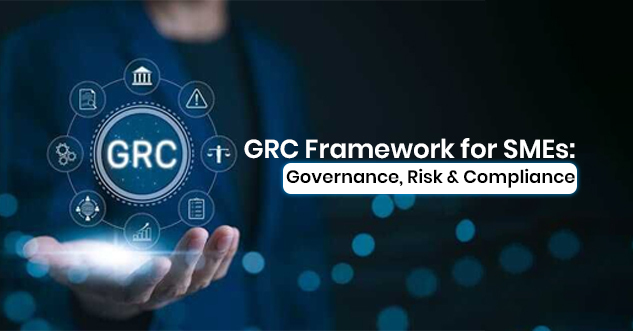
A GRC framework Governance, Risk, and Compliance framework is a structured operating model that unifies three previously separate functions: governance (the policies, roles, and decision-making structures that direct how the organization operates), risk management (the process of identifying, assessing, and mitigating risks to the business), and compliance (the process of meeting legal, regulatory, and contractual obligations).
The unifying principle of GRC is control mapping the practice of defining specific operational controls (a policy, a technical configuration, a process) that simultaneously satisfy governance objectives, mitigate identified risks, and demonstrate compliance with applicable frameworks. A single well-designed access control policy, for example, can satisfy a governance objective (defining who can access what), mitigate a risk (unauthorized data access), and demonstrate compliance with multiple frameworks (ISO 27001 Annex A.9, SOC 2 CC6, GDPR Article 32) simultaneously.
GRC framework for SMEs differs from enterprise GRC in three structural ways:
Scope, not rigor. SME GRC frameworks cover fewer frameworks, fewer business units, and fewer controls but the controls that are in scope must meet the same evidentiary standard as enterprise controls. A SOC 2 auditor does not apply a lower evidence bar to an SME than to a Fortune 500 company.
Tooling, not headcount. Enterprise GRC programs are staffed by dedicated GRC teams of 5–50+ people. SME GRC programs achieve equivalent outcomes through compliance automation platforms that handle continuous monitoring, evidence collection, and control mapping with 0.5–2 FTE of human oversight.
Single framework foundation, multiple framework outputs. SMEs typically cannot afford to build separate control sets for SOC 2, ISO 27001, GDPR, and HIPAA independently. A well-designed GRC framework builds one unified control set mapped to multiple frameworks simultaneously a single access review process that generates evidence for SOC 2 CC6.1, ISO 27001 A.9.2.5, and GDPR Article 32 in one execution.
A risk register the foundational GRC artifact is a structured inventory of identified risks, their likelihood and impact ratings, the controls that mitigate them, and the residual risk after controls are applied. Every other GRC activity policy creation, control implementation, audit preparation traces back to entries in the risk register. SMEs without a maintained risk register are, by definition, operating without a GRC framework regardless of what other compliance activities they perform.
The Numbers That Make the Business Case for GRC Frameworks in SMEs
SMEs implementing structured GRC programs reduce compliance risk and audit preparation time significantly and the commercial impact extends well beyond avoided penalties.
GRC Maturity Impact on SME Outcomes
|
Outcome Metric |
No Structured GRC |
Structured GRC Framework |
Difference |
|
Audit preparation time (SOC 2 Type II) |
8–12 weeks |
1–2 weeks |
80–85% reduction |
|
Security questionnaire response time |
3–5 days per questionnaire |
2–4 hours per questionnaire |
90% reduction |
|
Time to close enterprise deals requiring compliance verification |
+30–60 days delay |
No delay |
Eliminates sales cycle extension |
|
Compliance violation incidents |
Baseline |
60–75% lower |
Significant reduction |
|
Vendor risk assessment completion rate |
35–50% |
90%+ |
Near-complete coverage |
Sources: Vanta State of Trust Report 2025; Drata Compliance Benchmark Report 2025; ISACA SME Governance Survey 2025.
The Revenue Impact of Compliance Readiness
-
71% of mid-market and enterprise buyers eliminate vendors lacking adequate security certifications from consideration entirely (Vanta, 2025)
-
SMEs with active SOC 2 Type II reports close enterprise deals 40% faster on average than those without, due to eliminated security review delays (Drata, 2025)
-
The average SOC 2 Type II audit costs $20,000–$60,000 for SMEs using compliance automation platforms, compared to $80,000–$200,000 for manual audit preparation processes (Vanta/Drata pricing analysis, 2025)
-
Organizations with continuous compliance monitoring identify and remediate control gaps an average of 45 days before an audit, compared to discovering gaps during the audit itself for organizations without monitoring (ISACA, 2025)
The Cost of GRC Failure for SMEs
-
Average GDPR fine for SMEs (organizations under 250 employees) in 2024–2025: €45,000–€180,000 a figure that represents existential risk for many SMEs at that scale (EU DPA Enforcement Tracker, 2025)
-
SMEs that fail a SOC 2 audit due to undocumented controls lose an average of 4–6 months in remediation and re-audit before regaining the certification needed for enterprise sales (Vanta, 2025)
-
43% of SME data breaches involve a third-party vendor with inadequate security controls that the SME never assessed (Verizon DBIR, 2025) a gap that vendor risk management within a GRC framework directly closes
How to Build a GRC Framework for Your SME: A 5-Step Implementation Framework
Step 1: Build Your Risk Register and Identify Your Applicable Framework Stack
Begin with two parallel exercises. First, build your risk register a structured list of risks to your business across categories: cybersecurity (data breach, ransomware, unauthorized access), operational (key person dependency, vendor failure, business continuity), legal and regulatory (data protection, employment law, sector-specific regulation), and financial (fraud, payment security). For each risk, document likelihood (low/medium/high), impact (low/medium/high), and current mitigating controls.
Second, identify your applicable framework stack the specific compliance frameworks your business is subject to or needs to demonstrate for sales purposes:
-
SOC 2 required for almost any B2B SaaS or technology services company selling to enterprise customers in the US
-
ISO 27001 the international standard most frequently required by enterprise customers outside the US, and increasingly required in EU and GCC procurement
-
GDPR / UK GDPR applicable to any organization processing EU or UK resident personal data, regardless of where the organization is located
-
PCI DSS required for any organization processing, storing, or transmitting payment card data
-
HIPAA required for any organization handling US protected health information
-
NIS2 applicable to mid-sized organizations in "important entity" sectors in the EU
Most SMEs find that 70–80% of the controls required across their applicable framework stack overlap building your control set from the overlap first maximizes coverage efficiency.
Step 2: Build Your Unified Control Set Mapped to Multiple Frameworks
Rather than building separate control documentation for each framework, build a single set of operational controls and map each control to every framework requirement it satisfies. A practical starting control set covers:
-
Access control role-based access provisioning, deprovisioning on termination, periodic access reviews
-
Change management code review requirements, deployment approval processes, change documentation
-
Vendor risk management third-party security assessment before vendor onboarding, ongoing vendor risk monitoring
-
Incident response documented incident response plan, defined escalation paths, breach notification procedures
-
Data protection encryption standards, data classification, data retention and deletion policies
-
Business continuity backup procedures (including immutable backup architecture for ransomware resilience), disaster recovery testing
-
Security awareness employee onboarding security training, annual refresher training, phishing simulation
-
Risk assessment annual risk assessment process, risk register maintenance, control effectiveness review
Each control should be documented with: the policy statement, the implementation evidence (configuration screenshots, process logs, training records), the review frequency, and the framework requirements it satisfies (mapped explicitly "this control satisfies SOC 2 CC6.1, ISO 27001 A.9.2, and GDPR Article 32").
Step 3: Implement Continuous Compliance Monitoring Not Point-in-Time Assessment
The single highest-impact shift for SME GRC programs is moving from point-in-time compliance assessment (the "fire drill before the audit" model) to continuous monitoring. Compliance automation platforms connect directly to your cloud infrastructure, identity provider, HR system, and code repositories continuously verifying that controls remain in effect and automatically collecting evidence as it is generated, rather than reconstructing evidence retroactively before an audit.
Continuous monitoring transforms three specific GRC activities:
-
Access reviews that previously required manual export and review of user lists from multiple systems are automated, with alerts for access anomalies (former employees retaining access, excessive permission grants) flagged in real time
-
Vendor risk assessments that previously required annual manual outreach to vendors are automated through continuous vendor risk monitoring platforms that track vendor security posture changes
-
Evidence collection that previously required weeks of screenshot-gathering before an audit is continuously captured when the auditor requests evidence, it already exists with timestamps proving continuous operation, not point-in-time compliance theater
Step 4: Establish Governance Roles and a Compliance Operating Cadence
GRC frameworks fail when no one owns them. Define explicit roles even in organizations too small for dedicated compliance staff:
-
GRC owner typically the CEO, COO, or Head of Operations in SMEs accountable for the overall program, reporting to the board or leadership team quarterly
-
Control owners the individual or team responsible for each control's implementation and evidence (e.g., the engineering lead owns access control and change management; HR owns security awareness training)
-
Risk committee even a quarterly meeting of 2–3 leadership team members reviewing the risk register, discussing emerging risks, and approving control changes constitutes a functional risk committee at SME scale
Establish a compliance operating cadence:
-
Weekly: automated monitoring alerts reviewed by control owners
-
Monthly: access reviews, vendor risk monitoring review
-
Quarterly: risk register review, control effectiveness assessment, leadership reporting
-
Annually: full risk assessment refresh, security awareness training renewal, framework stack review (have new frameworks become applicable due to growth or new markets?)
Step 5: Prepare for and Execute Your First Audit Using Continuous Evidence
With continuous monitoring and a unified control set in place, audit preparation shifts from a multi-week evidence-gathering exercise to a readiness review:
-
Run a readiness assessment most compliance automation platforms include automated gap analysis against your target framework, identifying any controls not yet meeting evidentiary standards
-
Remediate identified gaps typically 2–4 weeks for organizations with continuous monitoring already in place
-
Select an auditor with SME-specific experience auditors familiar with compliance automation platforms complete SME audits significantly faster than auditors expecting manual evidence packages
-
For SOC 2 Type II specifically, your observation period (typically 3–6 months for first-time SOC 2) must demonstrate controls operating effectively over time continuous monitoring data from your compliance platform directly satisfies this requirement
Which GRC Tools and Platforms Deliver Best Results for SMEs in 2026?
For compliance automation (the foundational platform):
Vanta is the category leader for SME compliance automation automated evidence collection across 300+ integrations (AWS, GitHub, Google Workspace, HR systems), pre-built control frameworks for SOC 2, ISO 27001, GDPR, HIPAA, and continuous monitoring with real-time compliance scoring. Vanta's Trust Center feature allows SMEs to publish their compliance posture publicly, accelerating enterprise sales by pre-answering security questionnaires. Drata provides equivalent capability with particular strength in multi-framework mapping a single control implementation automatically generates evidence across SOC 2, ISO 27001, and additional frameworks simultaneously. Both platforms typically cost $7,000–$25,000/year for SME-scale implementations a fraction of manual audit preparation cost.
For ISO 27001-specific implementation:
Secureframe provides strong ISO 27001 control mapping with guided implementation workflows specifically designed for organizations pursuing ISO certification for the first time including Statement of Applicability generation and risk treatment plan templates aligned to ISO 27001's risk-based approach.
For risk register and risk management:
Resolver and LogicGate provide dedicated risk management platforms with risk register functionality, risk scoring methodologies, and risk treatment workflow appropriate for SMEs whose risk management needs exceed what's built into compliance automation platforms (typically organizations with more complex operational or financial risk profiles beyond cybersecurity and data protection).
For vendor risk management:
Vanta and Drata both include vendor risk management modules that automate third-party security assessments and continuous vendor monitoring. Whistic and SecurityScorecard provide specialist vendor risk platforms for organizations managing larger vendor portfolios requiring continuous security posture monitoring across dozens or hundreds of third parties.
For policy management:
Vanta and Drata both include policy template libraries and policy management workflows generating the governance policy documentation (acceptable use, information security policy, incident response plan) required by every major framework, pre-mapped to framework controls.
For security awareness training:
KnowBe4 remains the category standard for security awareness training and phishing simulation required evidence for SOC 2, ISO 27001, and most cyber insurance applications. Integration with compliance automation platforms automatically captures training completion as control evidence.
Explore our Compliance Consulting and Cybersecurity Services capabilities for SMEs building GRC frameworks that combine the right tooling with the operational governance model that makes compliance sustainable.
What Goes Wrong With SME GRC Implementations and How to Prevent Each Failure
Failure 1: Building Compliance Documentation Without Operational Controls
The most common SME GRC failure is treating compliance as a documentation exercise writing policies that describe how the organization should operate without implementing the technical and process controls that make those policies true. An information security policy stating that "access is reviewed quarterly" without an actual quarterly access review process in place is not a control it is a liability, because it creates a documented commitment the organization is not meeting. Every policy statement must correspond to an actual operational practice with evidence, or it should not be written until the practice exists.
Failure 2: Pursuing Multiple Frameworks Sequentially Instead of Building a Unified Control Set
SMEs that achieve SOC 2 certification and then separately build ISO 27001 controls as an independent project duplicate 70–80% of the work unnecessarily. The unified control set approach building one control framework mapped to multiple compliance frameworks from the start reduces the incremental cost of each additional framework to 15–25% of building it independently. Organizations that don't plan for multi-framework mapping from the start frequently discover, when their second enterprise customer requires ISO 27001 after they've already achieved SOC 2, that their existing controls require significant rework rather than simple framework mapping.
Failure 3: Treating the Risk Register as a One-Time Exercise
A risk register created during initial GRC implementation and never updated becomes inaccurate within months as the business changes new vendors are onboarded, new products are launched, new regulatory frameworks become applicable due to geographic expansion or growth past employee thresholds. Organizations with stale risk registers fail audits not because their controls are inadequate, but because their documented risk assessment doesn't reflect their actual current risk profile an immediate audit finding. Quarterly risk register review is not optional overhead; it is the mechanism that keeps the entire GRC framework aligned to actual organizational risk.
Failure 4: Underinvesting in Vendor Risk Management Until a Customer Demands It
SMEs frequently focus GRC investment entirely on their own internal controls while giving minimal attention to the security posture of vendors and suppliers who have access to their systems or data. 43% of SME breaches involve a third-party vendor with inadequate controls (Verizon DBIR, 2025) meaning an SME's own excellent internal controls provide no protection against a breach originating from a vendor's compromised systems. Vendor risk assessment before onboarding, and continuous monitoring of vendor security posture afterward, must be part of the GRC framework from the start not added reactively when a customer's procurement team asks for a vendor risk management policy the SME doesn't have.
Frequently Asked Questions
What Is a GRC Framework?
A GRC framework Governance, Risk, and Compliance framework is a structured operating model that unifies an organization's governance policies, risk management processes, and compliance controls into a single system built around control mapping. Rather than managing governance, risk assessment, and regulatory compliance as separate activities, a GRC framework defines operational controls that simultaneously satisfy governance objectives, mitigate identified business risks, and demonstrate compliance with applicable frameworks like SOC 2, ISO 27001, or GDPR. The foundational artifact of any GRC framework is the risk register a structured inventory of business risks, their likelihood and impact, and the controls that mitigate them.
Why Do SMEs Need GRC?
SMEs need GRC because compliance posture has become a binding procurement requirement for B2B sales, not an optional cybersecurity enhancement. 71% of mid-market and enterprise buyers eliminate vendors lacking adequate security certifications like SOC 2 or ISO 27001 from consideration entirely. Beyond sales impact, regulatory scope has expanded to include SMEs directly NIS2 in the EU now covers mid-sized organizations in important entity sectors, and GDPR enforcement against organizations under 250 employees has increased significantly. A structured GRC framework reduces compliance risk, cuts audit preparation time by 80%+, and converts compliance from a recurring operational fire drill into continuous, low-effort monitoring.
How Much Does GRC Implementation Cost for SMEs?
GRC implementation cost for SMEs centers primarily on compliance automation platform licensing, which ranges from $7,000–$25,000/year for platforms like Vanta or Drata depending on company size and the number of frameworks covered. Implementation support initial control set design, risk register development, and policy creation typically costs $10,000–$40,000 as a one-time engagement if using external GRC consulting rather than internal staff time. The first SOC 2 Type II audit itself costs $20,000–$60,000 when prepared using compliance automation platforms, compared to $80,000–$200,000 for manual preparation processes. Total first-year GRC program cost for an SME pursuing SOC 2 typically ranges from $40,000–$100,000, with subsequent years costing significantly less as the program matures into continuous operation.
Build the Control Set Once. Map It to Every Framework You Need. Monitor Continuously.
A GRC framework for SMEs delivers its full value reduced compliance risk, dramatically faster audit preparation, and unblocked enterprise sales pipelines when it is built around a unified control set mapped to multiple frameworks and operated through continuous monitoring rather than point-in-time assessment.
The SMEs winning enterprise deals fastest in 2026 share one operational discipline: they treated their first compliance certification not as a one-time project to complete, but as the foundation of a control set designed from the start to extend to additional frameworks as their customer base and regulatory obligations grow. That design decision determines whether their second certification costs 20% of the first or 100% of it again.
Build your risk register this month even a basic version covering your top 10 business risks is more valuable than no risk register at all. Identify your applicable framework stack based on your current and target customer base. Implement a compliance automation platform before your next enterprise sales cycle requires a security questionnaire response. And establish your quarterly risk review cadence now, before the risk register becomes the thing everyone agreed to build but no one maintains.
To build a GRC framework that combines the right compliance automation tooling with governance structures that fit your organization's size and growth trajectory, explore our Compliance Consulting and Cybersecurity Services capabilities structured for SMEs that need compliance readiness delivered as an operational capability, not a one-time audit project.