


Top 8 Zero Trust Architecture Providers for Fintech in 2026: The CISO's Evaluation Guide
Reading time: ~14 minutes
|
TLDR ; Zero trust architecture providers secure fintech organizations by replacing perimeter-based trust with continuous verification of every identity, device, and connection — regardless of network location. The financial services sector averages $5.9 million per data breach (IBM Cost of a Data Breach Report, 2025), making zero trust the highest-ROI security investment available to fintech CISOs. The 8 providers profiled in this guide cover identity-centric, network-centric, and platform-unified zero trust approaches across enterprise and mid-market fintech deployment contexts. |
Why Zero Trust Architecture Has Become Non-Negotiable for Fintech in 2026
The fintech threat environment has changed structurally and perimeter-based security architecture has not kept pace. Three converging factors have made zero trust architecture a regulatory and commercial requirement rather than an advanced security aspiration.
First, the attack surface has expanded beyond any perimeter. The average fintech organization in 2026 operates across 4–7 cloud environments, supports 60–80% remote or hybrid workforce, connects to 30–50 third-party APIs and data partners, and processes transactions through mobile and web interfaces that sit entirely outside the corporate network. There is no perimeter to defend. The security model must assume breach and verify continuously.
Second, regulatory pressure is translating directly into zero trust procurement mandates. The EU Digital Operational Resilience Act (DORA), effective January 2025, explicitly requires financial institutions to implement continuous monitoring, identity verification, and network segmentation the three technical pillars of zero trust architecture. The US Federal Financial Institutions Examination Council (FFIEC) updated its cybersecurity guidance in 2024 to align with NIST SP 800-207 zero trust principles. Non-compliance carries material financial penalties and operating license risk.
Third, the cost of inaction is quantified. Financial services organizations that have not implemented zero trust controls report breach costs averaging 28% higher than industry peers with mature zero trust programs (IBM, 2025). For a mid-market fintech processing $500M in annual transactions, that differential represents $800,000–$2.4M in avoidable breach cost exposure per incident.
What Is Zero Trust Architecture, Exactly? (And What Fintech Teams Often Get Wrong About It)
Zero trust architecture (ZTA) is a cybersecurity model built on the principle of "never trust, always verify" eliminating the assumption that users, devices, or applications inside a network perimeter are inherently trustworthy, and replacing it with continuous, context-aware verification of every access request regardless of origin.
It is not a single product. It is not a VPN replacement. And it is not achieved by deploying one vendor's platform. Zero trust is an architectural framework implemented across multiple security control layers.
The National Institute of Standards and Technology (NIST) defines zero trust through seven core tenets in SP 800-207 the document that underpins every major regulatory framework's zero trust requirements:
-
All data sources and computing services are considered resources
-
All communication is secured regardless of network location
-
Access to individual resources is granted on a per-session basis
-
Access is determined by dynamic policy including behavioral attributes
-
All owned and associated devices are monitored for security posture
-
Authentication and authorization are dynamic and strictly enforced
-
Security data is collected and used to improve posture continuously
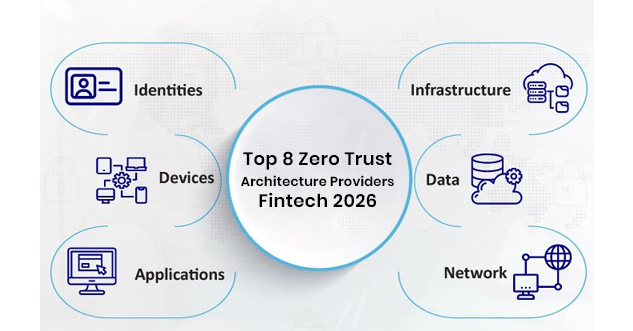
In fintech-specific deployment, zero trust architecture addresses five distinct security domains:
-
Identity security verifying who is accessing what, under what conditions, with what risk score in real time
-
Device security ensuring every endpoint meets defined posture requirements before access is granted
-
Network microsegmentation isolating workloads so a breach in one segment cannot propagate laterally to payment processing, customer data, or trading systems
-
Application access control replacing VPN-based application access with identity-aware, least-privilege application proxies
-
Data security classifying and controlling data access based on sensitivity, user context, and behavioral signals
SASE (Secure Access Service Edge) the convergence of network security and wide-area networking delivered as a cloud service is the architectural framework through which most modern zero trust deployments connect these domains into a unified policy enforcement system.
The Security and Compliance Numbers Driving Zero Trust Adoption in Fintech
Zero trust adoption in financial services is accelerating at a rate that reflects both regulatory pressure and measurable breach cost reduction.
Fintech Breach Cost and Zero Trust Impact
|
Security Metric |
Without Zero Trust Controls |
With Mature Zero Trust |
Difference |
|
Average breach cost (financial services) |
$6.8M |
$4.9M |
28% lower |
|
Mean time to identify breach |
194 days |
112 days |
42% faster |
|
Mean time to contain breach |
64 days |
38 days |
41% faster |
|
Credential theft incident frequency |
Baseline |
43% lower |
Significant reduction |
|
Lateral movement success rate |
High |
Near-zero (with microsegmentation) |
Critical control |
Sources: IBM Cost of a Data Breach Report 2025; Forrester Zero Trust Impact Study 2025; CrowdStrike Global Threat Report 2025.
Regulatory Compliance Drivers
Zero trust architecture satisfies specific requirements across the primary regulatory frameworks fintech organizations operate under:
-
DORA (EU) Articles 9 and 10 require continuous monitoring, network segmentation, and privileged access management all core zero trust controls
-
PCI DSS 4.0 Requirements 1, 7, and 8 mandate network segmentation, least-privilege access, and multi-factor authentication across cardholder data environments
-
SOC 2 Type II CC6.1 through CC6.8 map directly to zero trust identity, access, and monitoring controls
-
FFIEC Cybersecurity Assessment Advanced maturity rating requires zero trust-aligned identity and access management, network segmentation, and continuous monitoring
The compliance alignment creates a dual ROI case for zero trust: it reduces breach cost exposure and simultaneously satisfies audit requirements that would otherwise require separate control implementations.
How to Implement Zero Trust Architecture in a Fintech Organization: A 5-Step Framework
This framework is designed for CISOs and security managers structuring a zero trust program not for vendors selling individual products. Every step is sequenced to deliver measurable security improvement at each phase rather than requiring full program completion before any value is realized.
Step 1: Define Your Protect Surface
Zero trust implementation starts with the protect surface the specific data, applications, assets, and services (DAAS) that are most critical to your fintech operations and most attractive to attackers. For most fintech organizations, the protect surface includes:
-
Payment processing systems and APIs
-
Customer identity and financial record databases
-
Trading platforms and order management systems
-
Core banking or ledger infrastructure
-
Privileged administrator access paths
Defining the protect surface before selecting technology prevents the most common zero trust implementation failure: attempting to apply zero trust controls to the entire environment simultaneously and stalling on scope complexity.
Step 2: Map Transaction Flows Across Your Protect Surface
Document exactly how data, users, and applications interact with each element of your protect surface. For a payment processing system, this means mapping: which users access it, from which devices and locations, through which applications and APIs, under which business conditions. Transaction flow mapping reveals the access patterns that your zero trust policies must permit and the anomalous patterns that should trigger verification escalation or denial.
Step 3: Architect Microsegmentation Around Your Most Critical Workloads
Microsegmentation dividing your network into isolated zones with granular access controls between them is the control that most directly limits breach impact in fintech environments. Implement microsegmentation first around your payment processing and customer data environments, where lateral movement following a credential compromise would have the highest consequence. Tools: Illumio, Guardicore (Akamai), or native cloud security groups (AWS Security Groups, Azure Network Security Groups with enforced policy).
Step 4: Deploy Identity as the New Perimeter
Replace network location as a trust signal with identity posture as the primary access control mechanism. This requires four coordinated implementations:
-
Multi-factor authentication (MFA) enforced for all users on all applications no exceptions
-
Privileged access management (PAM) for all administrative and service accounts with session recording and just-in-time access provisioning
-
Continuous authentication re-verifying user identity during sessions based on behavioral signals, not just at login
-
Device posture assessment blocking access from endpoints that fail defined health checks (unpatched OS, missing EDR agent, jailbroken mobile device)
Step 5: Implement Continuous Monitoring and Automated Response
Zero trust without continuous monitoring is a policy framework without enforcement. Deploy a SIEM (Security Information and Event Management) or XDR (Extended Detection and Response) platform that aggregates signals from identity, endpoint, network, and application layers and applies behavioral analytics to detect anomalies in real time. Configure automated response playbooks for the highest-frequency attack patterns: credential stuffing, impossible travel, privilege escalation, and unusual API call volumes.
The Top 8 Zero Trust Architecture Providers for Fintech in 2026
Tier 1 Unified Zero Trust Platforms
1. Zscaler Zero Trust Exchange The category-defining cloud-native zero trust platform. Zscaler's architecture proxies all traffic through its cloud eliminating direct internet exposure for fintech applications while enforcing identity, device, and application policy at global scale. Zscaler's Financial Services vertical includes pre-built policy templates for PCI DSS 4.0 and SOC 2 environments. Best for: large fintech organizations with complex hybrid cloud environments and significant remote workforce. Pricing: $40–$80/user/month depending on module configuration.
2. Palo Alto Networks Prisma Access Palo Alto's SASE platform combines zero trust network access (ZTNA), cloud access security broker (CASB), and next-generation firewall (NGFW) capabilities in a unified policy framework. Prisma Access's ML-powered threat prevention is particularly effective in fintech environments where transaction API traffic generates high-volume, high-velocity connection patterns that traditional rules-based detection cannot adequately analyze. Best for: fintech organizations requiring integrated network security and zero trust access in a single vendor relationship.
3. CrowdStrike Falcon Zero Trust CrowdStrike's zero trust offering leads with endpoint detection and response (EDR) as the identity signal using real-time device health and behavioral data from the Falcon agent to inform access decisions. For fintech organizations where endpoint compromise is the primary breach vector, this identity-plus-endpoint approach provides stronger signal quality than identity-only platforms. Best for: fintech organizations prioritizing endpoint-centric zero trust with strong threat intelligence integration.
4. Microsoft Entra (formerly Azure AD) + Defender XDR For fintech organizations already operating on Microsoft Azure and Microsoft 365, the Microsoft zero trust stack Entra ID for identity, Defender for Endpoint for device posture, Defender XDR for extended detection provides deep integration at a cost point significantly below best-of-breed alternatives. Microsoft's Conditional Access policies in Entra ID support risk-based, continuous authentication natively. Best for: Microsoft-ecosystem fintech organizations seeking zero trust without vendor proliferation.
Tier 2 Identity-Centric Zero Trust Specialists
5. Okta Identity Security Platform Okta remains the identity layer of choice for fintech organizations building zero trust on a multi-cloud, multi-application environment. Okta's adaptive MFA, universal directory, and workforce identity governance capabilities integrate with 7,000+ pre-built application connectors reducing integration cost significantly for fintech stacks with diverse SaaS applications. Okta's Financial Services accelerator includes pre-configured policies for FFIEC and DORA compliance. Best for: identity-first zero trust programs in mid-market to enterprise fintech.
6. CyberArk Identity Security Platform CyberArk leads the privileged access management (PAM) category the most critical zero trust control for fintech organizations where administrator credential compromise creates catastrophic blast radius. CyberArk's just-in-time provisioning, session isolation, and privileged credential vaulting are the standard controls for fintech environments handling cardholder data and core banking access. Best for: fintech organizations with complex privileged access environments, shared service accounts, and compliance-intensive audit requirements.
Tier 3 Network and Application Zero Trust Specialists
7. Cloudflare Zero Trust (Access + Gateway) Cloudflare's zero trust platform replaces VPN with identity-aware application access and adds DNS-layer and HTTP traffic filtering through Cloudflare Gateway. For fintech startups and mid-market organizations, Cloudflare's pricing ($3–$10/user/month) and deployment simplicity make it the most accessible enterprise-grade zero trust entry point available. Cloudflare's network spans 300+ cities globally providing low-latency zero trust enforcement for fintech organizations with distributed teams. Best for: fintech startups and mid-market organizations deploying zero trust for the first time.
8. Illumio Core Microsegmentation Illumio is the specialist leader in workload microsegmentation the zero trust control that limits lateral movement following a breach. For fintech organizations where payment processing, customer data, and trading systems run in shared data center or cloud environments, Illumio's policy-as-code microsegmentation provides granular isolation without network redesign. Illumio's Ransomware Impact Assessment tool quantifies the blast radius reduction achievable through segmentation a useful input for CISO board presentations. Best for: fintech organizations prioritizing lateral movement prevention and blast radius reduction in hybrid cloud environments.
What Goes Wrong With Zero Trust Implementation in Fintech and How to Prevent It
These are the four failure patterns that derail zero trust programs in financial services organizations. Each one is a program design error, not a technology failure.
Failure 1: Attempting Enterprise-Wide Deployment From Day One
Zero trust programs that scope the entire organization as the initial implementation target consistently stall within 90 days. The scope is too large, the stakeholder alignment is too complex, and the disruption to existing workflows generates organizational resistance before any security improvement is demonstrated. Start with your highest-risk, highest-value protect surface typically your payment processing or customer data environment and demonstrate measurable security improvement before expanding scope. Phased deployment with defined success metrics at each phase is the only implementation model with consistent completion rates.
Failure 2: Treating MFA as the Completion of Identity Zero Trust
Multi-factor authentication is the entry point of identity-centric zero trust not the destination. Organizations that deploy MFA and declare their identity security program complete are protecting the front door while leaving the rest of the house unlocked. Privileged access management, continuous session authentication, device posture integration, and behavioral anomaly detection are all required to complete the identity control layer. MFA alone stops password spray attacks. The full identity stack stops the credential compromise sequences that precede most fintech breaches.
Failure 3: Purchasing a Platform Without Mapping Existing Access Patterns
Zero trust platforms enforce policies against access patterns. If your access patterns are not documented before policy deployment, your platform will block legitimate business workflows and the resulting business disruption will generate executive pressure to disable the controls that caused it. Map your transaction flows (Step 2 of the implementation framework) before configuring any zero trust platform. The policy writes itself from the map. The map cannot be written from the policy.
Failure 4: Under-Resourcing the Ongoing Operations Model
Zero trust is not a deployment project with a completion date. It is an operational security model that requires continuous policy maintenance, anomaly investigation, and adaptation as the threat environment and business systems evolve. Organizations that staff for deployment but not for operations consistently see zero trust effectiveness degrade within 12 months as policies drift, exceptions accumulate, and monitoring alerts go unreviewed. Budget at minimum 1 FTE for zero trust operations per 500 protected users before committing to any enterprise platform contract.
Frequently Asked Questions
What Is Zero Trust Architecture?
Zero trust architecture is a cybersecurity framework built on the principle of continuous verification no user, device, or application is trusted by default, regardless of whether it is inside or outside the corporate network. Every access request is authenticated, authorized, and validated against dynamic policy before access is granted, and access is limited to the minimum required for the specific task. NIST SP 800-207 is the definitive reference standard for zero trust architecture design, and it is the framework referenced by DORA, FFIEC, and PCI DSS 4.0 in their zero trust-aligned requirements.
Why Is Zero Trust Architecture Critical for Fintech?
Zero trust is critical for fintech because financial services organizations are the highest-value targets for cybercriminals and because the traditional perimeter-based security model cannot protect environments where users, data, and applications are distributed across cloud platforms, third-party APIs, and remote endpoints with no defined network boundary. The average financial services data breach costs $5.9 million (IBM, 2025). Zero trust controls specifically microsegmentation and continuous identity verification reduce breach cost by 28% and reduce mean time to contain by 41% in financial services organizations with mature zero trust programs.
How Much Does Zero Trust Implementation Cost?
Zero trust implementation cost for a fintech organization ranges from $50,000–$150,000 for a mid-market deployment (500 users, cloud-first environment, Cloudflare or Microsoft stack) to $500,000–$2,000,000+ for an enterprise deployment (5,000+ users, hybrid cloud, best-of-breed platform stack including Zscaler, CyberArk, and CrowdStrike). The primary cost variables are user volume, environment complexity, number of privileged accounts requiring PAM controls, and whether existing Microsoft or cloud-native security investments can be leveraged before purchasing additional point solutions. Implementation services typically add 30–50% of software cost on top of licensing.
Select Your Protect Surface First. Then Select Your Provider.
Zero trust architecture providers cannot deliver security outcomes your implementation program did not design for. The CISO who selects a platform before defining the protect surface, mapping access patterns, and scoping the phased deployment program will spend more, implement slower, and achieve less than the CISO who follows the reverse sequence.
The eight providers profiled in this guide cover every fintech deployment context from a 50-person payments startup deploying Cloudflare Zero Trust in two weeks to a 10,000-employee regional bank implementing CyberArk PAM, Zscaler ZTNA, and Illumio microsegmentation across a three-year program. The platform decision is consequential. The program design decision is more consequential.
Define your protect surface. Map your transaction flows. Select your starting control layer identity, network, or endpoint based on where your highest breach risk lives. Then evaluate providers against that specific, scoped requirement.
To explore how zero trust architecture integrates with your fintech security program and existing infrastructure, review our Cybersecurity Services and Security & Compliance capabilities structured to support fintech organizations from zero trust program design through production deployment and ongoing operations.