
AI Legacy Modernization 2026
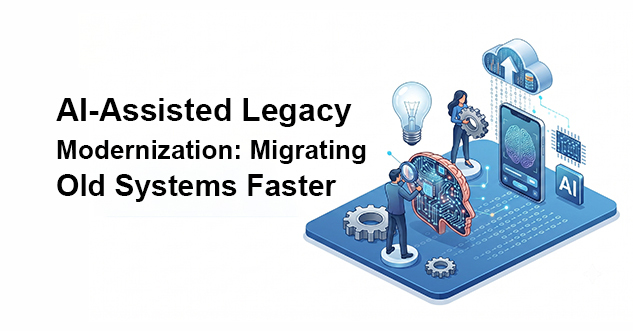
AI Legacy Modernization 2026
Published by AgamiSoft | Reading time: ~14 minutes
|
TLDR ; AI legacy modernization applies large language models, code analysis tools, and intelligent automation to the phases of legacy migration that have historically consumed the most time: undocumented system discovery, business logic extraction, code conversion, and test coverage generation. AI-assisted modernization reduces manual analysis, documentation, and code conversion effort during legacy migration projects directly addressing the reason most legacy modernization programs exceed their budgets: not the transformation work, but the archaeology work that precedes it. Organizations that modernize with AI assistance are completing in months what equivalent manual programs estimated in years. |
Why AI Legacy Modernization Has Become a 2026 CIO Priority That Can No Longer Be Deferred
Legacy systems are becoming simultaneously more expensive to maintain and more dangerous to leave in place. The average enterprise runs core business processes on applications that are 20–40 years old, written in languages with shrinking talent pools (COBOL, RPG, PL/1, early Java), maintained by documentation that was last updated in the application's first decade, and architecturally incompatible with the cloud infrastructure, API integration, and DevOps practices that modern digital business requires.
The cost of inaction has crossed a threshold in 2026 that is forcing legacy modernization onto CIO agendas that have deferred it for a decade:
COBOL and RPG developer retirement has created a genuine talent crisis. The average COBOL developer is now 55–60 years old (MICROFOCUS/Compuware developer survey, 2025). Financial institutions, insurance companies, and government agencies running mission-critical batch processing on mainframe COBOL cannot find developers to maintain those systems at any price point that makes economic sense and the knowledge those developers carry about how the systems actually behave is leaving the organization faster than it can be documented.
Cloud migration has exposed the integration incompatibility of legacy systems. Organizations that migrated infrastructure to cloud while leaving legacy applications on-premises have created integration architecture debt that grows more expensive to service every quarter. Legacy systems that cannot expose REST APIs, consume modern authentication protocols, or participate in event-driven integration patterns are bottlenecks for every digital transformation initiative built around them.
AI-assisted modernization tools have crossed the practical utility threshold. The generation of LLM-based code analysis and code conversion tools available in 2026 trained specifically on large corpora of enterprise programming languages including COBOL, PL/1, RPG, and early Java can analyze undocumented legacy code, extract business rules, and generate documented, readable equivalent code in modern languages at a quality level that changes the economic calculation for legacy modernization programs. Tools that previously could handle toy examples now handle production-grade enterprise code with the complexity and edge cases that mainframe financial systems accumulate over decades.
What Is AI Legacy Modernization, Exactly and What Does "AI-Assisted" Actually Mean for Migration Projects?
Legacy modernization is the process of updating or replacing aging software systems maintaining the business functionality those systems provide while rebuilding their technical foundation on modern languages, architectures, platforms, and integration patterns.
It encompasses a spectrum of transformation approaches:
-
Rehost (lift and shift): move the legacy application to new infrastructure without changing the code fastest, lowest risk, but doesn't address technical debt or architectural limitations
-
Replatform: move to a new runtime with minor code changes modernizing the hosting environment while preserving the application logic
-
Refactor: restructure the code's internal design without changing its external behavior improving maintainability and performance without full language migration
-
Re-architect: change the application's fundamental architecture decomposing a monolith into microservices, converting batch processing to event-driven, adding API layers
-
Rebuild: rewrite the application in modern technology highest cost and risk, required when the legacy system's architecture is incompatible with required functionality
-
Replace: retire the legacy application and replace it with a commercial product appropriate when the legacy system doesn't provide differentiated business value
AI legacy modernization specifically addresses the phases of transformation that have historically consumed the most project time and budget: the phases that precede the actual modernization work.
What AI-assisted means in practice across five specific migration phases:
Phase 1 Discovery and code archaeology
LLM-based code analysis tools read undocumented COBOL, RPG, or legacy Java code and generate English-language business rule documentation, system behavior summaries, data flow diagrams, and dependency maps work that previously required one or two senior developers who understood the legacy language to spend months reading code and writing documentation.
Phase 2 Business logic extraction
AI tools identify which sections of legacy code implement business rules that must be preserved in the modernized system versus which sections implement infrastructure concerns (file I/O, screen formatting, job scheduling) that will be replaced by modern equivalents eliminating the risk of losing critical business logic that was never documented.
Phase 3 Code conversion
LLM-based code conversion tools translate legacy code (COBOL to Java, PL/1 to Python, RPG to C#) at a functional level generating equivalent modern code that implements the same logic, rather than literal character-for-character translation that previous "translator" tools produced. The output requires review and refinement, but starts at a significantly higher quality baseline than previous generation tools.
Phase 4 Test coverage generation
AI tools analyze the behavior of existing legacy systems through code analysis and, where available, execution traces to generate test cases that cover the business logic documented in Phase 2, providing the regression test foundation that modernization requires but that undocumented legacy systems lack.
Phase 5 Documentation generation
AI tools maintain documentation as modernization progresses updating data dictionaries, generating API documentation for newly created interfaces, and documenting the business rules that the modernized system implements for the benefit of the teams who will maintain it.
AI legacy modernization does not make legacy migration simple. It makes the archaeology phases discovery, documentation, business logic extraction faster and less dependent on the rare humans who can read 30-year-old COBOL. The transformation judgment what to rehost versus refactor versus rebuild, how to decompose a monolith, how to manage the cutover still requires experienced architects.
The Data Behind Why Legacy Systems Have Become Unaffordable to Ignore
Legacy System Maintenance Cost and Business Risk
|
Metric |
Average Enterprise Legacy State |
Source |
|
% of IT budget consumed by legacy maintenance |
60–80% |
Gartner IT Budget Analysis 2025 |
|
Average age of core business application |
22 years |
McKinsey Technology Council 2025 |
|
% of enterprise applications in "end of vendor support" |
43% |
IDC Application Lifecycle Report 2025 |
|
New feature delivery time for legacy vs modern systems |
4–8x slower on legacy |
McKinsey, 2025 |
|
Average legacy developer attrition rate (COBOL, RPG, PL/1) |
12–15% annually |
ISG Outsourcing Index 2025 |
Sources: Gartner IT Budget Analysis 2025; McKinsey Technology Council Digital Modernization Report 2025; IDC Application Lifecycle Management Survey 2025.
AI-Assisted Modernization Impact on Project Economics
-
AI-assisted code analysis reduces the discovery and documentation phase of legacy modernization programs by 40–60% in calendar time the phase that most frequently causes modernization programs to miss initial cost and timeline estimates (Gartner, 2025)
-
LLM-based COBOL-to-Java conversion tools produce first-draft converted code that requires 30–50% less manual correction than previous-generation rule-based translators significantly improving the ROI of conversion-based modernization approaches (IBM Consulting Modernization Practice Data, 2025)
-
Automated test generation for legacy system behavior produces 60–70% of the test coverage that a fully manual test writing effort would achieve, at approximately 15% of the cost the coverage gap representing edge cases that automated analysis cannot identify without execution data (Diffblue, 2025)
The Cost of Continued Deferral
-
The average enterprise spending 70% of its IT budget on legacy maintenance has approximately 30% available for new capability development organizations that modernize to 40% maintenance / 60% new development double their innovation investment capacity without increasing IT budget (Gartner, 2025)
-
Every year of COBOL legacy maintenance deferral increases modernization complexity by an estimated 8–12% as further functionality is added to the legacy codebase and institutional knowledge of the system's behavior continues leaving the organization (McKinsey, 2025)
-
Financial institutions that have not modernized core banking platforms by 2028 will face regulatory examination findings citing technology risk in jurisdictions including the UK (PRA guidance), EU (EBA digital operational resilience requirements under DORA), and US (OCC model risk management guidance), according to industry forward guidance from all three regulators (2025)
How to Execute AI-Assisted Legacy Modernization: A 6-Step Framework
Step 1: Conduct a Legacy Portfolio Assessment to Sequence Modernization by Risk and Value
Not every legacy system has the same modernization urgency or the same appropriate modernization approach. The first step is assessing your legacy portfolio across four dimensions:
-
Business criticality: which systems support core revenue-generating, regulatory-mandated, or operationally essential functions these have the highest transformation risk but also the highest value from modernization
-
Technical debt severity: which systems have the most fragile codebases, the most developer knowledge concentration in individuals, and the most compatibility gaps with modern integration patterns
-
Maintenance cost trajectory: which systems are consuming an increasing share of IT budget with diminishing return the financial case for modernization is strongest where maintenance costs are growing and new feature delivery is getting slower
-
Modernization approach fit: which systems are candidates for rehost versus refactor versus rebuild generally, systems with stable, well-understood business logic are candidates for AI-assisted code conversion; systems where the business requirements have changed significantly are candidates for rebuild
This assessment produces a prioritized modernization sequence not attempting all systems simultaneously, but sequencing transformation where the combination of business value and technical feasibility is highest.
Step 2: Run AI-Assisted Discovery and Documentation Before Any Architecture Decisions
The most common cause of legacy modernization program overruns is discovering mid-project that the legacy system does something the project team didn't know about an undocumented business rule, an edge case that surfaces only in production, a data dependency that wasn't visible in the initial analysis. AI-assisted discovery addresses this before it becomes a mid-project crisis:
-
Deploy LLM-based code analysis tools (AWS Transform, IBM's watsonx Code Assistant for Z, or Luc.ai for COBOL) against your legacy codebase
-
Generate system documentation: business rule inventory, data flow diagrams, external dependency maps, control flow documentation
-
Have a domain expert (not just a developer) review the generated documentation against their business process knowledge identifying gaps and inconsistencies that indicate where the AI analysis has missed something important
-
Use this documentation as the specifications for the modernized system ensuring business rules discovered in legacy code are explicitly captured as requirements for the modern replacement
This documentation becomes the authoritative specification for what the modernized system must do replacing the legacy code as the single source of truth for business behavior.
Step 3: Deploy AI Code Conversion for Appropriate Code Categories
AI-assisted code conversion is not a single approach applied uniformly to all legacy code. Different code categories respond differently to AI conversion:
High-conversion-success categories:
-
Pure calculation and business rule code with clear logic and minimal external dependencies
-
Data transformation routines with defined input and output structures
-
Validation logic with explicit conditional rules
-
Report generation code with defined layouts
Requires human-led approach (AI assists, not leads):
-
Database access patterns with complex query optimization that must be preserved
-
Integration code with external systems using legacy protocols
-
Performance-critical code where the conversion must maintain specific execution characteristics
-
Code with complex concurrency or transaction management
Apply AI conversion tools to the high-conversion-success categories while routing complex categories to human-led modernization with AI assistance maximizing the cost reduction from AI conversion while maintaining quality on the sections where AI conversion would require more rework than the tool saves.
Step 4: Implement the Strangler Fig Pattern for Incremental Cutover
The strangler fig pattern incrementally replacing legacy system functionality with modern equivalents while running both in parallel, routing an increasing share of traffic to the modern system until the legacy system is no longer needed is the modernization approach that most effectively manages cutover risk for large, complex legacy systems:
-
Identify a self-contained slice of functionality (a report generation module, a data validation service, an external integration) that can be modernized and deployed independently
-
Build the modern equivalent, route new requests to it, and maintain the legacy version for comparison and rollback
-
Run both versions in parallel, comparing outputs to validate that the modern version produces identical results to the legacy version under all observed input conditions
-
Increase traffic routing to the modern version incrementally as confidence builds, maintaining the legacy version until the modern version has demonstrated equivalent behavior at full production load
-
Retire the legacy slice only after the modern equivalent has operated at full production load without incidents for a defined stability period
Repeat this cycle for each functional slice until the legacy system has no remaining active functionality and can be decommissioned entirely.
Step 5: Generate and Execute Regression Tests Before and After Each Migration Wave
Legacy systems rarely have meaningful automated test coverage the test for whether legacy systems work is that they have worked for decades in production. Modernization without test coverage means the first test of whether the modernized system behaves correctly is live production traffic:
-
Deploy AI test generation tools (Diffblue Cover for Java, Copilot-assisted test generation for other languages) against the modernized code to generate unit tests for converted functions
-
Generate integration tests by capturing actual production request/response pairs from the legacy system during a representative period these production traces become the ground truth test cases for the modernized system
-
Run generated tests against both the legacy and modernized versions before cutover any test that the legacy system passes and the modernized system fails represents a behavioral difference that must be investigated before traffic is routed to the modern version
-
Maintain and expand the test suite as modernization progresses each wave of modernization should increase overall test coverage, so the final legacy decommission is backed by a test suite that didn't exist when the program started
Step 6: Implement a Parallel Running and Comparison Architecture for High-Stakes Systems
For mission-critical systems where behavioral differences between legacy and modern code could cause financial, regulatory, or safety consequences, parallel running executing both systems simultaneously on every production request and comparing outputs provides the highest-confidence validation before full cutover:
-
Deploy a comparison infrastructure that routes every production request to both legacy and modern systems, captures both outputs, and flags any difference for investigation
-
Define "acceptable difference" criteria some output differences (formatting changes, timestamp precision, whitespace) are acceptable; others (calculation differences, status code differences, data content differences) are not
-
Investigate every flagged difference to determine whether it represents a bug in the modern system, an intentional behavior improvement, or a legacy system behavior that should not be replicated
-
Achieve zero unacceptable output differences on 30 consecutive days of full production traffic before retiring the legacy system the evidence standard that high-stakes cutover decisions should require
Which AI Legacy Modernization Tools Deliver Best Results in 2026?
For COBOL and mainframe modernization:
IBM watsonx Code Assistant for Z provides the most mature LLM-based COBOL analysis and Java generation capability trained specifically on enterprise mainframe code patterns and integrated with IBM's broader Z modernization toolchain. AWS Mainframe Modernization provides managed infrastructure for COBOL refactoring and replatforming, with automated tooling for converting COBOL batch processing to cloud-native equivalents. Broadcom's automated COBOL modernization toolset provides code analysis and transformation specifically for Broadcom (formerly CA Technologies) mainframe environments.
For general legacy code analysis and documentation:
Luc.ai provides LLM-based business rule extraction from COBOL, RPG, and PL/1 with natural language documentation output designed for business domain expert review. Cast Software provides automated application architecture analysis across 80+ languages and frameworks, producing application composition maps and technical debt quantification for legacy portfolio assessment. Sourcegraph Cody provides AI-assisted code understanding at repository scale useful for legacy Java, C++, and C# analysis where the codebase is large enough to exceed individual developer comprehension.
For AI-assisted code conversion:
GitHub Copilot and Amazon CodeWhisperer provide AI-assisted code generation that accelerates modernization work within IDEs developers describe what a legacy function does, and the AI generates a modern equivalent for review and refinement. Snyk DeepCode AI provides AI-powered code analysis that identifies patterns in converted code that may represent security vulnerabilities introduced during conversion. For COBOL-to-Java specifically, Micro Focus COBOL Analyzer combined with LLM-assisted review of converted code is the current practical combination in large-scale programs.
For automated test generation:
Diffblue Cover provides autonomous unit test generation for Java code deployed post-conversion to generate test coverage for modernized Java code that COBOL didn't have tests for. EvoSuite provides evolutionary algorithm-based test generation for Java that complements LLM-based test generation. Copilot-assisted test generation within GitHub Copilot Chat provides effective test case generation when the developer provides business rule context from the AI documentation generated in the discovery phase.
For strangler fig implementation:
AWS App Mesh and Istio provide the service mesh infrastructure for routing traffic between legacy and modern systems during parallel running. AWS Migration Hub and Azure Migrate provide the migration tracking and comparison infrastructure for managing modernization wave sequencing across large application portfolios.
Explore our Legacy System Modernization and Cloud Migration Services capabilities for enterprise organizations executing AI-assisted legacy modernization programs that need architectural guidance alongside tooling deployment.
What Goes Wrong With AI Legacy Modernization Programs and How to Prevent Each Failure
Failure 1: Using AI Conversion Output Without Human Review as Production Code
AI code conversion tools even the most capable LLM-based tools available in 2026 produce first-draft converted code that requires expert review before production deployment. Organizations that treat AI conversion output as production-ready code without review consistently discover behavioral differences, edge case handling failures, and performance issues that the conversion tool didn't catch. AI conversion compresses the time from zero to reviewable first draft it does not replace the review. Budget for 30–50% of the time you would have spent on manual conversion for expert review of AI conversion output, and you will still achieve a significant net time saving.
Failure 2: Starting Modernization Without Completing Discovery
Programs that begin code conversion before completing business rule documentation and dependency mapping consistently hit mid-program discoveries that require significant rework an undocumented calculation that feeds 15 downstream reports, an external integration that wasn't in the initial system inventory, a data format that varies by customer segment in a way that wasn't documented. The discovery and documentation phase the phase where AI assistance provides the largest effort reduction is the prerequisite that the entire subsequent program depends on. Compress it with AI, but don't skip it.
Failure 3: Attempting Big-Bang Cutover Rather Than Strangler Fig Incremental Migration
Legacy modernization programs that plan to migrate the entire system and cut over on a defined go-live date consistently face the same failure: the go-live date approaches, testing reveals behavioral differences that can't be resolved in time, the date slips, the organization loses confidence in the program, and the program scope gets reduced or cancelled. The strangler fig pattern exists specifically because big-bang cutover of complex legacy systems has a documented failure rate that incremental migration avoids. If your legacy modernization program's risk management plan doesn't include a rollback path for each migration wave, the risk management plan is incomplete.
Failure 4: Not Capturing and Preserving the Business Logic Knowledge That AI Extraction Surfaces
AI-assisted discovery extracts business logic documentation that frequently represents the first time anyone has written down what the legacy system actually does. Organizations that use this documentation as a transient artifact read by the modernization team and discarded after conversion lose an organizational asset that should outlive the modernization program. The business rule documentation generated by AI analysis of legacy code is valuable beyond the modernization project: for regulatory audit support, for training future maintainers, for validating future change requests against intended system behavior. Treat AI-generated legacy system documentation as a permanent organizational knowledge asset with a defined owner and maintenance process.
Frequently Asked Questions
What Is Legacy Modernization?
Legacy modernization is the process of updating or replacing aging software systems maintaining the business functionality those systems provide while rebuilding their technical foundation using modern languages, architectures, cloud infrastructure, and integration patterns. It ranges from rehosting (moving to modern infrastructure without code changes) to rebuilding (rewriting from scratch in modern technology), with refactoring, re-architecting, and replatforming in between. The right modernization approach for a specific system depends on its technical debt severity, how much its business requirements have changed since original development, and how well its current architecture fits the target modern platform.
How Does AI Help Software Migration?
AI helps software migration across five specific phases that have historically consumed the most project time. Discovery and documentation: LLM-based code analysis reads undocumented legacy code (COBOL, RPG, PL/1) and generates natural language business rule documentation and system behavior descriptions. Business logic extraction: AI tools identify which code sections implement business rules that must be preserved versus infrastructure concerns that will be replaced. Code conversion: LLM tools translate legacy code to modern equivalents at a functional level, producing first-draft converted code that requires review but starts at higher quality than rule-based translators. Test generation: AI tools analyze converted code to generate unit and integration tests that provide the regression coverage legacy systems lack. Documentation maintenance: AI tools generate and update technical documentation as modernization progresses, ensuring the modernized system is better documented than the legacy it replaces.
When Should Organizations Modernize Legacy Systems?
Organizations should prioritize legacy modernization when three or more of these conditions apply: legacy maintenance is consuming more than 60% of the IT budget, leaving insufficient capacity for new capability development; key personnel who understand the legacy systems are approaching retirement or have left; the legacy system cannot integrate with modern platforms through APIs, event streams, or standard authentication protocols; the vendor has discontinued support for the platform or programming language; regulatory requirements (DORA, PRA, OCC model risk guidance) are creating technology risk examination findings; or competitive capability delivery is measurably slower than market alternatives because the legacy system is the bottleneck. Organizations should not defer modernization purely because the legacy system "still works" the cost of deferral compounds as institutional knowledge leaves, technical debt grows, and integration complexity increases.
Run Discovery Before Architecture. Convert With AI, Review With Experts. Migrate in Waves, Not in One.
AI legacy modernization delivers its transformation acceleration compressing in months what manual programs estimated in years when the AI assistance is applied to the phases where it provides the highest leverage: discovery and documentation, where LLM analysis replaces months of manual code archaeology; code conversion, where AI first drafts replace weeks of manual translation; and test generation, where automated tools provide coverage that didn't previously exist.
The enterprise architects and IT directors achieving the fastest successful legacy modernization outcomes in 2026 share one sequencing discipline: they completed AI-assisted discovery and generated business rule documentation before committing to a modernization approach for any system, because the documentation consistently revealed complexity that changed the chosen approach and would have caused mid-program surprises if discovered later. That sequencing discipline discover before design, document before convert is what separates modernization programs that finish from those that stall.
Deploy an AI code analysis tool against your highest-maintenance legacy application this quarter and generate the business rule documentation that may not exist anywhere in your organization. Conduct a portfolio assessment against the four dimensions in this framework before your next IT budget cycle. Identify one self-contained functional slice of your highest-priority legacy system that can be modernized as a strangler fig pilot validating your toolchain, your team capability, and your parallel comparison infrastructure on a recoverable scope before committing to full program execution.
To build an AI-assisted legacy modernization program with the architectural guidance, toolchain selection, and program structure that determine whether modernization delivers in 18 months or stalls in 36, explore our Legacy System Modernization and Cloud Migration Services capabilities structured for CIOs and enterprise architects who need transformation delivered as a managed program, not a technology experiment.
United States
Salesforce Tower, 415 Mission Street,
San Francisco, CA 94105
Canada
206-15268 100 Avenue,Surrey,
British Columbia, V3R 7V1, Canada
Bangladesh
Sharif Complex (11th floor),
31/1 Purana Paltan, Dhaka - 1000