
Fractional CTO Services 2026
Fractional CTO Services 2026
Published by AgamiSoft | Reading time: ~14 minutes
|
Featured Snippet Fractional CTO services provide businesses with experienced technology leadership on a part-time or project basis — typically 1–3 days per week — covering technology strategy, architecture decisions, engineering team oversight, vendor selection, and technical due diligence without the $250,000–$400,000 annual cost of a full-time executive hire. Fractional CTOs enable SMEs to access executive-level technology leadership at a cost that matches their stage, making senior technical guidance accessible at the growth phase where it has the highest impact and where most SMEs cannot justify a full-time CTO. |
|
TL;DR ; Cyber resilience for SMEs in 2026 has fundamentally shifted from reactive defence to proactive Zero-Trust architecture. SMEs are no longer flying under the radar — attackers now deploy the same sophisticated tactics once reserved for the Fortune 500. The top 10 resilience partners in this guide provide Universal Zero Trust Network Access (ZTNA) to counter the 149% spike in ransomware observed in 2025. AgamiSoft's Zero-Trust model identified 23 sophisticated attack attempts for one UK fintech client within six months — none resulted in a breach. |
Why Fractional CTO Services Have Become a Standard Part of the SME Technology Model in 2026
The gap between what SMEs need from technology leadership and what a full-time CTO hire costs has always existed. What has changed is the availability of experienced executives who are specifically choosing the fractional model — building portfolios of 3–5 client engagements rather than taking single company roles — creating a supply of fractional CTO talent that makes the model practical rather than a compromise.
Three forces have accelerated fractional CTO adoption specifically in 2026:
AI adoption has created urgent technology strategy decisions that most SME founders are not equipped to make alone. Should your company build an AI product feature or integrate a third-party AI API? Should you fine-tune a model or use retrieval-augmented generation? How do you evaluate AI vendor claims against your actual use case? These are not questions that require a full-time CTO 40 hours per week — but they are questions that require senior technical judgment to answer correctly, and getting them wrong costs far more than a fractional CTO engagement.
Software outsourcing has created oversight gaps that hurt companies without technical leadership. SMEs increasingly use offshore or nearshore development teams for engineering capacity — but without a technical executive who can evaluate code quality, architecture decisions, and delivery velocity, those outsourcing relationships frequently produce technical debt rather than technical capability. A fractional CTO provides the senior technical oversight that makes outsourced development deliver its potential rather than its risk.
The cost of bad technology decisions compounds faster than it used to. A poor architectural decision in 2016 cost a company 12–18 months to unwind. The same decision in 2026 — when cloud infrastructure commitments, AI platform dependencies, and data architecture choices have longer and more expensive lock-in periods — can cost significantly more to reverse. Fractional CTO services provide the senior architectural oversight that prevents the expensive decisions before they're made, at a cost that is a fraction of a single bad vendor contract.
What Are Fractional CTO Services, Exactly — and What Does a Fractional CTO Actually Do?
Fractional CTO services are engagements in which an experienced technology executive provides CTO-level leadership, strategy, and oversight to a company on a part-time basis — typically 1–3 days per week, at a monthly retainer or project rate — rather than as a full-time employee.
This is different from a technology consultant, who provides advice on a defined question and delivers a report. A fractional CTO provides ongoing leadership — attending leadership meetings, participating in hiring decisions, reviewing code architecture, meeting with vendors, and making or guiding the technology decisions that a full-time CTO would make.
A fractional CTO's work falls across five functional domains that SMEs most frequently need at the growth stage:
Domain 1 — Technology strategy and roadmap
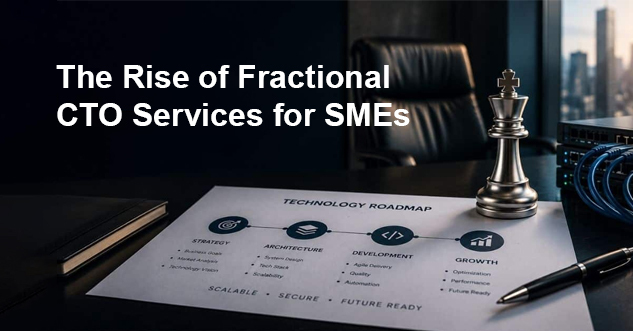
Defining where the company's technology needs to be in 12–36 months to support business objectives — what platforms, architectures, and capabilities need to be built, bought, or retired, and in what sequence. The technology roadmap is the output that most founders commission a fractional CTO to produce first, because it provides the strategic context for every subsequent technology investment decision.
Domain 2 — Architecture oversight and technical decision governance
Providing senior technical judgment on the decisions that determine long-term scalability, security, and maintainability — database architecture, cloud platform selection, API design, third-party integration choices, and AI platform decisions. These are decisions where the cost of getting it wrong significantly exceeds the cost of the fractional CTO engagement that gets it right.
Domain 3 — Engineering team leadership and hiring
Providing technical leadership to internal or outsourced development teams — conducting or overseeing technical interviews, reviewing code quality, establishing engineering standards, and giving developers a senior technical voice to escalate to when architectural questions arise. For companies with outsourced development teams, this oversight function is where fractional CTOs provide some of their clearest measurable value.
Domain 4 — Vendor selection and management
Evaluating technology vendors — cloud providers, SaaS platforms, development agencies, AI API providers — against the company's specific technical requirements and long-term architecture. Vendor selection made by non-technical founders without technical advisor support consistently produces either over-complex enterprise solutions or under-powered tools that require replacement within 18 months.
Domain 5 — Investor and board technical communication
Translating technology strategy and capability into language that investors, boards, and enterprise customers can evaluate — technical due diligence support, CTO-level presentations to investor committees, and security and compliance questionnaire responses that require executive-level sign-off.
What a fractional CTO is not:
-
A part-time developer — fractional CTOs lead and advise, they don't write production code
-
A project manager — they provide architectural and strategic oversight, not delivery management
-
A technical co-founder — they are advisors and leaders, not equity-bearing founding partners
The Business Case Numbers Behind Fractional CTO Services
Cost Comparison: Fractional vs Full-Time CTO
|
Model |
Annual Cost |
Time Commitment |
Best Fit |
|
Full-time CTO (US market) |
$250,000–$450,000 (salary + benefits + equity) |
40+ hours/week |
Series B+, 50+ person engineering teams |
|
Full-time CTO (UK market) |
£150,000–£280,000 + benefits + equity |
40+ hours/week |
Series B+, established UK tech companies |
|
Fractional CTO (1 day/week) |
$36,000–$72,000/year |
8 hours/week |
Seed-Series A, 1–10 person dev teams |
|
Fractional CTO (2–3 days/week) |
$72,000–$150,000/year |
16–24 hours/week |
Series A-B, 10–30 person engineering teams |
|
Technology advisor (quarterly) |
$15,000–$40,000/year |
As-needed |
Pre-seed, validating technology choices |
Sources: Levels.fyi CTO compensation data 2025; Toptal Fractional CTO Market Report 2025; Gartner SME Technology Advisory Survey 2025.
The Value of Prevented Bad Decisions
The ROI of fractional CTO services is most clearly quantified in the category of decisions prevented rather than decisions made:
-
A wrong cloud architecture selection at the Series A stage typically costs $150,000–$500,000 to reverse 18–24 months later, when the platform must be rebuilt to support growth the original architecture couldn't sustain (Gartner Cloud Migration Cost Analysis, 2025)
-
A development agency engagement without senior technical oversight produces an average of 35–50% higher rework costs than equivalent engagements with technical leadership oversight (Clutch Development Quality Survey, 2025)
-
A premature AI platform commitment without architectural review locks companies into vendor pricing and capability constraints that cost an average of $80,000–$200,000 to exit when the platform proves inadequate (Forrester AI Platform Switching Cost Analysis, 2025)
Demand and Market Data
-
The global fractional CTO market has grown 42% since 2022, with the highest growth in SME engagements of 2–3 days per week — reflecting the growth-stage company demand profile that benefits most from the model (Toptal Market Report, 2025)
-
67% of fractional CTO engagements begin as 3–6 month projects and convert to ongoing retainer relationships — indicating that the value delivered during initial engagements consistently justifies continuation (Gartner, 2025)
-
Companies with fractional CTO oversight complete technology projects on-time and on-budget at 2.3x the rate of equivalent companies without technical executive leadership — specifically for companies in the 10–100 employee range where the risk of unsupervised technology investment is highest (Deloitte SME Technology Report, 2025)
How to Structure a Fractional CTO Engagement: A 5-Step Framework
Step 1: Define the Specific Outcomes You Need Before Searching for a Fractional CTO
Fractional CTO engagements fail most frequently when the company hasn't defined what success looks like before the engagement begins. Before approaching any fractional CTO candidates, document:
-
The specific decisions or deliverables you need guidance on — a technology roadmap, an architecture review, a vendor selection, an engineering team assessment
-
The ongoing oversight functions the fractional CTO will perform — weekly developer meetings, monthly board reporting, ongoing architecture sign-off
-
The engagement duration — a 3-month project to produce a technology roadmap, a 12-month retainer for ongoing CTO function, or a defined milestone (first product launch, Series A close)
-
The internal stakeholders the fractional CTO will work with and report to — founder, board, investors, development team
This specification becomes the brief for candidate selection — enabling you to evaluate whether a candidate's experience matches your specific needs rather than their general seniority.
Step 2: Evaluate Candidates on Relevant Experience, Not Just Technical Credentials
Fractional CTOs bring value through judgment accumulated from relevant experience — not through the deepest technical skill in any specific programming language or framework. Evaluate candidates against:
-
Industry and business model relevance: a fractional CTO who has led technology for SaaS companies at your stage will understand your specific architecture, vendor, and scaling challenges better than one whose experience is primarily in enterprise software or hardware
-
Technology stack relevance: not identical stack experience, but comfort with the technology categories your company uses — cloud-native, AI/ML, mobile, embedded, fintech
-
Stage experience: fractional CTOs who have worked with companies at your specific stage (pre-revenue, post-product-market fit, scaling) bring the judgment about what technology decisions matter most at that stage versus what can be deferred
-
Reference quality: speak specifically with founders or CEOs from previous engagements, not just professional references — ask whether the fractional CTO's guidance produced measurable business outcomes, not just technically sound advice
Step 3: Structure the Engagement With Clear Deliverables and Communication Cadence
A fractional CTO engagement needs structure that most consulting relationships don't — because the fractional CTO is functioning as an executive, not a project deliverable provider:
-
Weekly rhythm: define the standing commitments — which meetings the fractional CTO attends, which they lead, which team members they have direct access to, and what their weekly communication output to leadership looks like
-
Decision rights: define explicitly which decisions the fractional CTO makes, which they advise on, and which they are informed about — establishing clear accountability without ambiguity
-
90-day deliverable: specify the specific output the first 90 days will produce — technology assessment, vendor recommendations, roadmap document, architecture decision records — so both parties have a clear, measurable initial milestone
-
Review cadence: plan a formal engagement review at 90 days, assessing whether the scope, commitment level, and outcomes are aligned — adjusting before a mismatch between expectations and delivery compounds into a failed engagement
Step 4: Integrate the Fractional CTO Into Your Team, Not Into Your Calendar
Fractional CTOs who are booked for weekly check-in calls but not integrated into the actual work context of the company consistently deliver advisory value rather than leadership value — and advisory value is what you pay a consultant for, not a fractional executive. Integration requires:
-
Access to engineering team communication channels (Slack, Teams) so the fractional CTO has ongoing context, not just briefing-call context
-
Involvement in hiring decisions for technical roles — fractional CTOs who participate in technical interviews add value beyond what their scheduled hours alone would suggest
-
Access to the technical artifacts they need to provide oversight — code repositories, architecture diagrams, vendor contracts, infrastructure cost dashboards
-
Introduction to the development team, outsourced partners, and key vendors as the technical leader — not as an external consultant whose involvement the team doesn't understand
Step 5: Define the Transition Plan at Engagement Start, Not at Engagement End
Fractional CTO engagements have natural endpoints — either because the company grows to the point where a full-time CTO hire is justified, or because the specific project the fractional CTO was engaged for is complete. Defining the transition before it becomes urgent produces better outcomes than planning it under pressure:
-
Define the milestone at which a full-time CTO hire becomes appropriate — engineering team size, funding stage, revenue threshold — so the fractional CTO can actively participate in building toward that milestone rather than avoiding it
-
Engage the fractional CTO in the full-time CTO hiring process when the threshold is reached — their knowledge of the company's technology context makes them the best evaluator of full-time CTO candidates
-
Plan for a defined overlap period when the incoming full-time CTO and fractional CTO work together — transferring context that the fractional CTO has accumulated about the company's architecture, vendors, and team
How to Find and Evaluate Fractional CTO Candidates in 2026
Platforms and networks for fractional CTO sourcing:
Toptal provides the most rigorous vetting of fractional CTO candidates — a multi-stage technical and professional evaluation that screens approximately 3% of applicants, providing founders with pre-vetted senior candidates rather than requiring them to conduct technical evaluation they may not be qualified to perform. Catalant provides access to independent technology executives with deep enterprise backgrounds for companies whose fractional CTO needs include enterprise technology strategy and procurement. Expert360 (strong in APAC and GCC markets) provides technology advisory talent for companies in those geographies.
Community-based discovery:
YC's Hacker News "Who Wants to Be Hired" threads and CTO Craft community regularly surface experienced technology executives actively seeking fractional engagements. Lenny's Network (product and engineering community) connects founders with technology advisors and fractional leaders who have specific startup and growth-stage experience. Warm referrals from other founders in your network who have used fractional CTO services remain the highest-quality sourcing channel — the reference is embedded in the introduction.
Evaluating a fractional CTO candidate:
A structured evaluation for fractional CTO candidates should include:
-
Technical depth assessment: present 2–3 real technology decisions you're facing and evaluate whether the candidate's response demonstrates senior judgment, not just technical knowledge — the quality of their reasoning about trade-offs matters more than their answer
-
Communication style evaluation: assess whether they can explain technical recommendations in terms your board and investors can act on — a technically excellent fractional CTO who can't communicate clearly to a non-technical leadership team will be underutilized
-
Reference conversations: speak directly with two or three founders or CEOs from recent engagements — specifically asking about decisions the fractional CTO influenced, whether those decisions proved correct in retrospect, and whether the candidate's communication style worked for their team
Explore our Technology Consulting Services and Digital Transformation Solutions capabilities for SMEs evaluating technology leadership options — including fractional CTO engagements designed around specific technology strategy and program delivery outcomes.
What Goes Wrong With Fractional CTO Engagements — and How to Prevent Each Failure
Failure 1: Engaging a Fractional CTO as a Status Signal Rather Than a Leadership Resource
Companies that engage a fractional CTO primarily to list on their pitch deck or investor materials — but don't actually involve them in the decisions and team interactions that CTO-level involvement requires — get neither leadership value nor credible status signal. Investors conducting due diligence will speak directly with the fractional CTO and ask what decisions they've influenced and what architectural knowledge they've accumulated — a fractional CTO who has attended biweekly briefing calls but hasn't been integrated into actual technology leadership will not pass that conversation. Engage a fractional CTO for the leadership they provide, and the credibility follows naturally.
Failure 2: Not Giving the Fractional CTO Access to the Problems That Matter
Fractional CTO engagements that route only polished, safe topics to the fractional CTO — strategic presentations, vendor evaluations, investor communications — while keeping messy internal problems (team conflicts, engineering quality issues, accumulating technical debt) away from them consistently produce advice that doesn't address the actual technology risks the company faces. The fractional CTO's judgment is most valuable on the messy, uncertain, consequential problems. Give them full access to the internal technology situation — including the parts that reflect poorly on past decisions — and their advice will produce proportionally higher value.
Failure 3: Expecting Fractional CTO Hours to Scale With Company Needs Without Renegotiating Commitment
A fractional CTO engaged at one day per week for a team of five developers frequently finds themselves pulled into a team of fifteen developers' questions, reviews, and decisions without the engagement structure or compensation having changed. Fractional CTO engagements require explicit scope renegotiation when the company's scale and complexity change significantly — treating the fractional CTO's time as elastic without compensation adjustment consistently produces either burned-out fractional CTOs who reduce their engagement, or under-served companies who interpret reduced engagement as disinterest.
Failure 4: Using Fractional CTO Services as a Permanent Substitute for Hiring a Full-Time CTO
Fractional CTO services are the right model for a specific growth stage — when technology leadership is needed but not at the volume that justifies a full-time executive. Companies that continue the fractional model past the point where a full-time CTO is genuinely needed — typically when the engineering team exceeds 15–20 people or when technology is the primary product rather than an enabler — are under-investing in the leadership function that determines their competitive capability. Fractional CTO services work best when both parties treat them as the right tool for a defined stage, not as a permanent cost-avoidance strategy.
Frequently Asked Questions
What Is a Fractional CTO?
A fractional CTO is an experienced technology executive who provides CTO-level leadership, strategy, and oversight to a company on a part-time basis — typically 1–3 days per week under a monthly retainer or project arrangement — rather than as a full-time employee. They function as the company's chief technology officer for the scope of their engagement: attending leadership meetings, guiding architecture decisions, overseeing engineering teams, evaluating vendors, and providing the senior technical judgment that growth-stage companies need but cannot yet justify funding at full-time executive salary and equity levels. A fractional CTO is distinct from a technology consultant, who delivers a defined report or recommendation; a fractional CTO provides ongoing executive leadership with accountability for technology outcomes.
When Should a Company Hire a Fractional CTO?
A company should engage a fractional CTO when it faces technology decisions with significant long-term consequences but cannot justify a full-time CTO hire — typically between the $500K and $10M revenue stage. Specific triggers include: the founders are non-technical and are making vendor, architecture, or hiring decisions without senior technical guidance; the company has an outsourced development team without internal technical leadership to oversee it; a fundraising round is approaching and investors will conduct technical due diligence; the company is evaluating a significant technology investment (platform migration, AI adoption, product rebuild) and needs senior judgment on the approach; or technical debt has accumulated to the point where the cost of continuing to add to it exceeds the cost of addressing it with expert guidance.
How Much Do Fractional CTO Services Cost?
Fractional CTO services in 2026 typically cost $3,000–$8,000 per day or $8,000–$20,000 per month for a 1–3 day per week engagement, depending on the fractional CTO's experience level, geography, and the specific scope of engagement. US-market fractional CTOs at senior levels with Series A+ experience command $6,000–$10,000 per month for a one-day-per-week engagement. UK and Western European fractional CTOs run £4,000–£8,000 per month for equivalent engagement. GCC and South and Southeast Asian market rates are typically 30–50% lower for equivalent seniority. Project-based engagements (technology roadmap, architecture review, technical due diligence) are typically priced at $15,000–$50,000 depending on scope and delivery timeline. The annual cost of a fractional CTO at two days per week — typically $80,000–$130,000 — remains significantly below the $250,000–$450,000 total cost of a full-time US CTO hire.
Define the Outcomes You Need First. Integrate, Don't Just Consult. Plan the Transition Before You Need It.
Fractional CTO services deliver their strongest ROI when the company treats the engagement as executive leadership with genuine authority, access, and accountability — not as an advisory relationship that provides cover for decisions already made. The SME founders and CEOs achieving the highest value from fractional CTO services share one discipline: they engaged their fractional CTO on the real, messy, consequential problems — not just the presentable ones — and gave them full access to the team and technical context those problems required.
The decisions a fractional CTO prevents — the wrong cloud architecture, the underqualified development agency, the premature AI platform commitment — typically cost multiples of the entire engagement fee when made without senior technical guidance. That prevention value is only realizable when the fractional CTO has enough access and integration to see the decision coming before it's made.
Define the specific outcomes your company needs from fractional CTO services this quarter — roadmap, architecture review, development team oversight, or investor due diligence preparation. Identify two or three fractional CTO candidates through warm referrals or vetted platforms and conduct the structured evaluation described in this guide. Define your engagement scope, deliverables, and decision rights document before day one. And set the milestone at which you'll evaluate whether a full-time CTO hire is the right next step — so the fractional engagement serves the stage it's right for and transitions when the stage changes.
To explore fractional CTO services or technology strategy advisory matched to your company's stage and technology priorities, review our Technology Consulting Services and Digital Transformation Solutions capabilities — structured for SME founders and CEOs who need senior technology leadership delivered at the commitment level their stage requires.
United States
Salesforce Tower, 415 Mission Street,
San Francisco, CA 94105
Canada
206-15268 100 Avenue,Surrey,
British Columbia, V3R 7V1, Canada
Bangladesh
Sharif Complex (11th floor),
31/1 Purana Paltan, Dhaka - 1000