

Published by AgamiSoft | Reading time: ~14 minutes
|
Featured Snippet / AEO Answer : LangGraph, CrewAI, and AutoGen are the three leading AI orchestration platforms for building multi-agent AI systems — each with distinct architectural approaches: LangGraph provides stateful graph execution for complex conditional workflows with the strongest production governance features; CrewAI provides role-based crew architecture for the fastest path to multi-agent deployment; AutoGen provides conversational agent collaboration optimized for iterative, debate-style multi-agent tasks. AI orchestration platforms help developers manage agent workflows, memory, tool execution, and collaboration for enterprise-grade AI applications — the best platform depends on whether workflow control, deployment speed, or agent collaboration pattern is the primary requirement.
|
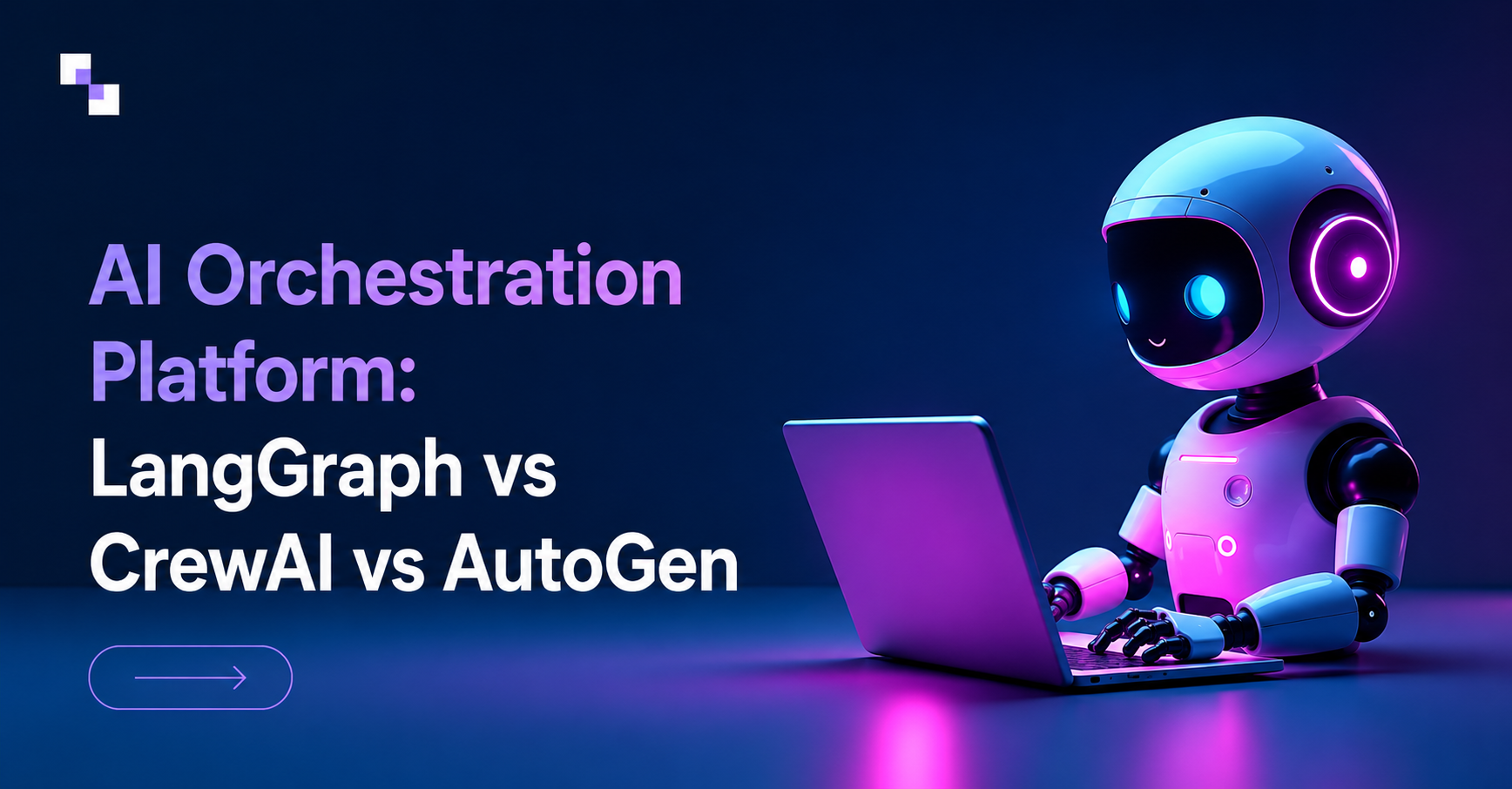
AI Orchestration Platform Compared: LangGraph vs CrewAI vs AutoGen in 2026
|
Quick Answer / TL;DR : An AI orchestration platform is the framework that coordinates how AI agents plan, communicate, access tools, manage state, and hand off work across complex multi-step workflows — the infrastructure layer that determines whether a multi-agent AI system is reliable, scalable, and governable in production. LangGraph, CrewAI, and AutoGen are the dominant choices in 2026, each with a distinct architectural philosophy: LangGraph for production-grade stateful control flow, CrewAI for accessible role-based multi-agent deployment, and AutoGen for conversational agent collaboration. The correct choice is not which framework is most capable overall — it is which framework's architecture fits your specific workflow pattern, team capability, and production requirements.
|
Why AI Orchestration Platform Selection Has Become a Critical Architecture Decision in 2026
Two years ago, "building an AI agent" meant writing a prompt and calling an API. The resulting systems were impressive demos and unreliable production deployments — because a prompt and an API call has no state management, no error handling, no tool execution governance, no memory persistence, and no mechanism for coordinating multiple agents on a complex task.
AI orchestration platforms solve exactly these problems. They provide the infrastructure layer between the LLM API and the business application: managing what each agent knows (memory), what each agent can do (tools), how agents communicate with each other (coordination), what happens when an agent fails (error handling), and how complex workflows with conditional branching execute reliably (stateful control flow).
Three developments have made orchestration platform selection a 2026 architecture priority:
Production deployments have exposed the specific gaps that demos don't show. LangGraph, CrewAI, and AutoGen have each been deployed in production enterprise environments long enough for their specific strengths and limitations to be documented through real operational experience — not just through benchmark performance on curated tasks. The production AI teams that have used all three platforms have developed clear opinions about which fits which use case, and those opinions have circulated through the AI engineering community in ways that 2024 benchmark comparisons could not.
Enterprise requirements have become more specific. Human-in-the-loop checkpoints, audit trails for AI decisions, integration with enterprise authentication systems, deployment on private cloud infrastructure, and compliance documentation for regulated industries have emerged as requirements that distinguish enterprise AI orchestration from research and prototyping. These requirements favor different frameworks for different enterprise contexts.
The frameworks have diverged in maturity and focus. LangGraph v0.2 (late 2025) significantly expanded its persistence and deployment infrastructure. CrewAI 2.0 introduced enterprise features including crew memory management and improved tool governance. AutoGen Studio provided a visual interface for AutoGen workflow design. Each platform has evolved along its own architectural philosophy, making the 2026 comparison meaningfully different from the 2024 comparison.
What Is an AI Orchestration Platform, Exactly — and What Does Each Framework Provide?
An AI orchestration platform is a software framework that manages the execution of multi-step AI workflows involving one or more AI agents — providing the infrastructure for agent state management, tool integration, inter-agent communication, error handling, and workflow control flow that production AI systems require.
Without an orchestration platform, developers implement these capabilities manually — writing custom state management code, building their own tool execution wrappers, and implementing ad-hoc agent communication protocols. The result is fragile, untestable, and difficult to govern. An orchestration platform replaces this custom code with a framework that has been designed, tested, and iterated specifically for multi-agent AI execution patterns.
LangGraph: Stateful Graph-Based Orchestration
LangGraph (LangChain, 2024) is an AI orchestration platform that models agent workflows as directed graphs — nodes are agents or functions, edges are transitions between them, and the graph state is a typed data structure that persists across the entire workflow execution.
Core architectural concept: every step in the workflow reads from and writes to a shared graph state object. Transitions between nodes are conditional — determined by the current state values. This enables complex conditional branching, cycles, and human-in-the-loop interruption patterns that linear orchestration frameworks cannot express.
Key characteristics:
-
Stateful execution with persistent state across workflow steps
-
Conditional edge routing based on state values
-
Native human-in-the-loop interruption at any node
-
Full audit trail through state history
-
Deployment via LangGraph Cloud or self-hosted LangGraph Server
-
Steeper learning curve than CrewAI due to graph construction paradigm
Best for: complex enterprise workflows with conditional branching, workflows requiring human approval at defined steps, and production deployments requiring full execution auditability.
CrewAI: Role-Based Crew Orchestration
CrewAI is an AI orchestration platform that models multi-agent systems as crews of agents with defined roles — each agent is given a role description, a goal, a backstory, and a set of tools, and the crew is assigned a task that the agents collaborate to complete.
Core architectural concept: agents are defined by their role identity (who they are) and their tools (what they can do), and CrewAI manages the collaboration pattern — sequential (agents work in order), hierarchical (a manager agent delegates to worker agents), or parallel — based on crew configuration.
Key characteristics:
-
Role-based agent definition with natural language role descriptions
-
Three collaboration patterns: sequential, hierarchical, parallel
-
Built-in memory types: short-term, long-term, entity, contextual
-
Lower learning curve than LangGraph
-
Less fine-grained control over execution flow than LangGraph
-
Strong community and broad integration ecosystem
Best for: use cases where role-based agent specialization is the natural mental model, teams new to multi-agent architecture who want faster deployment, and workflows that fit neatly into sequential or hierarchical collaboration patterns.
AutoGen: Conversational Multi-Agent Orchestration
AutoGen (Microsoft, 2023) is an AI orchestration platform that models multi-agent collaboration as a conversation — agents communicate through messages in a multi-party dialogue, with each agent responding to previous messages according to its role configuration.
Core architectural concept: agents are conversational participants. An orchestrator agent manages the conversation, assigning tasks to participant agents through dialogue and collecting their responses. Termination conditions determine when the conversation ends and a result is returned.
Key characteristics:
-
Conversation-first architecture — all agent coordination happens through message passing
-
Strong support for iterative refinement tasks (code generation, review, testing cycles)
-
AutoGen Studio provides visual workflow design
-
Group Chat Manager coordinates multi-party agent conversations
-
Less suited to rigid sequential workflows with strict state management requirements
-
Strong for human-computer collaborative agent workflows
Best for: iterative tasks where AI agents debate, review, and improve outputs through conversation cycles; code generation workflows where a coder agent, reviewer agent, and tester agent interact conversationally; research tasks where agents contribute diverse perspectives through dialogue.
The Performance and Capability Data That Defines Each Platform's Strengths
Feature Comparison Matrix
|
Capability |
LangGraph |
CrewAI |
AutoGen |
|
State management |
Persistent typed state |
Agent memory stores |
Conversation history |
|
Workflow control |
Graph with conditional edges |
Sequential/hierarchical/parallel |
Conversation flow |
|
Human-in-the-loop |
Native interruption at any node |
Callback-based |
Human proxy agent |
|
Error handling |
Explicit error state transitions |
Try-catch + retry |
Conversation error messaging |
|
Production deployment |
LangGraph Cloud / self-hosted |
Self-hosted |
Self-hosted |
|
Learning curve |
Steep (graph paradigm) |
Moderate |
Moderate |
|
Enterprise governance |
Strongest (full state audit) |
Moderate |
Moderate |
|
Iterative refinement tasks |
Possible but not natural |
Possible |
Native strength |
|
Complex conditional branching |
Native strength |
Workaround-required |
Difficult |
Sources: LangGraph documentation v0.2 2025; CrewAI 2.0 documentation 2025; Microsoft AutoGen documentation 2025; AI engineering community benchmark surveys, 2025.
Production Deployment Data
-
AI orchestration platforms help developers manage agent workflows, memory, tool execution, and collaboration for enterprise-grade AI applications — LangGraph is the most widely deployed orchestration framework in regulated industry enterprise environments where audit trails and human-in-the-loop governance are requirements (LangChain usage data, 2025)
-
CrewAI reports the fastest time-to-first-working-agent-system across the three frameworks — typically 60–80% shorter than LangGraph for teams new to multi-agent architecture, due to its higher-level role-based abstraction (CrewAI developer survey, 2025)
-
AutoGen demonstrates the highest output quality on iterative code generation benchmarks — where a code-generating agent, a code-reviewing agent, and a testing agent collaborate conversationally — outperforming single-agent and structured orchestration approaches by 25–40% on code correctness metrics (Microsoft AutoGen benchmark, 2025)
How to Choose the Right AI Orchestration Platform: A 5-Step Decision Framework
Step 1: Define Your Workflow Pattern Before Evaluating Any Platform
Platform selection that starts with "let's pick the most popular framework" consistently produces teams building workarounds for the fundamental mismatch between their workflow pattern and the chosen framework's architecture:
-
Map your workflow as a diagram: draw the specific steps your workflow requires, the conditions that determine which step executes next, the data that must persist across steps, and the human checkpoints that must interrupt autonomous execution
-
Identify whether your workflow is: primarily sequential (most steps execute in a fixed order with rare branching), primarily conditional (significant branching logic determines execution paths), or primarily iterative (agents review and improve outputs through repeated cycles)
-
Identify your human-in-the-loop requirements: are human checkpoints required at specific workflow stages? Do humans need to approve specific action types before they execute? Must humans be able to interrupt at any arbitrary point?
This mapping produces a clear workflow profile that maps to framework strengths:
-
Complex conditional branching with strict human-in-the-loop requirements → LangGraph
-
Role-based multi-agent with sequential or hierarchical execution → CrewAI
-
Iterative review, debate, or code generation cycles → AutoGen
Step 2: Assess Your Team's Framework Experience and Learning Investment Tolerance
The best AI orchestration platform for your workflow profile is useless if your team cannot implement it reliably within the project timeline:
-
LangGraph requires understanding graph construction, typed state schema design, conditional edge logic, and LangGraph-specific deployment concepts — teams without prior graph-based programming experience require 2–4 weeks to reach confident production implementation
-
CrewAI requires understanding role-based agent definition and crew configuration — teams with basic Python and LLM API experience typically reach confident implementation in 1–2 weeks
-
AutoGen requires understanding conversational agent configuration and Group Chat Manager patterns — learning curve similar to CrewAI for basic workflows, steeper for complex multi-agent conversation orchestration
For teams under delivery pressure, CrewAI's faster onboarding may justify accepting its workflow control limitations even for use cases that theoretically fit LangGraph better — if the team cannot implement LangGraph reliably within the timeline, LangGraph's architectural superiority is academic.
Step 3: Evaluate Enterprise Production Requirements
Enterprise production requirements that most differentiate the platforms:
For audit trail and compliance requirements:
LangGraph's typed state object that persists across every workflow step provides a natural, complete audit trail of every decision and action in the workflow — the audit trail is a side effect of how LangGraph works, not an add-on. CrewAI and AutoGen require additional instrumentation to produce equivalent audit evidence.
For regulated industry deployment:
LangGraph's native human-in-the-loop interruption at any workflow node, combined with its state persistence, makes it the strongest fit for the Human-in-the-Loop AI requirements covered in our HITL guide — healthcare, financial services, and legal services applications where human approval of AI decisions is a regulatory requirement.
For private cloud deployment:
All three frameworks support self-hosted deployment. LangGraph additionally offers LangGraph Cloud for managed deployment. None of the three requires external API calls from the framework itself (they call LLM APIs you configure, not their own).
Step 4: Prototype the Same Workflow in Two Frameworks Before Committing
For enterprise deployments with significant implementation investment, the cost of prototyping a representative subset of your workflow in two candidate frameworks is substantially less than the cost of discovering mid-project that the chosen framework requires complex workarounds for your specific workflow:
-
Implement a 3–5 step representative sub-workflow in your top two candidate frameworks
-
Assess implementation complexity: how many lines of code, how many framework-specific concepts required, how many workarounds for things the framework doesn't natively support
-
Assess the robustness of error handling in each framework for the specific failure modes your workflow will encounter
-
Assess the quality and completeness of observability output for debugging the prototype — the ease of debugging in prototyping predicts the ease of debugging in production
Step 5: Design the Framework Integration With Your Existing Infrastructure
Whichever framework is selected, its integration with your existing enterprise infrastructure is as important as its internal capability:
-
LLM provider integration: all three frameworks support multiple LLM providers (OpenAI, Anthropic, Azure OpenAI, local models via Ollama). Confirm your chosen LLM provider has mature support in your chosen framework before committing.
-
Tool integration: confirm that the tools your agents need — database connectors, API clients, document processors — have existing integrations or simple custom tool implementation paths in your chosen framework
-
Observability integration: confirm your chosen framework integrates with your observability platform (LangSmith, Langfuse, or custom logging) before building — retrofitting observability to a multi-agent workflow is significantly harder than building it in from the start
-
Memory backend integration: confirm your chosen framework supports your memory backend (vector database, relational database, Redis) for the memory persistence pattern your workflow requires
Platform-Specific Deep Dives: When to Use Each and Best Configuration Practices
When LangGraph is the Right Choice
Use LangGraph when:
-
Your workflow has significant conditional branching where execution path depends on intermediate results
-
Human approval at specific workflow stages is a hard requirement (healthcare, financial services, legal)
-
You need full audit trail of every state transition for compliance
-
You're building a long-running workflow that must persist state across multiple sessions or days
-
Your team has the engineering capability and timeline to invest in LangGraph's steeper learning curve
LangGraph configuration best practices:
-
Define your state schema as a TypedDict before writing any nodes — the state schema is the contract that all nodes read from and write to, and changing it mid-development is expensive
-
Use Command objects for node outputs that need to route to different next nodes — this is how LangGraph implements conditional branching cleanly
-
Implement checkpointing from day one using LangGraph's built-in checkpointer (SQLiteSaver for development, PostgresSaver for production) — checkpointing is what enables workflow resumption and human-in-the-loop interruption
When CrewAI is the Right Choice
Use CrewAI when:
-
Your workflow maps naturally to specialized roles (researcher, analyst, writer, reviewer) that are intuitive to define with natural language role descriptions
-
Time-to-deployment is a priority over maximum workflow control
-
Your workflow follows sequential or hierarchical execution patterns without complex conditional branching
-
Your team is newer to multi-agent architecture and benefits from CrewAI's higher abstraction level
CrewAI configuration best practices:
-
Write specific, detailed role descriptions and backstories for each agent — CrewAI's role-based agents perform significantly better with rich role context than with minimal descriptions
-
Use the hierarchical process mode (with a manager agent) for tasks requiring quality control and review — the manager agent reviews subagent outputs and iterates until quality criteria are met
-
Configure crew memory explicitly — CrewAI's long-term memory uses an embeddings-based store that significantly improves multi-session consistency for workflows that benefit from remembering prior execution context
When AutoGen is the Right Choice
Use AutoGen when:
-
Your workflow is fundamentally iterative — code generation with review and testing, research with critique and refinement, content creation with editorial review
-
You need AI agents to collaboratively debate, review, and improve outputs through natural conversation
-
Your use case involves human-computer collaboration where a human periodically contributes to an ongoing agent conversation
-
Code generation, testing, and debugging workflows where the coder-reviewer-tester collaboration pattern is natural
AutoGen configuration best practices:
-
Configure termination conditions precisely — AutoGen conversations can continue indefinitely without well-defined termination criteria, which produces runaway token consumption in production
-
Use AssistantAgent and UserProxyAgent as the foundational pattern — the UserProxyAgent is your human-in-the-loop entry point and should be configured as a human proxy even for fully automated workflows, as it provides the conversation management that GroupChatManager coordinates
-
Configure max_consecutive_auto_reply carefully — this controls how many consecutive agent responses can occur without human input, preventing infinite loops in automated workflows
Which Supporting Tools Maximize Each Framework's Production Value?
For LangGraph:
-
LangSmith (LangChain's observability platform) provides native LangGraph trace visualization — showing the graph execution path, state at each node, and agent outputs in a graph-structure view that matches LangGraph's architecture
-
LangGraph Studio provides local visual debugging of LangGraph workflows with state inspection at each node
-
PostgreSQL with pgvector for production LangGraph checkpointing and long-term memory integration
For CrewAI:
-
Langfuse provides strong observability for CrewAI workflows — capturing agent-to-agent interactions, tool calls, and crew task completion with structured logging
-
CrewAI Tools (built-in tool library) and LangChain Tools (extensive third-party tool library accessible from CrewAI) provide the broadest tool integration coverage
-
Chroma or Pinecone for CrewAI's long-term memory vector store backend
For AutoGen:
-
AutoGen Studio provides a visual interface for designing and testing AutoGen agent conversations without writing code — useful for prototyping and for non-engineers who need to configure agent roles
-
Azure OpenAI Service provides the most mature AutoGen integration given Microsoft's ownership of both — particularly for organizations requiring enterprise Azure compliance and data residency
-
LangSmith and Langfuse both support AutoGen trace logging through their respective integration libraries
Across all three frameworks:
Mem0 provides a memory layer that integrates with all three orchestration frameworks for persistent cross-session agent memory. NVIDIA NIM and Ollama provide local LLM deployment options that reduce cloud API dependency for organizations requiring air-gapped or private deployment.
Explore our AI Development Services and Multi-Agent AI Solutions capabilities for AI engineers and CTOs evaluating AI orchestration platforms for enterprise multi-agent system deployment.
What Goes Wrong When Teams Select AI Orchestration Platforms — and How to Prevent Each Failure
Failure 1: Selecting LangGraph for Simple Sequential Workflows
Teams that select LangGraph because it's the most enterprise-mature framework consistently over-engineer simple sequential workflows — spending 3–4x the development time building graph state schemas and conditional routing logic for workflows that CrewAI's sequential process would implement in hours. LangGraph's architectural power is wasted on simple sequential execution. Reserve LangGraph for workflows that genuinely require conditional branching, complex state management, or strict human-in-the-loop requirements — and use CrewAI for everything else.
Failure 2: Selecting CrewAI for Workflows With Strict Execution Control Requirements
Teams that select CrewAI for workflows where precise control over execution sequence, retry behavior, and error recovery is critical consistently discover that CrewAI's abstraction level makes implementing those requirements through workarounds fragile and difficult to maintain. When your workflow design session produces a conditional logic diagram with multiple branching paths, CrewAI is probably the wrong choice — LangGraph's graph construction paradigm will produce cleaner, more maintainable code for that workflow pattern.
Failure 3: Not Setting Termination Conditions in AutoGen
AutoGen workflows deployed without explicit termination conditions routinely produce runaway conversations that consume unlimited tokens — agents that have no defined stopping point will continue iterating indefinitely, particularly in code generation workflows where "keep improving until perfect" is the implicit default. Always define and test termination conditions before any AutoGen workflow reaches production — minimum: maximum message count, maximum iteration count, and an explicit success/failure detection condition.
Failure 4: Skipping Framework Evaluation and Defaulting to the Most Recently Discussed Option
The most common AI orchestration platform selection failure is not selecting the wrong platform for the wrong reasons — it is not selecting intentionally at all. Teams that default to whichever framework was mentioned in the most recent conference talk or blog post they read consistently discover mid-project that the framework doesn't fit their specific workflow requirements. Apply the five-step selection framework in this guide to every AI orchestration decision — the 2–3 hours of structured evaluation prevents the 2–3 weeks of mid-project framework switching.
Frequently Asked Questions
What Is an AI Orchestration Platform?
An AI orchestration platform is a software framework that manages the execution of multi-step AI workflows involving one or more AI agents — providing the infrastructure for agent state management, tool integration, inter-agent communication, error handling, memory persistence, and workflow control flow that production AI systems require. Without an orchestration platform, developers must implement these capabilities manually in custom code, producing fragile systems that are difficult to test, govern, and maintain. AI orchestration platforms like LangGraph, CrewAI, and AutoGen provide these capabilities as framework primitives, enabling developers to focus on workflow logic rather than infrastructure — while providing the governance, observability, and deployment infrastructure that enterprise production requirements demand.
Which AI Orchestration Framework Is Best for Enterprise AI?
No single framework is universally best for enterprise AI — the correct choice depends on workflow pattern and enterprise requirements. LangGraph is best for enterprise workflows with complex conditional branching, strict human-in-the-loop governance requirements, and compliance audit trail needs — particularly in regulated industries including healthcare, financial services, and legal. CrewAI is best for enterprise workflows that fit a role-based, sequential or hierarchical execution pattern and where faster deployment is valued over maximum control flow precision. AutoGen is best for enterprise workflows where AI agents iteratively refine outputs through conversational collaboration — code generation pipelines, research refinement, and content review cycles. For most large enterprises, the answer is not one framework but a portfolio: LangGraph for compliance-sensitive critical workflows, CrewAI for operational automation, and AutoGen for developer productivity and research applications.
How Do LangGraph, CrewAI, and AutoGen Differ?
LangGraph, CrewAI, and AutoGen differ primarily in their architectural model for representing and executing multi-agent workflows. LangGraph models workflows as directed graphs with typed persistent state — enabling complex conditional branching, stateful execution across sessions, and native human-in-the-loop interruption, at the cost of a steeper learning curve and more verbose implementation. CrewAI models workflows as crews of role-defined agents with natural language role descriptions — enabling faster implementation and intuitive role-based agent design, at the cost of less precise execution control and more limited conditional branching capability. AutoGen models workflows as multi-party agent conversations — enabling natural iterative refinement and human-computer collaboration, at the cost of less structured workflow control and a requirement for explicit termination condition management.
Map Your Workflow Pattern First. Prototype Before Committing. Match Framework Architecture to Actual Requirements, Not to Framework Popularity.
AI orchestration platform selection delivers its production value — reliable multi-agent execution, maintainable workflow code, and enterprise governance compliance — when the framework is selected against the specific workflow pattern and production requirements it will be deployed against, not against which framework has the most GitHub stars or the most recent conference talk.
The AI engineers and enterprise architects making the best orchestration platform decisions in 2026 share one discipline: they mapped their workflow as a diagram before opening documentation for any framework, and they matched the diagram's structure — conditional, sequential, or iterative — against framework strengths before writing a line of code. That sequencing produced framework selections that required no mid-project pivots, because the architectural fit was validated before the implementation investment was made.
Map your target multi-agent workflow as a step diagram this week — identifying whether it's primarily conditional, sequential, or iterative. Select two candidate frameworks based on the mapping, and prototype your 3–5 most representative workflow steps in each. Configure LangSmith or Langfuse observability before your first production deployment in whichever framework you select.
To build enterprise multi-agent AI systems on the right AI orchestration platform for your specific workflow requirements and governance needs, explore our AI Development Services and Multi-Agent AI Solutions capabilities — structured for AI engineers and CTOs who need orchestration platform selection backed by workflow analysis, not framework marketing.