

Published by AgamiSoft | Reading time: ~14 minutes
|
Featured Snippet / AEO Answer: An AI risk assessment is a systematic evaluation of the harms, biases, failures, and compliance exposures associated with an AI system conducted before deployment and continuously throughout its operational life. A practical enterprise framework assesses seven risk dimensions security, privacy, reliability, bias and fairness, compliance, operational resilience, and third-party dependencies and produces a scored risk register with documented mitigations that satisfies EU AI Act Article 9 and NIST AI RMF requirements.
|
AI Risk Assessment Framework: A Practical Guide for Enterprise Risk and Compliance Leaders
|
Quick Answer / TL;DR: 78% of enterprise buyers now require AI risk documentation from vendors before procurement (Gartner, 2025). Yet only 18% of organizations have aligned their compliance and risk activities with their AI deployments, and only 36% have moved from AI governance policy to operational framework implementation (IBM IBV, 2024; Gartner, 2026). An AI risk assessment framework is not a policy document it is the operational artifact that closes that gap: a documented, scored, and continuously maintained evaluation of every risk dimension your AI system carries, from initial deployment through decommission.
|
Why AI Risk Assessment Has Become a Legal and Commercial Prerequisite in 2026
The EU AI Act entered full application for high-risk AI systems on August 2, 2026, making risk assessment a legal obligation not a recommended practice for every organization deploying AI in or affecting EU markets (Vision Compliance, 2026). The scope is extraterritorial: any company serving EU customers, regardless of where it is headquartered, falls under the Act's requirements for systems classified as high-risk under Annex III. Penalties for non-compliance with high-risk obligations reach €15 million or 3% of global annual turnover; violations of prohibited AI practices carry penalties up to €35 million or 7% of global turnover (Dan Cumberland Labs, 2026).
The US regulatory environment is moving in parallel. California AB 2013 and SB 942 took effect in January 2026. More than 1,000 AI-related bills were introduced across US states in 2025, with multiple state laws taking effect on January 1, 2026 (Risk Publishing, 2026; Green Leaf Consulting, 2026). The SEC's 2026 examination priorities explicitly elevated AI and cybersecurity concerns above cryptocurrency for the first time (Risk Publishing, 2026). NIST AI RMF alignment, while voluntary, is becoming table stakes as federal and state regulations continue to catch up to the EU Act's structural approach.
The commercial pressure reinforces the regulatory one. 78% of enterprise buyers now require AI risk documentation from vendors before procurement (Gartner, 2025). ISACA documented multiple cases in 2025 where AI hallucinations, bias incidents, and security vulnerabilities caused real organizational harm not because the technology failed, but because governance was weak, ownership was unclear, and nobody had assessed the risk properly before deployment (Risk Publishing, 2026). Gartner projects that 30% of generative AI projects will be abandoned after proof-of-concept by end of 2025, primarily due to poor data quality and inadequate risk controls (Infomineo, 2026).
By 2026, Gartner forecasts that 50% of companies will have formal AI risk management programs, up from just 10% in 2023 (Risk Publishing, 2026). The organizations building that capability now not after the first regulatory inquiry or the first AI-driven incident are the ones capturing the competitive advantage that documented AI risk governance provides: fewer incidents, faster deployments, and vendor relationships that survive enterprise procurement scrutiny.
What Is an AI Risk Assessment, Exactly?
An AI risk assessment is a systematic evaluation of the potential harms, failures, biases, and compliance exposures associated with an AI system conducted before initial deployment and maintained continuously throughout the system's operational life. It is the operational artifact that converts an AI governance policy from a document into a practice: a scored, documented record of every risk dimension the system carries, the controls in place to mitigate each risk, and the monitoring in place to detect when mitigation is failing.
AI risk assessment is distinct from traditional IT risk assessment in four specific ways that traditional frameworks miss:
-
AI systems produce non-deterministic outputs the same input can yield different outputs across runs, making risk quantification probabilistic rather than exact
-
AI systems carry embedded biases from their training data that may not surface until the system encounters specific demographic distributions or edge cases in production
-
AI systems can hallucinate generating plausible-sounding but factually incorrect outputs that a traditional system would simply refuse or error
-
AI systems operating as autonomous agents make decisions and take actions without human authorization of each individual step, creating accountability gaps that traditional access control frameworks don't address
Traditional AI risk frameworks were designed for narrow, deterministic models classification, prediction, recommendation. Generative AI and agentic AI risk includes all of that plus the unique categories above (Infomineo, 2026). Any enterprise conducting AI risk assessments with a traditional IT risk template is systematically missing the categories that produce the most consequential AI failures.
The three regulatory frameworks that define current enterprise AI risk assessment practice:
-
NIST AI RMF (AI Risk Management Framework 1.0) The US voluntary baseline, structured around four continuous functions: Map (identify and contextualize AI risks), Measure (assess and monitor impact and likelihood), Manage (prioritize and mitigate), and Govern (establish culture and accountability). NIST also released the Generative AI Profile (NIST-AI-600-1) in July 2024, specifically addressing LLM and generative AI risks. Maps cleanly to ISO 31000 enterprise risk management (Risk Publishing, 2026).
-
EU AI Act The legally enforceable global benchmark, using a four-tier risk classification pyramid: Prohibited (biometric surveillance, social scoring banned entirely), High-Risk (credit scoring, employment, education, law enforcement, medical devices mandatory risk assessment, conformity assessment, registration), Limited Risk (chatbots, deepfake generators transparency obligations only), and Minimal Risk (spam filters, AI-assisted games no specific requirements) (Vision Compliance, 2026; Dan Cumberland Labs, 2026).
-
ISO/IEC 42001 The international AI management system standard that integrates NIST AI RMF principles and EU AI Act requirements into a certifiable management system compatible with ISO 27001 and ISO 9001. Enterprise buyers increasingly cite ISO 42001 alongside SOC 2 in vendor due diligence as a signal of AI governance maturity (Green Leaf Consulting, 2026).
For organizations operating in both US and EU markets the vast majority of enterprise technology companies all three apply simultaneously. They are complementary, not competing: NIST AI RMF provides the governance lifecycle, EU AI Act provides the regulatory compliance obligation, and ISO 42001 provides the certifiable management system that makes both demonstrable in vendor audits.
The Numbers: What the Governance Gap Actually Costs
The gap between AI adoption and AI governance is both measurable and consequential. These figures are from primary research conducted in 2025 and 2026.
On the governance deficit:
-
78% of organizations treat AI as an emerging risk, yet only 18% have aligned compliance and risk activities (IBM IBV, 2024)
-
75% of organizations have an AI governance policy; only 36% have an operational implementation of that policy (Gartner, 2026)
-
50% of companies will have formal AI risk management programs by 2026, up from 10% in 2023 meaning 50% still won't (Gartner, 2026)
-
Only 8% of organizations maintain a comprehensive AI governance framework (Economist Impact Research, 2026)
-
AI ethics spending rose from 2.9% of AI spend in 2022 to 4.6% in 2024, expected to reach 5.4% in 2025 the organizations driving that increase are building ongoing monitoring infrastructure, not static governance documents (IBM IBV, 2024)
On the regulatory and financial exposure:
-
$2.1 billion in regulatory fines related to AI misuse were issued globally in 2025 a 7x increase from 2023 (Medhacloud, 2026)
-
EU AI Act conformity assessments for high-risk systems cost €15,000 to €50,000 for SMBs; financial services AI affecting credit, pricing, or risk assessment requires Model Risk Management (MRM) with independent validation before production deployment, adding 3–6 months to deployment timelines (HST Solutions, 2026)
-
78% of enterprise buyers require AI risk documentation from vendors before procurement (Gartner, 2025)
-
Emerging AI liability insurance offers lower premiums for documented risk management; VCs and PE firms increasingly require AI risk assessments during due diligence (Vision Compliance, 2026)
On the competitive upside of documented risk management:
Organizations that master AI risk assessment gain three quantifiable advantages: fewer AI-related incidents (because systematic risk assessment catches failure modes before they produce incidents), faster deployments (because documented risk governance eliminates the ad-hoc procurement security review that delays every deployment), and greater stakeholder trust (because 78% of enterprise buyers require the documentation your assessment produces). The AI risk assessment is not a cost centre. It is a sales and procurement asset for every enterprise AI product that touches regulated buyers.
How to Conduct an AI Risk Assessment: A 6-Step Framework
This framework is aligned to NIST AI RMF (Map → Measure → Manage → Govern) and EU AI Act Article 9 documentation requirements. It produces the risk register, control documentation, and monitoring plan that satisfy both frameworks simultaneously.
Step 1: Classify the system under the EU AI Act four-tier framework.
Before assessing risk dimensions, determine which regulatory tier your AI system occupies. This classification governs what the assessment must produce and whether independent conformity assessment is legally required. Apply the EU AI Act's four-tier pyramid:
-
Prohibited Biometric surveillance, social scoring, manipulation stop; these uses are banned
-
High-risk Credit scoring, employment screening, educational assessment, medical devices, law enforcement, border control mandatory risk assessment, technical documentation, human oversight controls, and registration in the EU AI Act database before deployment
-
Limited risk Chatbots, deepfakes, emotion recognition transparency disclosures required
-
Minimal risk Spam filters, recommendation engines no specific obligations
If your system is High-risk, the remaining steps of this assessment are legally mandated under Article 9, not optional governance. If your system is Limited or Minimal risk, the steps below remain operationally valuable even where not legally mandated.
Step 2: Map the AI system's full operational context.
Document who uses the system, for what decisions, with what data inputs, on what infrastructure, in what jurisdictions. This mapping is the input to every subsequent risk dimension assessment you cannot evaluate bias risk without knowing the demographic distribution of the system's users; you cannot evaluate security risk without knowing the data flows; you cannot evaluate third-party risk without knowing the model providers and API dependencies. NIST AI RMF's Map function requires exactly this: identifying and contextualizing AI risks before measuring or managing them.
Step 3: Assess risk across seven dimensions simultaneously.
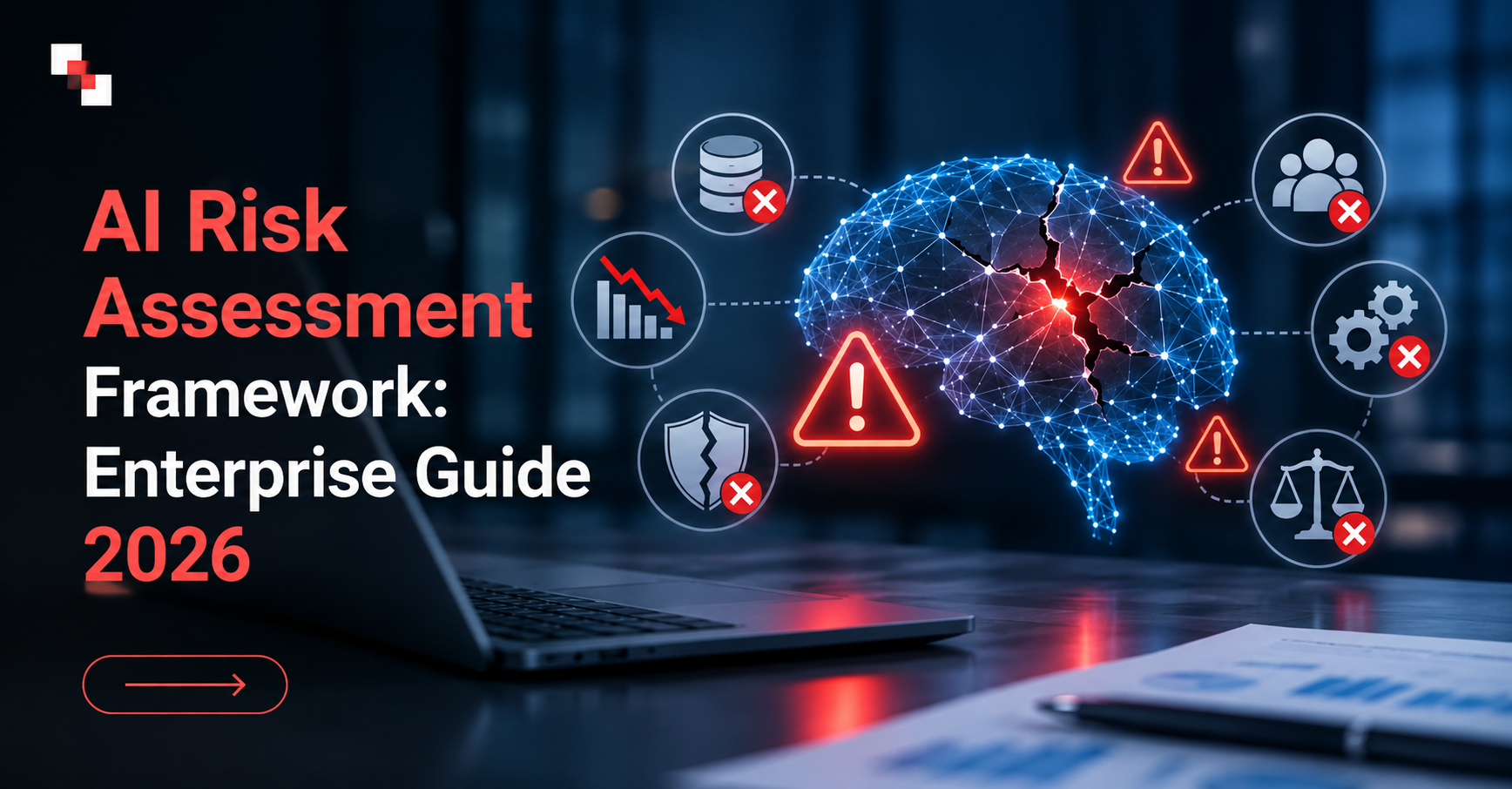
The seven-dimension model covers every risk category that matters for enterprise AI and that traditional IT risk assessments systematically miss. Score each dimension on a 1–5 likelihood scale multiplied by a 1–5 impact scale, producing a scored risk register by dimension:
-
Security Adversarial attacks (prompt injection, model inversion, data poisoning), unauthorized access to training data, API key exposure, and inference attacks. For agentic AI systems, also assess tool permission scope vulnerabilities and memory/context manipulation risks.
-
Privacy and data protection PII in training data, data residency compliance, GDPR/CCPA/DPDPA obligations, inference risk (deriving sensitive attributes from non-sensitive inputs), and data retention beyond the operational lifetime of the model.
-
Reliability and accuracy Hallucination rate and its consequences for the use case, performance degradation under distributional shift, test coverage gaps, and failure mode mapping (what does the system do when it encounters inputs outside its training distribution?).
-
Bias and fairness Performance disparities across demographic groups, proxy discrimination through correlated features, bias amplification in feedback loops (the model's outputs influence future training data), and protected characteristic coverage in evaluation datasets.
-
Compliance and regulatory EU AI Act classification and conformity obligations, sector-specific regulations (HIPAA for healthcare AI, MiFID II for financial services AI, FERPA for educational AI), explainability requirements for regulated decisions, and audit trail completeness.
-
Operational resilience System availability and SLA requirements, disaster recovery coverage, vendor lock-in and provider concentration risk, and incident response readiness for AI-specific failure modes.
-
Third-party and supply chain Foundational model provider risk (what happens to your system if the API changes pricing, terms, or is deprecated?), data supplier risk, open-source component license exposure, and the documentation depth of third-party AI components embedded in your stack.
Step 4: Build the AI risk register.
The risk register is the documentary output of Step 3 a structured artifact that records every identified risk, its likelihood and impact scores, the controls currently in place, the residual risk after controls, the owner accountable for each risk, and the review date. The risk register is what your compliance team presents to a regulator, what your enterprise buyers request in vendor due diligence, and what your board's risk committee reviews for AI risk reporting.
Format each entry with: Risk ID, Risk description, Dimension category, Likelihood (1–5), Impact (1–5), Inherent risk score (L×I), Current controls, Residual risk score after controls, Risk owner, Review date, and Status (Open/Accepted/Mitigated). Maintain this register in your existing GRC platform (ServiceNow, Archer, OneTrust) so that AI risk lives alongside operational and security risk in a single view, not in a separate AI-specific spreadsheet that gets out of sync with your enterprise risk posture.
Step 5: Define and implement controls for High and Critical residual risks.
Residual risk scores above a defined threshold (commonly 12–15 on a 25-point scale) require documented mitigation controls before deployment. Controls should map to the specific risk dimension: security risks require technical controls (input validation, output filtering, access scoping); bias risks require evaluation controls (demographic parity testing, protected characteristic coverage in test sets); compliance risks require governance controls (human-in-the-loop checkpoints, audit trail configuration, explainability tooling). Document each control's owner, implementation date, and effectiveness measure. EU AI Act Article 9 requires this documentation for high-risk systems it is the evidence base for conformity assessment.
Step 6: Establish the ongoing monitoring and review cadence.
A risk assessment conducted at deployment and never updated is not an AI risk management program it is a historical document. AI systems and their risk profiles change continuously: models drift, data distributions shift, regulatory requirements evolve, and new threat vectors emerge. Set a minimum review cadence: quarterly for High-risk systems under active regulatory scrutiny; biannual for Medium-risk production systems; annual for Low-risk and Minimal-risk systems. Review triggers that require an immediate out-of-cycle assessment include: a significant model update, a change in deployment scope or user population, a regulatory change that affects classification, an AI-related incident or near-miss, and a major change in third-party provider terms.
Tools and Platforms That Support Enterprise AI Risk Assessment
These platforms are used by enterprise risk and compliance teams for AI risk assessment, governance documentation, and ongoing monitoring in 2026.
For AI governance and risk register management:
-
OneTrust AI Governance The most complete commercial platform for EU AI Act compliance, with use-case risk classification, seven-dimension risk assessment workflows, conformity documentation generation, and audit trail management. Integrates with existing OneTrust GRC modules, so AI risk lives in the same platform as data privacy, security, and third-party risk. The fastest path to documented, audit-grade AI risk governance for organizations facing EU AI Act compliance timelines.
-
ServiceNow Integrated Risk Management For enterprises standardized on ServiceNow. AI risk register management, control documentation, and risk reporting integrated with existing operational risk and audit workflows. The natural choice when AI risk governance needs to connect to IT risk, operational risk, and compliance management in a single platform.
-
IBM OpenPages with Watson AI Enterprise GRC platform with native AI risk management module covering model inventory, risk assessment workflows, and regulatory mapping for EU AI Act and NIST AI RMF. Strong for financial services organizations with existing IBM infrastructure and MRM (Model Risk Management) requirements.
For bias and fairness assessment:
-
IBM AI Fairness 360 (AIF360) Open-source toolkit for bias detection and mitigation across classification, regression, and ranking models. Implements 70+ fairness metrics covering demographic parity, equalized odds, and calibration. The standard starting point for bias assessment in regulated AI systems.
-
Google What-If Tool / TensorFlow Model Analysis Exploratory bias and performance analysis tools that visualize model behavior across demographic subgroups without writing code. Strongest for teams building or fine-tuning their own models rather than evaluating API-based AI products.
For security assessment and adversarial testing:
-
Giskard AI-specific vulnerability testing platform. Generates adversarial test cases automatically, covering prompt injection, jailbreaks, hallucination probing, and bias injection. Produces structured vulnerability reports suitable for inclusion in EU AI Act technical documentation. Open-source core with commercial enterprise features.
-
PromptFoo Open-source LLM red-teaming and security testing tool. Runs automated adversarial attacks against your AI configuration and scores guardrail effectiveness. The fastest path to documented security testing for prompt injection and policy compliance risks.
For regulatory compliance mapping:
-
Certa / Prevalent Third-party AI risk assessment platforms that extend vendor risk management to AI-specific risk dimensions: model documentation requirements, EU AI Act supplier obligations, and contractual risk allocation in AI vendor agreements.
-
NIST AI RMF Playbook (public) The NIST-published set of suggested actions for each of the four AI RMF core functions. Free resource that maps directly to the Step 3 framework above. Use as the baseline for building your risk dimension assessment criteria before customizing for your sector and use case.
What Goes Wrong: The 5 Most Expensive AI Risk Assessment Failures
1. Using a generic IT risk template for AI-specific risk.
A traditional IT risk assessment asks about unauthorized access, system availability, and data backup. It does not ask about hallucination rate, demographic performance parity, prompt injection resistance, or model drift. ISACA documented multiple cases in 2025 where AI incidents caused real organizational harm precisely because the risk assessment didn't cover the AI-specific failure modes that actually produced the incident (Risk Publishing, 2026). Build your AI risk register against the seven dimensions above, not against your existing IT risk template.
2. Treating the EU AI Act four-tier classification as optional.
Every AI system deployed in or affecting EU markets must be classified under the EU AI Act's four-tier pyramid including systems operated by non-EU companies serving EU customers. The extraterritorial scope is explicit and enforcement-active: the Act applied to high-risk systems from August 2, 2026. Organizations that haven't classified their AI systems have no documented basis for the controls they do or don't have in place, and no defense against regulatory inquiry. Classification is not the end of the risk assessment it is the prerequisite that determines how much of the rest of the framework is legally mandatory.
3. Conducting a one-time assessment and treating it as permanent.
AI risk is not static. Models drift. Data distributions change. Regulatory requirements evolve. New attack vectors emerge. A risk assessment that was accurate at deployment will not reflect the system's actual risk profile 12 months later, unless it has been actively maintained. Organizations that conduct a deployment-phase assessment and file it as evidence of ongoing risk management are creating a compliance liability: when the regulatory inquiry or the incident arrives, the assessment document and the system's current state will not match. Build the quarterly and biannual review cadence from Step 6 into your AI governance calendar before the first deployment, not as a remediation after the first incident.
4. Documenting controls that exist on paper but not in production.
87% of organizations claim they have clear AI governance frameworks; fewer than 25% have fully implemented the controls needed to manage bias, transparency, and security risks (IBM, 2026). That gap between policy and implementation is precisely what regulators are trained to find. If your risk register says "input validation controls are in place," the production deployment must actually have those controls configured and verified. If it says "human-in-the-loop review required for high-risk decisions," there must be a documented, trained, auditable review process not a theoretical option. Test every documented control against the production system before filing the risk assessment as complete.
5. Treating third-party AI risk as out of scope.
An organization's AI risk profile includes every model provider, data supplier, and open-source component embedded in its AI stack not just the application layer the organization built itself. If your production AI system depends on a third-party foundation model API, your risk assessment must document: what happens to your system if that API changes pricing, terms, or is deprecated; what data the API provider processes on your behalf and under what contractual data protection obligations; and what security certification the provider maintains for the infrastructure your prompts and user data traverse. Third-party AI risk is the fastest-growing risk category in enterprise AI deployments (Green Leaf Consulting, 2026) and the most commonly excluded from risk assessments that focused only on the application tier.
FAQ
What is an AI risk assessment?
An AI risk assessment is a systematic evaluation of the potential harms, biases, failures, and compliance exposures associated with an AI system conducted before deployment and maintained continuously throughout the system's operational life. It is legally mandated for high-risk AI systems under EU AI Act Article 9 and required by NIST AI RMF for organizations adopting the US voluntary framework. A complete AI risk assessment produces a scored risk register across seven dimensions (security, privacy, reliability, bias, compliance, operational resilience, and third-party dependencies) with documented controls and a monitoring plan that demonstrates ongoing risk management, not just a point-in-time snapshot.
What risks should an enterprise AI system be assessed for?
An enterprise AI system should be assessed across seven risk dimensions: security (adversarial attacks, prompt injection, data poisoning, API exposure); privacy and data protection (PII in training data, data residency, GDPR/CCPA compliance, inference risk); reliability and accuracy (hallucination rate, distributional shift, test coverage gaps); bias and fairness (demographic performance disparities, proxy discrimination, feedback loop amplification); compliance and regulatory (EU AI Act classification, sector-specific regulations, explainability requirements); operational resilience (availability, disaster recovery, vendor lock-in, incident response); and third-party and supply chain risk (foundation model provider dependencies, data supplier risk, open-source license exposure).
How often should AI risk assessments be performed?
AI risk assessments should be reviewed on a minimum cadence of quarterly for High-risk systems under active regulatory scrutiny, biannually for Medium-risk production systems, and annually for Low-risk and Minimal-risk systems. Out-of-cycle reviews are required immediately when any of the following occur: a significant model update or change in training data; a change in deployment scope, user population, or use case; a regulatory change affecting the system's classification or obligations; an AI-related incident or near-miss; or a major change in third-party provider terms, pricing, or service availability. A static risk assessment is a historical document, not an ongoing risk management program.
Conclusion: The AI Risk Assessment Is the Foundation Every Other Governance Investment Depends On
Every other element of enterprise AI governance human-in-the-loop controls, observability, model monitoring, prompt management, bias testing is an implementation of what the risk assessment identifies as necessary. You cannot design the right controls without knowing the risk profile. You cannot set the right monitoring thresholds without knowing the failure modes. You cannot satisfy an EU AI Act conformity requirement or an enterprise procurement audit without the documented evidence that the assessment produces.
The organizations building AI risk assessment capability now not after the first regulatory inquiry or the first AI-related incident forces the issue are the ones that will capture the competitive advantage documented governance provides: procurement access to the 78% of enterprise buyers who require risk documentation, faster deployment through proactive risk identification, and regulatory confidence that turns the EU AI Act's enforcement deadline from a threat into a differentiator.
Your immediate action: classify every AI system currently in production or in active development against the EU AI Act's four-tier framework this quarter. Identify every system that falls in the High-risk tier. For each one, determine whether a documented risk assessment exists that covers the seven dimensions above, and whether it has been reviewed in the last 90 days. Those three questions will map your current AI risk governance gap and give your CISO, Chief Risk Officer, and legal team the information they need to prioritize the gaps that carry the highest regulatory and commercial exposure.
Related reading: For the governance architecture that the risk assessment feeds into, see our guides on Enterprise AI Governance Checklist for 2026 and AI Model Monitoring and Drift Detection Strategies to build the ongoing monitoring capability your risk management program requires.