

Published by AgamiSoft | Reading time: ~14 minutes
|
Featured Snippet / AEO Answer : An AI proof of concept tests whether an AI solution can solve a defined business problem before an organization commits to full production development validating technical feasibility, data readiness, performance against measurable KPIs, security posture, and user acceptance within a narrow, time-boxed scope. A successful AI POC has a specific problem statement, representative data, defined success metrics, and explicit production readiness criteria that make the go/no-go decision objective rather than a judgment call under organizational momentum pressure.
|
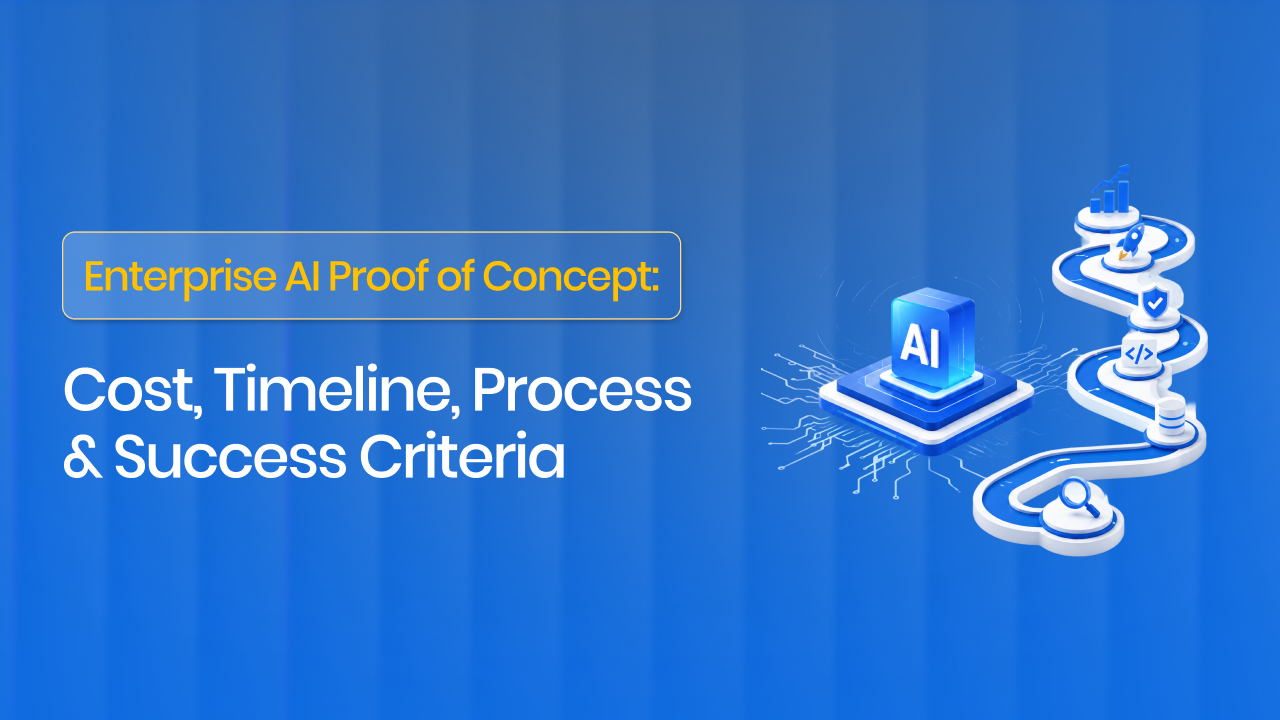
Enterprise AI Proof of Concept: Cost, Timeline, Process, and Success Criteria Guide for 2026
|
Quick Answer / TL;DR : An AI proof of concept (POC) is a time-boxed, narrowly-scoped technical experiment that validates whether a proposed AI solution is technically feasible, delivers meaningful business value on real data, and is production-ready in principle before the organization commits the full engineering investment required to build, deploy, and operate a production AI system. A strong AI POC validates technical feasibility, business value, data readiness, performance, security, and user acceptance before production investment. The organizations consistently getting AI POCs right in 2026 are not those running the most experiments they are those who define success criteria before building anything, and who stop POCs that don't meet those criteria rather than escalating to production under organizational momentum. |
Why Most Enterprise AI POCs Fail to Produce Useful Go/No-Go Decisions
Enterprise AI POCs fail in a specific, recurring pattern: the scope is too broad, the success criteria are undefined at the start, the data used is cleaner than production data, and the organization has invested enough organizational momentum by the end that "proceeding to production" is the path of least resistance regardless of what the POC actually demonstrated.
The result is AI systems that enter production with unvalidated assumptions about data quality, performance at scale, and user adoption discovering those gaps after production investment rather than during the POC, where they could have been addressed or used to make an evidence-based no-go decision.
Three failure patterns are most common:
Failure Pattern 1 The showcase POC. Built to demonstrate AI capability to leadership rather than to answer a specific feasibility question. Uses handpicked data, carefully selected example inputs, and a constrained scope that doesn't represent the production problem. Produces an impressive demo that doesn't test what production would test.
Failure Pattern 2 The unconstrained POC. Starts with a broad problem ("improve our customer service with AI"), never narrows to a specific, testable hypothesis, generates interesting findings without clear success criteria, and runs indefinitely without a defined timeline or decision gate. Resources accumulate without producing an actionable go/no-go outcome.
Failure Pattern 3 The wishful POC. Defines success criteria after seeing early results adjusting what "success" means to fit what the POC is producing rather than measuring the POC against pre-defined requirements. The success criteria drift to match the POC output, ensuring the POC "succeeds" regardless of what it actually demonstrated.
A correctly designed AI proof of concept avoids all three patterns by defining the specific question it is answering, the data it will test on, and the success criteria it will be measured against before a single line of code is written.
What Is an AI Proof of Concept, Exactly and How Does It Differ From an MVP?
An AI proof of concept (POC) is a controlled technical experiment that answers a specific feasibility question about a proposed AI application typically: "Can this AI approach solve this problem at this performance level, using this organization's actual data, within constraints relevant to production deployment?"
An AI MVP (Minimum Viable Product) is the smallest deployable AI system that delivers value to real users and generates the feedback required to guide further development a production deployment, intentionally limited in scope, but built to production quality standards with real users generating real feedback.
The distinction is significant:
A POC tests feasibility. It runs on representative data but not necessarily all production data. It is built by the development team, not exposed to end users at scale. It is measured against technical and performance thresholds, not against user behavior or business outcome metrics. It is explicitly temporary either it produces evidence that supports production investment, or it produces evidence that modifies or stops the approach.
An MVP tests market fit and product direction. It is deployed to real users. It generates real usage data. It is built to production quality (security, reliability, scalability in principle) even at minimum scope. It is not temporary it is the first version of a product that will continue to evolve.
The sequence: POC → production investment decision → production build → MVP → iteration. A POC that proceeds directly to "MVP" without a production investment decision is a POC that never produced its primary output the evidence for or against the production investment.
An AI feasibility study is a lighter-weight precursor to a POC typically a desk research and architecture review exercise that assesses whether a proposed AI approach is technically viable in principle, what data and infrastructure requirements it would have, and whether the expected performance is achievable without building anything. It produces a recommendation for whether a POC is warranted and what the POC should test.
What an Enterprise AI POC Should Cover: The Six Validation Dimensions
A strong AI POC validates six specific dimensions not just "does the AI produce reasonable output?":
Dimension 1 Technical feasibility
Does the proposed AI approach solve the defined problem at the required performance level on representative data? This is the core question of the POC and the answer must come from actual experimentation, not from benchmark comparisons or vendor claims.
Dimension 2 Data readiness
Is the organization's actual data in its current state, with its current quality characteristics sufficient to train, evaluate, and operate the AI system? The most common POC-to-production gap is that POC data was pre-cleaned and curated, while production data has quality issues the POC never encountered.
Dimension 3 Business value
Does the AI's performance on the POC task translate to measurable business value at the projected production scale? A classification model that is 85% accurate is only valuable if 85% accuracy on that specific task translates to meaningful cost reduction, revenue improvement, or operational benefit a connection that must be explicitly modeled, not assumed.
Dimension 4 Performance and scalability
Does the AI system perform within acceptable latency, throughput, and cost parameters when processing representative request volumes? Performance that works at POC scale (10 requests during a demo) may fail at production scale (10,000 requests per hour).
Dimension 5 Security and compliance
Does the proposed AI implementation handle data appropriately, satisfy the organization's security requirements, and operate within the regulatory constraints applicable to the specific use case? An AI POC that works technically but would require 12 months of security and compliance remediation before production deployment has not reduced production risk.
Dimension 6 User acceptance
Do the intended users of the AI system find it useful, trustworthy, and integrated into their workflow in the way the production implementation will require? A POC that works technically but requires users to change their workflow dramatically, provides outputs users don't trust, or generates results users routinely override has found a problem that production investment won't solve.
AI POC Cost, Timeline, and Resource Planning
AI POC Cost Ranges by Type
|
POC Type |
Timeline |
Typical Cost Range |
Primary Cost Driver |
|
Feasibility study (no build) |
2–4 weeks |
15,000–50,000 |
Architecture and research time |
|
Simple POC (1 AI capability, existing APIs) |
4–8 weeks |
30,000–80,000 |
Engineering + evaluation |
|
Medium POC (custom model, real data integration) |
6–12 weeks |
60,000–200,000 |
Data engineering + model development |
|
Complex POC (agentic system, multiple integrations) |
8–16 weeks |
100,000–400,000 |
Multi-disciplinary engineering team |
|
Enterprise POC (regulated industry, security review) |
10–20 weeks |
150,000–600,000 |
Compliance + security overhead |
Sources: Gartner AI Project Cost Survey 2025; West Monroe AI Development Practice Data 2025; McKinsey Enterprise AI Implementation Cost Analysis 2025.
What Drives POC Cost
Data preparation is typically the largest cost component. Organizations consistently underestimate how much effort is required to get real production data into a state where a POC can actually use it cleaning, labeling, formatting, privacy-scrubbing, and integrating data from multiple source systems. Data preparation typically represents 30–50% of total POC cost for medium and complex POC types.
Integration work is the second-largest driver. A POC that connects to real source systems (the actual CRM, the actual document management system, the actual data warehouse) costs significantly more than a POC that uses static sample files but produces significantly more reliable feasibility evidence. The POC that uses sample files instead of live integrations is testing a simplified version of the problem.
Evaluation infrastructure is frequently underbudgeted. Building the evaluation framework the dataset, metrics, baseline comparisons, and measurement infrastructure that produces the POC's success criteria measurement is an engineering effort in itself. POCs that skip evaluation infrastructure produce impressions rather than evidence.
AI POC Timeline: How Long Is Long Enough?
The correct POC timeline is as short as necessary to answer the specific feasibility question being tested not as short as possible to minimize investment, and not as long as it takes to build something impressive.
For most enterprise AI POC types:
-
4–6 weeks is sufficient for POCs testing a single, well-defined AI capability using existing APIs and representative but pre-prepared data
-
8–12 weeks is appropriate for POCs requiring data engineering, custom model development, or integration with live enterprise systems
-
12–20 weeks is warranted for POCs in regulated industries, POCs with complex multi-system integrations, or POCs testing genuinely novel AI approaches without precedent
POCs that extend beyond 20 weeks without an explicit decision gate are typically no longer POCs they are unmanned production builds without production quality standards.
How to Run an AI Proof of Concept: A 6-Step Process
Step 1: Define the Specific Problem Statement and Hypothesis Before Any Technical Work
A POC begins with a problem statement so specific that it determines exactly what the POC will test:
Weak problem statement: "Use AI to improve our document processing."
Strong problem statement: "Determine whether a large language model can extract the five required data fields (policy number, coverage type, claim amount, incident date, claimant name) from our insurance claim documents with 92%+ precision at a processing speed of under 3 seconds per document, using the last 12 months of our actual claim document archive as the test dataset."
The strong version specifies the AI approach (LLM), the task (field extraction), the performance target (92%+ precision, <3 seconds), the data (actual archive), and the scope (five specific fields). Every one of these specifications determines what the POC will test and what it will produce as evidence.
Write the problem statement before scoping the POC, and validate it with the business stakeholder who will make the production investment decision. If the business stakeholder can't confirm that achieving the stated performance target would justify production investment, the problem statement needs revision before work begins.
Step 2: Define Success Criteria and Go/No-Go Thresholds Before Building Anything
Success criteria defined after the POC are not success criteria they are rationalization of results. Define before building:
-
Must-meet thresholds (hard go/no-go gates): the minimum performance levels required to justify production investment below these, the POC result is a no-go regardless of other positive findings
-
Should-meet targets (production readiness indicators): performance levels that indicate the approach will succeed in production with expected engineering investment below these but above must-meet, a conditional go is appropriate with defined remediation requirements
-
Stretch targets (production optimization indicators): performance levels that indicate the approach will exceed production requirements context for investment prioritization if multiple approaches are tested
Document these thresholds before the first line of code is written, and circulate them to all POC stakeholders. The purpose is to make the go/no-go decision a threshold comparison rather than a judgment call and to prevent the success criteria from drifting to match what the POC produces.
Step 3: Assemble Representative Data Before Technical Development Begins
The single most impactful investment in a well-run AI POC is in data quality and it should precede, not run alongside, model development:
-
Use production-representative data, not curated samples: the POC data should reflect the range, quality variability, and format diversity of actual production data. A POC on hand-selected clean examples tests a different problem than a POC on real production data.
-
Size the dataset appropriately for the evaluation: a few hundred examples are sufficient to evaluate a classification model's accuracy; several thousand examples are needed to characterize performance across rare but important edge cases. Size the evaluation dataset to answer your specific question, not to maximize the scale of the POC.
-
Privacy-scrub before using personal data in a POC: POC environments typically have lower security standards than production personal data used in a POC should be anonymized or pseudonymized rather than using live production personal data in a non-production environment without the access controls that production applies.
Step 4: Build the POC to Test the Hypothesis, Not to Impress Stakeholders
POC scope should be the minimum necessary to test the defined hypothesis every feature, integration, and polish element that doesn't contribute to answering the success criteria question should be deferred to production:
-
Test the AI approach, not the application: a POC for an AI document extraction system should build and test the extraction model against the evaluation dataset not the full application UI, the user notification system, the reporting dashboard, or the audit trail. Those production components are not what the POC is testing.
-
Use the simplest integration that tests the real data flow: connect to real data sources through the minimum necessary integration but do connect to real data sources. A POC that reads from a static file instead of the live source system is testing a different problem than what production will face.
-
Build the evaluation framework before building the AI feature: the measurement infrastructure the labeled evaluation dataset, the metrics calculation, the baseline comparison should be built before or simultaneously with the AI model, not after results are seen. Evaluation frameworks built after results are visible are vulnerable to unconscious selection bias in what gets measured.
Step 5: Measure Against Success Criteria and Produce an Evidence-Based Go/No-Go Decision
At POC conclusion, produce a structured assessment against the pre-defined success criteria:
-
Report actual performance against each threshold: measured on the agreed evaluation dataset, using the agreed metrics, with the agreed methodology. "The model achieved 94% precision and 2.1 second average processing time, above the 92% precision and 3 second thresholds."
-
Identify gaps and their production remediation path: for performance measures below the should-meet targets but above must-meet, specify what production engineering investment is expected to close the gap and whether that investment is within the acceptable production budget.
-
Produce an explicit recommendation: go / conditional go (with defined conditions) / no-go. A POC that produces "findings" and "considerations" without an explicit recommendation has not produced its primary output.
-
Document the production investment estimate that the POC validates: a go recommendation should include an updated production cost estimate that reflects what the POC learned about scope, data requirements, and engineering complexity not the pre-POC estimate that was necessarily based on lower confidence.
Step 6: Apply Production Readiness Gates Before Escalating From POC to Production Build
Between a go POC outcome and beginning production development, validate three additional production readiness conditions that the POC environment may not have fully tested:
-
Security review of the POC architecture: assess the AI system's security posture against production standards the POC may have operated without the access controls, encryption, audit logging, and compliance requirements that production would require
-
Infrastructure scalability assessment: validate that the architecture tested in the POC scales to production request volume specifically that the latency and throughput measured at POC scale (single-user testing) will hold at production scale (concurrent users at peak load)
-
Integration completeness review: identify any production integrations that the POC tested in simplified form (static file rather than live API, sample database rather than production database) and assess the effort required to complete them to production standard
The AI POC Success Criteria Checklist
Before a POC moves to production, it should have answered yes to each of the following:
Technical:
-
☐ The AI approach achieves the defined performance threshold on the agreed evaluation dataset
-
☐ The performance holds across the full range of data variability in the evaluation set, not just on typical examples
-
☐ The system performs within acceptable latency and cost parameters at estimated production request volume
Data:
-
☐ The POC was evaluated on data representative of real production quality and variability, not on pre-cleaned or curated samples
-
☐ The data pipeline tested is connected to real source systems (or the gap to production data source is explicitly documented with remediation plan)
Business:
-
☐ The measured performance level translates to the business value that justified the POC investment
-
☐ The go decision has been confirmed by the business stakeholder who will own the production investment
Security and compliance:
-
☐ The AI approach has been assessed against the security and regulatory requirements that production deployment must satisfy
-
☐ No compliance issues identified in the POC would require production remediation estimated above the production budget
User:
-
☐ Representative end users have evaluated POC outputs and confirmed they meet the quality bar required for adoption
-
☐ The integration into user workflows has been tested at sufficient depth to validate adoption assumptions
Frequently Asked Questions
What Is the Difference Between an AI POC and an MVP?
An AI POC tests whether an AI approach is technically feasible and produces the defined business value it is a controlled experiment with a specific hypothesis and defined success criteria, not intended for real user deployment at scale. An AI MVP is the smallest deployable AI system that delivers value to real users and generates the product feedback needed to guide further development it is a production deployment, built to production quality standards, exposed to real users generating real usage data. The sequence is POC first (feasibility validation), then production investment decision, then production build, then MVP (minimum production scope), then iteration. A POC that skips directly to "MVP" has skipped the investment decision gate that the POC exists to produce.
How Long Should an AI POC Take?
An AI POC should take the minimum time necessary to answer its specific feasibility question typically 4–8 weeks for simple single-capability POCs using existing AI APIs and pre-prepared data, and 8–16 weeks for medium and complex POCs requiring data engineering, custom model development, or integration with live enterprise systems. POCs that extend beyond 20 weeks without a defined decision gate are typically no longer POCs they are unmanned production builds without production quality standards. The timeline should be defined before the POC starts and enforced through a hard decision gate at the end: a go, conditional go, or no-go outcome on the defined timeline, not an extension to continue building.
How Much Does an AI POC Cost?
AI POC cost ranges from 15,000–50,000 for a feasibility study without a technical build, to 30,000–80,000 for a simple single-capability POC using existing APIs, to 60,000–200,000 for a medium POC requiring data engineering and real system integration, to 100,000–400,000+ for complex agentic or multi-system POCs. Data preparation is typically the largest cost component representing 30–50% of total POC cost followed by integration engineering and evaluation framework development. POC costs are most commonly underestimated when data preparation is scoped as "we'll use our existing data" without accounting for the cleaning, labeling, and integration engineering required to make that data usable in a POC environment.
Define Success Criteria Before Writing Code. Test on Real Data, Not Curated Samples. Make an Explicit Go/No-Go Decision Before the POC Ends.
An AI proof of concept delivers its primary value evidence for or against a production AI investment when success criteria are defined before building begins, when evaluation uses data representative of actual production quality, and when the POC concludes with an explicit go/no-go recommendation measured against pre-defined thresholds rather than a set of findings that organizational momentum decides for itself.
The CEOs, CTOs, and innovation leaders running the most effective AI POCs in 2026 share one discipline: they treat the POC's go/no-go recommendation as a primary deliverable with the same weight as the technical work, and they enforce the timeline and decision gate even when organizational pressure favors extending the POC to continue building. That discipline produces AI investments that proceed to production on validated evidence and no-go decisions that save production investment on approaches that wouldn't have survived the contact with real data.
Write your AI POC problem statement this week specific enough to determine exactly what the POC will test and what measured performance would justify production investment. Define your must-meet, should-meet, and stretch thresholds before scoping the technical work. Assemble your evaluation dataset from real production data before model development begins.
To run an AI proof of concept that produces an evidence-based production investment decision across all six validation dimensions, explore our AI Readiness Assessment and AI Transformation Roadmap for Mid-Market Companies guides structured for CEOs, CTOs, and innovation leaders who need AI POCs that answer the production investment question with evidence, not organizational momentum.