

Published by AgamiSoft | Reading time: ~14 minutes
|
Featured Snippet / AEO Answer: Enterprise AI TCO is the complete cost of designing, deploying, operating, securing, and maintaining an AI system across its full operational lifetime. In a modeled year-one rollout for a regulated organization, the platform, model, and cloud costs represent only 16% of total TCO the remaining 84% is data engineering, integration, security architecture, compliance, governance, testing, training, monitoring, and vendor management (GS Consulting, 2026).
|
Enterprise AI TCO: The Costs Your Budget Forgot Before the API Bill Arrived
|
Quick Answer / TL;DR: .85% of organizations misestimate AI project costs by more than 10% (Xenoss, 2026). The most consistent cause: budgets built around API and model licensing as if those are the total cost, when they represent the smallest fraction of year-one spend. The useful measure is not cost per token it is the price of performing a reliable business activity at the required level of accuracy, security, and speed inside your specific enterprise environment (PC Tech Magazine, 2026). That price is significantly higher than any vendor quote, and calculating it honestly before you commit is the only way to build an AI budget that doesn't surprise your CFO in month five.
|
Why Enterprise AI TCO Has Become a CFO-Level Problem in 2026
Gartner projects global AI spending to reach $2.52 trillion in 2026, a 44% annual increase driven primarily by infrastructure not model access (Cohere TCO analysis, 2026). Enterprises are projecting $124 million in average annual AI spend, with 92% planning budget increases over the next three years (KPMG Q4 2025 AI Pulse Survey). Total enterprise AI spending has grown 483% in two years while per-token model prices dropped 214x in 40 months (Axis Intelligence LLMflation Index, 2026).
Both data points can be true simultaneously, and understanding why is the central financial literacy issue in enterprise AI. Per-unit AI costs are deflationary. Total AI spend is hyperinflationary. The reason: cheaper tokens enabled more deployments; more deployments created infrastructure, integration, governance, and maintenance costs that scale with the number of deployed systems, not with the per-token price. Your AI vendor cuts their API price by 50% and your AI budget grows anyway because the API is not where the money goes.
The CFO pressure compounds this. 56% of CEOs report zero measurable ROI despite active AI deployment (PwC, January 2026). Only 25% of enterprise AI deployments deliver expected ROI (IBM, 2025). The pattern across failed ROI cases is consistent: organizations budgeted for the visible costs and discovered the invisible ones mid-implementation, at which point the project was either underfunded, overspent, or both.
98% of FinOps teams are now managing AI spend as a distinct cost category the fastest-growing new line in the State of FinOps 2026 report (GS Consulting, 2026). That shift from "AI is an IT line item" to "AI has its own FinOps practice" reflects the scale of the hidden cost discovery that occurred across the enterprise market in 2024 and 2025. Your FinOps team has already encountered the problem. This article gives your CFO the framework to model it before the next implementation, not after.
What Enterprise AI TCO Actually Covers
Enterprise AI TCO Total Cost of Ownership is the complete financial model for designing, building, deploying, operating, securing, maintaining, and eventually decommissioning an AI system across its operational lifetime. It is the answer to the question your procurement team should be asking: not "what does the AI tool cost" but "what does it cost to use this tool safely, at scale, inside this organization's operating environment" (GS Consulting, 2026).
It differs from the API price, the model license, and the infrastructure line item in a specific and consequential way: those are the visible costs. Enterprise AI TCO encompasses the full cost including the categories that never appear on a vendor quote.
A typical production AI request sending a user query to a model and returning a useful result passes through authentication, access controls, prompt processing, document retrieval, model inference, output validation, logging, and potentially human approval. Where the system takes action, it also connects to a CRM, ERP, payment platform, document repository, or internal database. Each of those steps carries a cost. None of them are in the API price (PC Tech Magazine, 2026).
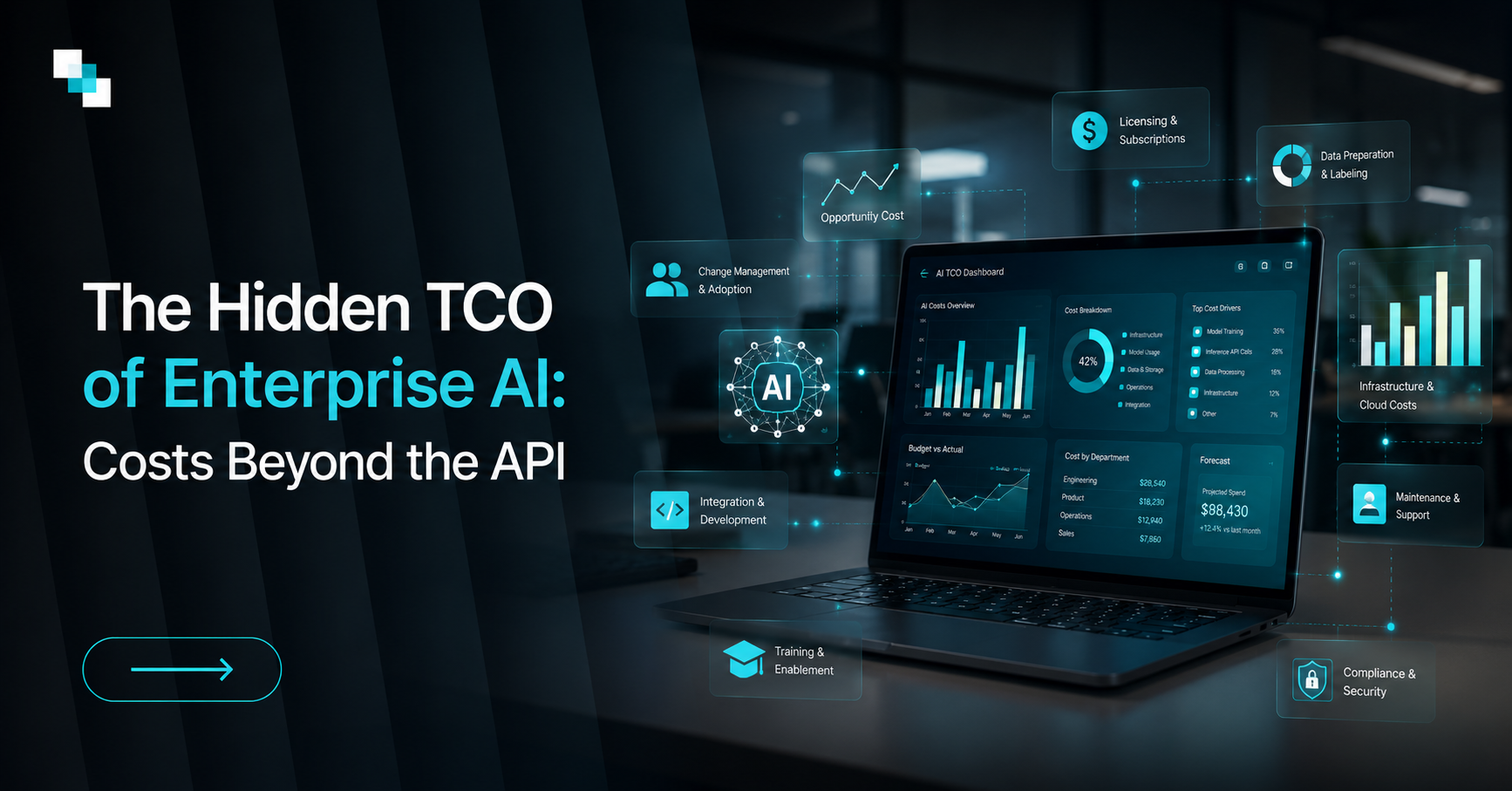
The eight cost categories that comprise the full enterprise AI TCO picture:
-
Model and API costs Per-token inference pricing, model licensing fees, fine-tuning costs, embedding generation
-
Infrastructure GPU compute (cloud rental or on-premises capital), storage, networking, serving runtime, vector databases
-
Data engineering Data quality remediation, pipeline construction, feature engineering, ongoing data maintenance as source systems evolve
-
Integration Connecting AI systems to existing enterprise applications (ERP, CRM, ITSM, document management), API development, and ongoing integration maintenance as enterprise systems update
-
Security architecture Access controls, prompt injection defenses, audit logging, data encryption, SIEM integration, penetration testing, incident response for AI-specific threat vectors
-
Governance and compliance EU AI Act conformity assessments, sector-specific regulatory compliance (HIPAA, MiFID II), bias testing, explainability tooling, audit trail management, and legal review
-
Monitoring and operations Observability infrastructure, drift detection, quality monitoring, automated alerting, on-call support, and retraining when model performance degrades
-
Human oversight and change management Training programs, HITL review workflows, help desk expansion for AI-related tickets, and the change management investment required for genuine adoption
The GS Consulting model is the most specific quantification of how these categories distribute: in a modeled year-one rollout for a regulated organization, the platform, model, and cloud line represented 16% of total year-one TCO (GS Consulting, 2026). The remaining 84% was the work required to make the AI usable in production the seven non-model categories above.
That 16% finding is not universal organizations with mature data infrastructure and existing MLOps pipelines will see a higher percentage of spend going to model costs. But the directional principle holds across most enterprise environments: the API is the smallest cost category, not the largest, and budgets built on API quotes will miss the majority of what the implementation will actually cost.
The Numbers: Where Enterprise AI Money Actually Goes
These figures come from primary research published in 2025 and 2026, covering cost breakdowns from real enterprise implementations.
On the scale of budget misestimation:
-
85% of organizations misestimate AI project costs by more than 10%; nearly a quarter are off by 50% or more (Mavvrik & BenchmarkIT, cited in Xenoss, 2026)
-
The average enterprise AI cost is 2.8x higher than the engineering team's original forecast, across 84 anonymized production AWS Bedrock deployments analyzed Q4 2025–Q1 2026 (Opslyft benchmark, Q1 2026)
-
79% of enterprises experienced AI cost overruns in the past 12 months (DoiT/Sapio Research, 2026)
On the hidden cost categories:
-
Data engineering and quality remediation is identified as the primary cost driver that organizations consistently underestimate 56% of companies cite data quality as a major barrier, and the remediation required before AI systems can function reliably is almost never in the initial budget (Process Excellence Network, 2025)
-
Shadow AI generates costs on two fronts: duplicate licensing spend plus enterprise license underutilization. 68% of employees access GenAI through personal accounts rather than company platforms; 57% have entered confidential information into public AI tools (TELUS Digital Experience survey, 2025)
-
Integration and maintenance represent 15–25% of annual AI system cost in production, typically larger than initial build cost over a 3-year horizon (Keyhole Software enterprise delivery analysis, 2026)
-
Governance and compliance: EU AI Act conformity assessments for high-risk systems cost €15,000–€50,000 per system for SMBs; for a $10 billion revenue enterprise, a prohibited AI practice under the EU AI Act carries a maximum fine of $700 million (7% of global turnover) (Witness.AI, 2026)
On infrastructure cost differences by deployment model:
-
Amortized cost per million tokens: owned H100 hardware: 0.11–0.12; equivalent cloud rented instance: $0.89; comparable frontier API: $2.00 (Lenovo TCO analysis, 2026; Cohere analysis, 2026)
-
On-premises breaks even against cloud at under four months for high-utilization workloads; up to 17x cost advantage per million tokens versus Model-as-a-Service APIs over a five-year lifecycle at sustained high utilization (Lenovo Press, 2026)
-
Cloud H100 rental: 0.58–8.54/hour (5,000–75,000/year for continuous use) rivaling the 25,000–30,000 purchase price before accounting for power, cooling, and maintenance (Xenoss, 2026)
The economic implication of these numbers: A budget that accounts only for API costs will underestimate year-one enterprise AI TCO by approximately 5x in a regulated environment. A budget that accounts for API plus infrastructure but excludes data engineering, integration, compliance, and ongoing operations will underestimate by 2–3x. The complete TCO model is the only budget that will not require mid-implementation emergency funding.
How to Calculate Enterprise AI TCO: An 8-Category Framework
Use this framework to build a complete, defensible TCO model before committing to any enterprise AI implementation. The categories map to the eight cost domains above; each one has a calculation methodology and a common underestimate trap.
1. Model and API costs. Calculate: monthly token volume (input and output separately, at their respective per-token rates) × 12 months, plus any fine-tuning costs (typically 5,000–50,000 for an initial domain-specific fine-tune), embedding generation for RAG workloads, and any model licensing fees. Common underestimate trap: pricing with a 1:1 input-to-output token ratio when output tokens are 4–5x more expensive. For agentic AI, apply the 5–30x token multiplier per task completion versus a chatbot interaction (Gartner, 2026).
2. Infrastructure costs. Calculate: GPU compute (cloud rental rate × expected utilization hours, or on-premises hardware cost + power + cooling + networking over 3–5 year depreciation period), storage for model artifacts and vector databases, and serving runtime infrastructure. Common underestimate trap: modeling GPU cost without networking InfiniBand for multi-node clusters adds 90,000–500,000 to multi-GPU deployments (Haink, 2026).
3. Data engineering costs. Calculate: engineering hours required for data quality audit, pipeline construction, data cleaning and normalization, feature engineering, and ongoing maintenance as source systems evolve. Common underestimate trap: treating data "readiness" as binary. Most enterprise data requires significant remediation before AI can use it reliably budget 2–4 months of data engineering before any model sees production data.
4. Integration costs. Calculate: engineering hours for connecting the AI system to each enterprise application it must access (CRM, ERP, ITSM, document management), API development, authentication setup, and ongoing integration maintenance as enterprise applications update. Common underestimate trap: budgeting integration once and not budgeting for ongoing maintenance. Enterprise application updates break integrations; budget 20–30% of initial integration cost annually for maintenance.
5. Security architecture costs. Calculate: security engineering hours for access control design, prompt injection defenses, audit log infrastructure, encryption configuration, and penetration testing. Common underestimate trap: assuming that existing IT security infrastructure covers AI-specific threat vectors. Prompt injection, model inversion, and data memorization exploits require specific controls not included in standard security architectures.
6. Governance and compliance costs. Calculate: legal review hours (EU AI Act classification, sector regulation mapping), conformity assessment fees (15,000–50,000 per high-risk system), bias testing, explainability tooling licensing, audit trail management, and ongoing compliance monitoring. Common underestimate trap: treating compliance as a one-time assessment. AI governance is ongoing models drift, regulations update, and new use cases require re-assessment.
7. Monitoring and operations costs. Calculate: observability platform licensing (Datadog, Langfuse, Arize AI), engineering hours for alert configuration and incident response, and the cost of quality degradation before monitoring catches it (including any human review loop for high-stakes AI outputs). Common underestimate trap: deploying without monitoring because "we'll add it later." Production AI systems without monitoring degrade silently the cost of discovered degradation always exceeds the cost of monitoring that would have caught it.
8. Human oversight, training, and change management. Calculate: training program development and delivery costs, help desk capacity for AI-related user tickets, HITL review workflow staffing, and change management consulting if the organization lacks internal capability. Common underestimate trap: assuming adoption is free. The technology deployment and the organizational adoption are different events, and the latter costs more than the former in most enterprise AI implementations.
Tools for Enterprise AI TCO Management and FinOps Governance
For infrastructure cost modeling:
-
SLYD TCO Calculator Public, configurable calculator for GPU infrastructure TCO comparison across cloud, hybrid, and on-premises deployments. Input your utilization, power, and depreciation assumptions to compare cloud versus owned inference cost per million tokens.
-
Lenovo TCO Whitepaper (2026 Edition) The most rigorous published comparison of on-premises versus cloud AI inference TCO using the Token Economics framework. Reference for CFO-level infrastructure decision-making.
For ongoing inference cost monitoring:
-
Opslyft AI FinOps platform with per-deployment cost allocation and hidden cost detection across AWS Bedrock and Azure AI deployments. Identifies the non-inference charges (guardrails, knowledge base queries, agent overhead) that account for 18–34% of total AI platform bills.
-
Datadog LLM Observability Per-request cost attribution integrated with existing infrastructure monitoring. Enables weekly cost-per-request reporting by endpoint that FinOps teams need to govern AI spend at the workload level.
For governance and compliance cost management:
-
OneTrust AI Governance Risk classification, EU AI Act conformity documentation, and audit trail management. Reduces legal and compliance engineering hours by centralizing documentation workflows and regulatory mapping.
For Shadow AI cost recovery:
-
Torii / Zylo SaaS spend management platforms that identify unauthorized AI tool usage and quantify the duplicate licensing and security exposure from employee AI tool purchases. Zylo documents that enterprises average 696 SaaS applications and $246 million in annual spend, with IT overseeing only 15% Shadow AI is a subset of this broader visibility gap.
What Goes Wrong: The 5 Most Expensive AI TCO Failures
1. Treating the vendor quote as the budget.
A vendor quote covers model access and possibly platform licensing. It does not cover data engineering, integration, security, governance, monitoring, or change management the categories that typically represent 84% of year-one TCO in a regulated environment (GS Consulting, 2026). Organizations that approve AI projects based on vendor quotes routinely discover mid-implementation that they need emergency budget for the infrastructure the quote didn't include. Build the full 8-category TCO model before presenting any AI investment to your CFO. The conversation is more expensive after the commitment than before it.
2. Underestimating ongoing maintenance relative to build cost.
Initial build cost and ongoing maintenance have an inverse relationship over a multi-year AI system lifecycle: build is expensive upfront, but maintenance integration updates, model retraining, prompt revision, governance review, and user support compounds over time and typically exceeds the original build cost by year three. Organizations that model year-one build cost but not years two and three produce business cases that look favorable on first-year ROI and break even or negative on multi-year NPV. Build a three-year cost model, not a build-cost model.
3. Ignoring the Shadow AI tax.
68% of employees access GenAI through personal accounts; 57% have entered confidential information into public AI tools (TELUS Digital Experience, 2025). This creates two costs: duplicate spending (enterprise licenses paid for tools employees aren't using, plus personal subscriptions employees are purchasing instead) and security exposure (proprietary information entered into public models that may use it for training). Organizations that audit their AI spend discover Shadow AI costs of 15–30% of their official AI budget in redundant and uncontrolled tools. Conduct a Shadow AI audit before approving new platform spend you may already be paying for something equivalent.
4. Building the compliance budget for the model, not for the use case.
EU AI Act risk classification applies to use cases, not models. A GPT-4o API call used for internal summarization is Limited Risk. The same API call used to support a lending decision is High Risk, triggering conformity assessment, human oversight requirements, and audit trail standards. Organizations that budget compliance for their model tier rather than their deployment use cases discover, after deploying a high-risk use case on a compliance budget designed for a limited-risk application, that they are in violation of obligations they never assessed against.
5. Treating AI system maintenance as a resolved problem after launch.
A production AI system is not a deployed piece of software that runs unchanged until the next release cycle. Models drift as data distributions shift. Source data quality changes as upstream systems are updated. Regulatory requirements evolve. User behavior changes in ways that create new edge cases. A system launched in January 2026 with a maintenance budget of zero will produce a compliance incident, a quality degradation, or a broken integration by Q3 2026. Budget for ongoing maintenance at 15–25% of annual system operating cost, not as a contingency but as a planned line item.
FAQ
What is the total cost of ownership for enterprise AI?
Enterprise AI TCO is the complete cost of designing, deploying, operating, securing, and maintaining an AI system across its full operational lifetime not just the API or model license. In a modeled year-one rollout for a regulated organization, platform, model, and cloud costs represent only 16% of total TCO; the remaining 84% is data engineering, integration, security architecture, compliance review, governance, testing, monitoring, user training, and vendor management. A complete TCO model covers eight categories: model and API costs, infrastructure, data engineering, integration, security, governance, monitoring, and human oversight (GS Consulting, 2026).
What costs are hidden in enterprise AI projects?
The most consistently hidden costs in enterprise AI projects are: data engineering (remediating data quality before AI can use it reliably, often 2–4 months of pre-deployment work); integration maintenance (20–30% of initial integration cost annually as enterprise applications update and break connections); security architecture for AI-specific threat vectors (prompt injection, model inversion, data memorization); governance and compliance (EU AI Act conformity assessments at 15,000–50,000 per high-risk system, plus ongoing compliance monitoring); monitoring infrastructure; and Shadow AI the 68% of employees accessing GenAI through personal accounts, generating duplicate spend and security exposure simultaneously.
How can companies reduce AI TCO?
Companies reduce AI TCO through five approaches: use the smallest model that meets quality requirements for each task (open models at $0.23/million tokens versus closed at $1.86/million tokens save 87% on inference for equivalent tasks); implement prompt caching and semantic output caching (75–90% input token reduction for stable system prompts); conduct a Shadow AI audit before approving new platform spend to eliminate duplicate licensing; invest in data infrastructure upfront rather than mid-implementation (retroactive data remediation costs 3–5x more than pre-deployment quality work); and automate governance and monitoring workflows rather than staffing them manually.
How should enterprises calculate AI ROI?
Enterprises calculate AI ROI by dividing net AI-attributed benefit by total AI TCO not by dividing benefit by API cost. Net benefit is measured using before-and-after comparisons of named business metrics (cycle time, error rate, cost per transaction, revenue attributed) connected to each specific AI deployment. Total TCO includes all eight cost categories. The calculation must use a defined time horizon (typically 24–36 months to capture the maintenance cost that compounds after launch) and must account for the cost of governance, security, and compliance overhead that enables the benefits to be legally and operationally sustainable. Organizations reporting high ROI from pilot projects are almost always measuring benefit against build cost, not against complete TCO which is why the same deployment looks like a success in the first-year ROI report and a cost overrun by year two.
Conclusion: The TCO Conversation Is the ROI Conversation
Every enterprise AI ROI discussion that produces a number your CFO considers credible is built on a cost model that includes the full eight categories not the vendor quote. Organizations that present AI business cases with 16% of the actual cost in the denominator are producing ROI figures that are approximately 6x too high. When those projects fail to deliver against their business cases, the diagnosis is usually "the AI didn't work" when the accurate diagnosis is "the financial model didn't include the costs that were always going to determine the outcome."
The practical shift required is simple to describe and requires discipline to execute: before any AI implementation receives budget approval, require a complete 8-category TCO model with realistic estimates for data engineering, integration, security, governance, monitoring, and human oversight not as contingency, but as planned primary costs. That model will produce a higher number than the vendor quote. It will also produce a number that survives contact with reality, which is the only kind of business case that actually delivers the ROI it promises.
Your immediate action: pull the budget for your most recent AI implementation and categorize every line item against the eight categories above. Identify which categories are missing entirely. The total of the missing categories is your current AI budget exposure the spend that will appear without a line item when the implementation encounters the infrastructure, compliance, and maintenance reality that the vendor quote never mentioned.
Related reading: For the supporting models and calculations that turn this framework into decision-grade artifacts, see our guides on Enterprise AI ROI Calculator: Measuring Business Value Beyond Chatbots and AI Infrastructure Cost Calculator: GPUs, Storage & Networking to build the complete cost and return model your CFO needs before the next AI investment decision.