

Published by AgamiSoft | Reading time: ~14 minutes
|
Featured Snippet / AEO Answer : On Prem AI provides greater control over sensitive data, infrastructure configuration, and workload placement making it cost-advantageous for high-utilization production inference and training workloads and better suited for regulated data that cannot leave organizational control. Cloud AI offers faster deployment, elastic scaling, and zero capital expenditure making it cost-advantageous for variable, bursty, or experimental workloads. Enterprise AI infrastructure decisions increasingly depend on workload sensitivity, inference volume, latency, compliance, GPU utilization, and total cost of ownership rather than simply comparing cloud and hardware prices.
|
On Prem AI vs Cloud AI: The Complete Enterprise Decision Framework for 2026
|
Quick Answer / TL;DR : On Prem AI and Cloud AI are not competing philosophies they are infrastructure options with different economics, security characteristics, and operational profiles that are each optimal for different workload types. The enterprise that deploys everything on-prem wastes capital on variable workloads. The enterprise that runs everything in cloud overpays for sustained, high-utilization production workloads. The enterprise that maps each AI workload to the infrastructure where its specific combination of data sensitivity, utilization rate, latency requirement, and regulatory obligation is best served consistently outperforms both extremes on total cost, on compliance, and on performance.
|
Why the On Prem AI vs Cloud AI Decision Has Become More Complex and More Consequential in 2026
The early AI cloud narrative was simple: cloud is faster, cloud is cheaper, cloud is where AI happens. That narrative was accurate for the organizations running occasional, small-scale AI experiments in 2020 and it has become progressively less accurate as AI has scaled from experimentation to production infrastructure running at sustained high utilization.
The organizations running production AI at scale in 2026 are doing the math that the early cloud narrative discouraged: what does this specific workload actually cost per GPU-hour on cloud versus on-prem, at our actual utilization rate, on our actual data, with our actual compliance requirements factored in? When that calculation is run honestly for high-utilization production workloads, on-prem frequently wins the total cost of ownership comparison by 30–50% over a 3–5 year horizon.
Three developments have elevated the On Prem AI decision from a technical infrastructure question to a strategic enterprise decision:
AI has moved from optional to mission-critical, changing the economics of its infrastructure. An AI experiment running 20% of the time doesn't justify owned GPU infrastructure. A production inference service running 24/7 at 80% GPU utilization absolutely might. As covered in our AI infrastructure cost guide, the GPU utilization crossover the point at which owned infrastructure beats cloud on TCO occurs at approximately 60–70% sustained utilization for most workload types against specialist cloud providers, and at even lower utilization against hyperscaler pricing.
Data sovereignty regulations have made "all AI in cloud" architecturally difficult for regulated data. Saudi PDPL, UAE Federal Data Law, EU GDPR combined with Schrems II, and sector-specific regulations in banking and healthcare have created data residency and operational sovereignty requirements that cloud AI services even region-specific deployments cannot always satisfy cleanly. Organizations that need to train or run inference on regulated data without sending it to a third-party processor are finding on-prem AI infrastructure to be the cleaner compliance story, not the harder technical one.
Open-weight models have made on-prem AI qualitatively competitive with cloud AI for many use cases. Llama 3.1, Mistral, Qwen, and their successors have closed the quality gap between open-weight models deployable on-premises and closed-weight models available only through cloud APIs. A Meta Llama 3.3 70B model running on your own H100 cluster produces responses that are competitive with GPT-4o for the majority of enterprise use cases eliminating the quality premium that once justified cloud API dependency for on-prem-capable workloads.
What Is On Prem AI, Exactly and How Does It Differ From Cloud AI?
On Prem AI on-premises artificial intelligence infrastructure is the deployment of AI computing hardware, software, and workloads within infrastructure that the organization owns, operates, and controls either in a physical data center the organization operates, in a colocation facility where the organization owns hardware hosted in a third-party facility, or in an Oracle Dedicated Region or similar cloud-operated private infrastructure on-site.
The defining characteristic is organizational control: the organization owns the hardware, holds the encryption keys, controls who accesses the infrastructure, and is not subject to a cloud provider's shared responsibility model, terms of service, or disclosure obligations.
Cloud AI is the deployment of AI workloads on computing infrastructure operated by a cloud provider AWS, Azure, Google Cloud, or specialist GPU clouds like CoreWeave and Lambda Labs where compute is consumed on-demand or on reserved basis without hardware ownership.
Private AI a related but distinct term refers to AI systems designed to keep data private from the AI provider, which may be achieved through on-premises deployment, through cloud deployment with customer-managed encryption, or through privacy-preserving AI techniques. On Prem AI is one implementation of Private AI, but not the only one.
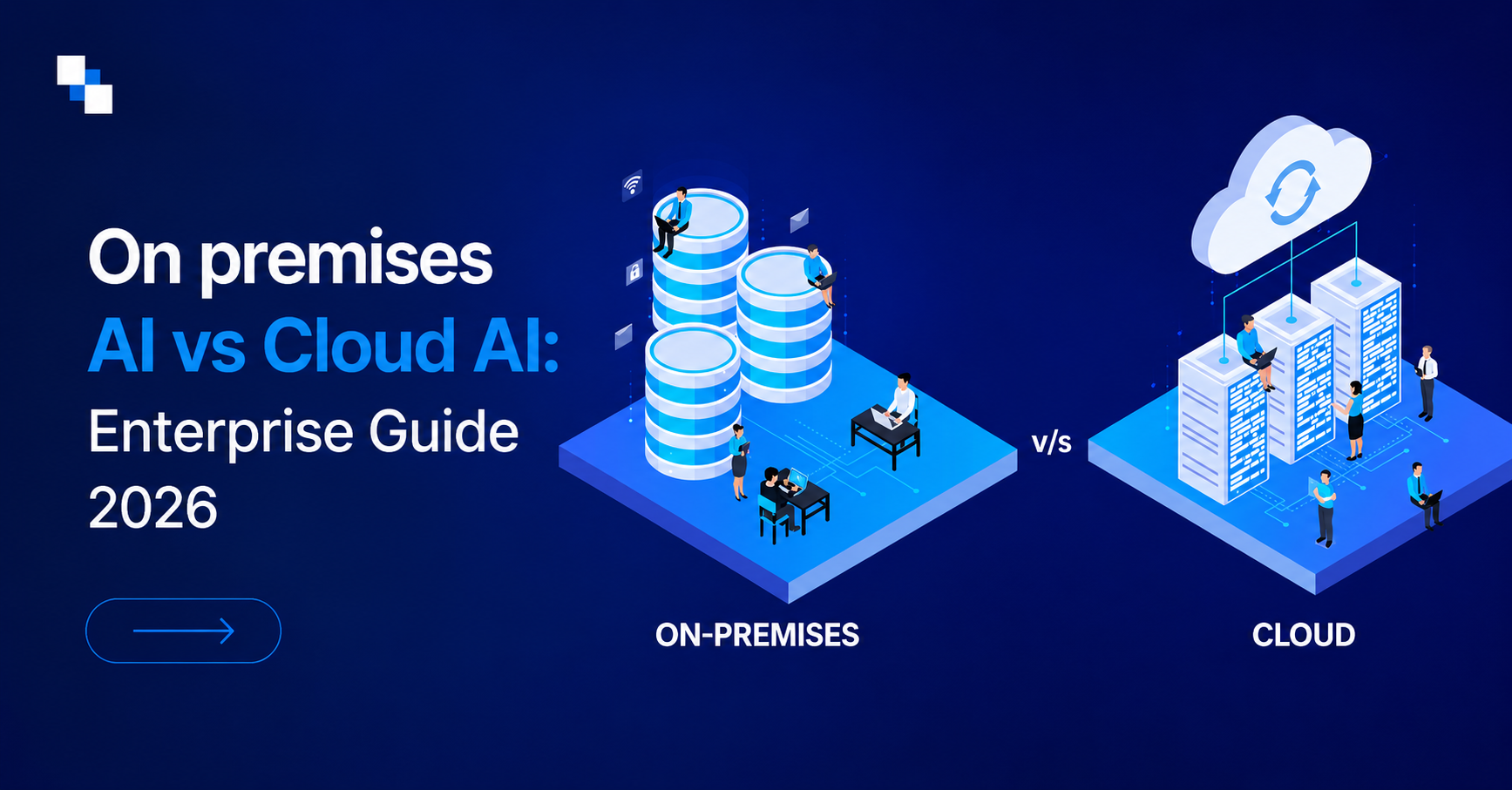
The meaningful distinctions between on-prem and cloud AI for enterprise decision-making operate across six dimensions:
Dimension 1 Data sovereignty and control
On-prem: complete control data never leaves organization-owned infrastructure, encryption keys are held by the organization, no third-party disclosure risk
Cloud: data processed on provider's infrastructure, subject to provider's terms of service, potential exposure to CLOUD Act or equivalent extraterritorial disclosure obligations depending on provider jurisdiction
Dimension 2 Capital vs operating expenditure
On-prem: high upfront capital expenditure (hardware), lower ongoing operating expense, long-term economics favorable for high-utilization workloads
Cloud: zero capital expenditure, ongoing operating expense that scales with usage, long-term economics favorable for variable-utilization workloads
Dimension 3 Deployment speed
On-prem: weeks to months (hardware procurement, data center space, networking, software configuration)
Cloud: hours to days (provision instances, deploy models, begin inference)
Dimension 4 Scalability
On-prem: fixed capacity until additional hardware is procured; scaling requires lead time
Cloud: elastic scale up in minutes, scale down when demand drops; no unused capacity cost
Dimension 5 Latency
On-prem: lowest possible inference latency for collocated applications (microseconds to low milliseconds from application to model to response)
Cloud: adds network round-trip latency (50–300ms depending on cloud region and network path)
Dimension 6 Operational burden
On-prem: full hardware and software operations responsibility patching, monitoring, hardware replacement, capacity planning
Cloud: provider manages hardware operations; customer manages software configuration and application
The Data That Determines Which Option Wins Your Specific TCO Calculation
On-Prem vs Cloud AI TCO Comparison by Workload Utilization
|
GPU Utilization |
Cloud (Specialist, per H100/yr) |
On-Prem (Colocation, per H100/yr amortized) |
Winner |
|
20% |
~$5,300 |
~$22,000 |
Cloud by 4x |
|
40% |
~$10,500 |
~$22,000 |
Cloud by 2x |
|
60% |
~$15,800 |
~$22,000 |
Cloud by 1.4x |
|
70% |
~$18,400 |
~$22,000 |
Roughly equal |
|
80% |
~$21,000 |
~$22,000 |
On-Prem edges ahead |
|
90% |
~$23,600 |
~$22,000 |
On-Prem by 1.1x |
|
95%+ |
~$24,900 |
~$22,000 |
On-Prem by 1.1x+ |
Illustrative estimates based on Lambda Labs H100 pricing (~$2.49/hr), amortized hardware cost ($300K per H100 server, 5-year life), and colocation/ops costs. Actual figures depend on specific provider pricing, hardware vintage, facility costs, and staffing. Verify with current pricing before modeling.
Sources: Lambda Labs published pricing 2026; Andreessen Horowitz "The Cost of Cloud" analysis; Gartner AI Infrastructure TCO Framework 2025.
The Compliance and Regulatory Cost That Cloud TCO Models Miss
Enterprise AI infrastructure decisions increasingly depend on workload sensitivity, inference volume, latency, compliance, GPU utilization, and total cost of ownership factors that aggregate cloud TCO estimates undercount consistently:
-
Compliance overhead for deploying regulated data on cloud infrastructure conducting vendor security assessments, negotiating DPA agreements, implementing additional encryption and access controls, and maintaining ongoing compliance monitoring adds an estimated $50,000–$300,000 per year in compliance program cost for regulated-data cloud AI deployments, depending on regulatory domain (Gartner Risk & Compliance Survey, 2025)
-
Data egress fees from cloud to on-prem applications when an on-prem application calls a cloud inference API repeatedly and receives large response payloads accumulate at $0.02–$0.12/GB, adding $24,000–$144,000/year for a high-volume inference application with 1TB/month of response data transfer (standard cloud provider pricing)
-
On-prem hardware for AI inference has a defined, predictable cost over a 5-year hardware life; cloud GPU pricing has historically increased 15–25% annually for reserved instances as demand outpaces supply a cost trajectory that on-prem deployments are immune to once hardware is purchased
Where Cloud AI Maintains Unambiguous Advantage
-
Variable-load workloads: applications that process 100 inference requests/day on Tuesday and 10,000 on Friday cannot be economically served by on-prem infrastructure without severe overprovisioning cloud's elastic scaling is specifically designed for this pattern
-
New model access: cloud providers deploy new model versions (GPT-4o, Claude, Gemini) instantly; on-prem open-weight model deployment requires downloading, testing, and serving infrastructure updates for each new model version
-
Geographic distribution: applications requiring inference close to globally distributed users benefit from cloud's global infrastructure footprint that on-prem cannot replicate without massive capital investment
The Enterprise Decision Framework: How to Choose Between On Prem AI and Cloud AI
Step 1: Classify Each AI Workload Independently Don't Make a Single Decision for Your Entire AI Portfolio
The most common on-prem vs cloud AI mistake is making a single infrastructure decision for all AI workloads. The correct approach is workload-level classification:
-
List every current and planned AI workload inference APIs, training runs, fine-tuning jobs, embedding generation, document processing, RAG retrieval
-
For each workload, assess:
-
Data classification: is the training or inference data regulated, sensitive, or sovereign-restricted?
-
Utilization profile: does this workload run at consistent high utilization (>60%) or variable/bursty utilization?
-
Latency requirement: does the application require sub-10ms inference (on-prem advantage), or is 100–300ms acceptable (cloud viable)?
-
Scale profile: does this workload scale by orders of magnitude unpredictably, or does it have a predictable, bounded scale?
-
Apply the infrastructure assignment:
-
Regulated data + high utilization + low latency requirement → on-prem
-
Unregulated data + variable utilization + latency-tolerant → cloud
-
Everything in between → evaluate TCO explicitly
Step 2: Run an Honest 5-Year TCO Model for Each Candidate Workload
For workloads where the initial classification doesn't produce a clear answer, model 5-year TCO explicitly:
On-prem TCO components:
-
GPU server hardware (amortized over 5 years): NVIDIA H100 SXM server $250,000–$350,000
-
Colocation or data center facility cost (power, cooling, rack space)
-
Networking hardware
-
IT operations staffing (loaded cost for the incremental FTE fraction managing on-prem AI)
-
Software licensing (OS, virtualization, monitoring)
Cloud TCO components:
-
Reserved instance or spot instance GPU cost at projected utilization and hours/year
-
Data egress cost at projected inference response volume
-
Compliance overhead cost for regulated data
-
Cloud management tooling
Refer to our AI infrastructure cost calculator guide for the full five-category TCO framework applied to this comparison.
Step 3: Assess Regulatory and Data Sovereignty Requirements Before Any Hardware or Cloud Commitment
Regulatory requirements are constraints, not preferences and they must be assessed before TCO modeling determines which option is optimal, because a cheaper option that violates data sovereignty requirements is not a real option:
-
Identify the data classification of AI training data and inference inputs
-
Map that classification against applicable regulatory requirements (GDPR, PDPL, UAE Federal Data Law, HIPAA, ITAR, financial services sector requirements)
-
Assess whether the cloud provider's compliance documentation satisfies those requirements or whether the operational sovereignty gap makes on-prem the cleaner compliance architecture
-
For regulated data where cloud is technically possible but requires extensive compliance overhead, include that compliance overhead in the cloud TCO model
Step 4: Evaluate Hybrid AI as the Default Architecture Not as a Compromise
Hybrid AI running some workloads on-prem and others in cloud, with defined workload placement policy is not a compromise between two options. It is the correct architecture for almost every enterprise with a diverse AI workload portfolio:
-
Assign high-utilization, regulated, latency-sensitive workloads to on-prem: production inference for regulated data, large-batch embedding generation on sensitive documents, fine-tuning on proprietary training data
-
Assign variable-utilization, unregulated, scalability-dependent workloads to cloud: development and testing environments, burst inference capacity for traffic spikes, new model experimentation before committing to on-prem deployment
-
Design the connectivity between on-prem and cloud: hybrid AI requires a network architecture that supports data flow between on-prem and cloud components without creating data sovereignty violations or unacceptable latency overhead
-
Establish workload placement policy: define which workload types belong on-prem versus cloud at the organizational policy level preventing the cloud-default behavior that causes regulated data to end up in cloud infrastructure because it was the path of least resistance for a developer provisioning a new service
Step 5: Plan for On-Prem AI Operations Before Hardware Procurement
On-prem AI fails most frequently not from the hardware decision but from the operations model organizations that procure GPU hardware without planning the operating model for that hardware discover they've made a capital investment they cannot operate effectively:
-
Staff or contract the MLOps capability: on-prem AI requires model serving infrastructure management, GPU health monitoring, software updates, and incident response for hardware failures functions that cloud abstracts but on-prem requires explicitly
-
Plan the model update process: on-prem deployments update models through a defined process (download new weights, test, deploy) rather than through a provider update establishing this process before the first model update is needed prevents urgent improvisation
-
Design for disaster recovery: on-prem hardware failures require a defined response spare hardware, colocation redundancy, or cloud burst capacity as fallback because cloud's built-in redundancy doesn't apply to hardware you own
Which Tools and Platforms Support On-Prem AI Deployment in 2026?
For on-prem LLM inference serving:
vLLM (open-source, UC Berkeley) is the standard high-throughput inference server for open-weight LLMs on on-prem GPU infrastructure providing continuous batching and PagedAttention that maximize GPU utilization for inference serving at production scale. NVIDIA NIM (NVIDIA Inference Microservices) provides containerized model serving optimized for NVIDIA hardware with pre-optimized model configurations. Ollama provides accessible on-prem model serving for smaller-scale deployments without NVIDIA infrastructure optimization.
For on-prem model management:
MLflow and Weights & Biases (self-hosted) provide model registry, experiment tracking, and deployment management deployable on-premises without cloud dependency essential for organizations requiring air-gapped or sovereignty-compliant ML operations.
For on-prem GPU infrastructure:
Dell EMC PowerEdge and HPE ProLiant with NVIDIA HGX configurations provide the enterprise hardware foundation. Supermicro AI servers provide lower-cost alternatives at the cost of less enterprise support. For colocation-hosted on-prem, Equinix Metal provides bare-metal GPU infrastructure with colocation economics and cloud-like API provisioning.
For hybrid AI management:
Portworx and NetApp Astra provide data management that spans on-prem and cloud storage enabling the data layer of hybrid AI architecture to be managed consistently across deployment locations. HashiCorp Terraform with cloud and on-prem providers enables infrastructure-as-code management across hybrid deployments.
For private cloud on-prem:
Oracle Dedicated Region Cloud deploys Oracle Cloud infrastructure in the customer's data center under customer operational control providing cloud-native services at on-prem sovereignty characteristics. Azure Stack HCI provides Microsoft Azure services on customer-owned hardware for organizations requiring Azure-compatible on-premises cloud infrastructure.
Explore our Private AI vs Public AI guide and AI Infrastructure Cost Calculator for the companion analyses that complete the on-prem AI decision framework.
What Goes Wrong With On Prem AI Decisions and How to Prevent Each Failure
Failure 1: Purchasing On-Prem GPU Hardware Before Validating Utilization Assumptions
The most expensive on-prem AI mistake is purchasing GPU hardware based on projected utilization that is not validated by actual usage data committing $1M+ in capital to infrastructure that runs at 20–30% utilization because the AI program didn't scale to the assumed volume within the assumed timeline. Validate utilization on cloud GPU first run the target workloads on cloud GPU and measure actual utilization before committing to hardware. The cloud period is not wasted spend; it is the due diligence that validates or invalidates the on-prem investment case.
Failure 2: Modeling On-Prem TCO Without Including IT Operations Staffing
On-prem AI TCO models that include hardware amortization and colocation but exclude the loaded cost of the IT operations staff required to manage the hardware consistently underestimate on-prem total cost by 20–40%. A 0.25–0.5 FTE of senior infrastructure engineer time dedicated to GPU cluster operations carries a loaded cost of $40,000–$100,000 per year a material addition to the TCO model that hardware-focused analysis omits. Include explicit IT operations cost at loaded rates in every on-prem TCO calculation.
Failure 3: Treating "On-Prem" and "Compliant" as Synonymous
On-prem hardware guarantees physical data location but does not automatically guarantee regulatory compliance. An on-prem AI system with inadequate access controls, insufficient audit logging, unencrypted data at rest, or insufficiently vetted software supply chain is not compliant simply by virtue of its physical location. Assess on-prem AI compliance against the same regulatory framework that drives the data sovereignty concern CMMC for defense, HIPAA for healthcare, PCI-DSS for payment data and implement the technical controls each framework requires, not just the physical location.
Failure 4: Failing to Design Cloud Burst Capacity for On-Prem Deployments
On-prem AI deployments without a defined cloud burst strategy consistently encounter two failure modes: over-provisioning on-prem hardware to handle peak demand that materializes rarely (wasting capital on idle capacity) or under-provisioning and failing to serve peak demand (impacting the application experience). Design cloud burst capacity an agreement and integration for routing overflow inference requests to cloud GPU when on-prem capacity is saturated as part of every on-prem AI architecture, not as a future enhancement.
Frequently Asked Questions
Is On-Prem AI Cheaper Than Cloud AI?
On Prem AI is cheaper than cloud AI for workloads running above approximately 60–70% sustained GPU utilization over a 3–5 year horizon the point at which amortized hardware and colocation costs fall below per-hour cloud GPU pricing at that utilization level. Cloud AI is cheaper for workloads below 60% sustained utilization, for variable or bursty workloads that would require on-prem overprovisioning to handle peak demand, and for workloads with short expected lifespans that don't justify capital expenditure. The comparison is not absolute it depends on specific hardware pricing, colocation costs, cloud provider pricing, and most critically, the actual utilization rate of the specific workload being modeled.
When Should Enterprises Choose On-Prem AI?
Enterprises should choose On Prem AI when three or more of these conditions apply: AI workloads process regulated data that cannot be sent to a third-party cloud processor without creating compliance risk; GPU utilization for production workloads consistently exceeds 60–70%; inference latency requirements are below 10ms (requiring sub-millisecond local network round-trips rather than cloud round-trip latency); data sovereignty requirements mandate that data remain within specific jurisdictions under organizational operational control; or the enterprise has an existing data center or colocation presence that reduces the incremental infrastructure cost of adding GPU compute. Conversely, enterprises should default to cloud when workloads are experimental or unpredictable in scale, when time-to-deployment is a priority, and when data classification permits cloud processing without sovereignty complications.
Is Hybrid AI Better Than Choosing Exclusively Cloud or On-Prem?
Hybrid AI running workloads across both on-prem and cloud infrastructure based on workload-specific requirements is the architecturally optimal answer for enterprises with a diverse AI workload portfolio, because it allows each workload to be placed in the environment where its specific combination of data sensitivity, utilization rate, latency requirement, and scale profile is most efficiently served. Choosing exclusively on-prem creates capital waste on variable workloads and a flexibility constraint on new model adoption. Choosing exclusively cloud creates overspending on high-utilization production workloads and compliance risk for regulated data. Hybrid AI requires workload placement policy, connectivity architecture between environments, and ongoing governance investments that pay off consistently at enterprise scale.
Classify Each Workload Independently. Model 5-Year TCO Honestly Including Staffing. Validate Utilization on Cloud Before Committing Capital to Hardware.
On Prem AI delivers its cost, compliance, and performance advantages when the decision is made workload-by-workload against actual utilization data, regulatory requirements, and honest total cost of ownership including IT operations staffing not as a blanket infrastructure strategy that ignores the workload characteristics that determine which environment is actually optimal.
The CIOs, CTOs, and AI infrastructure leaders making the best on-prem vs cloud decisions in 2026 share one validation discipline: they ran target workloads on cloud GPU first, measured actual utilization, and used that measured utilization to validate the on-prem TCO model before committing capital to hardware. That validation sequence produced on-prem investments that delivered the projected TCO improvement because the utilization assumptions in the model matched the utilization reality in production.
Classify your current AI workload portfolio this quarter assigning each workload to on-prem, cloud, or hybrid based on data sensitivity, utilization, and latency. Build the 5-year TCO model for your highest-cost AI workloads using the framework in our AI infrastructure cost calculator. Validate utilization assumptions for any on-prem candidate by running the workload on cloud GPU for 60–90 days before hardware procurement.
To design an On Prem AI, Cloud AI, or Hybrid AI architecture that correctly places each enterprise AI workload against its specific requirements, explore our Private AI vs Public AI guide and AI Infrastructure Cost Calculator and connect with our team for workload-specific infrastructure architecture support structured for CIOs, CISOs, and AI infrastructure leaders who need infrastructure decisions backed by workload data, not infrastructure ideology.