

Published by AgamiSoft | Reading time: ~14 minutes
|
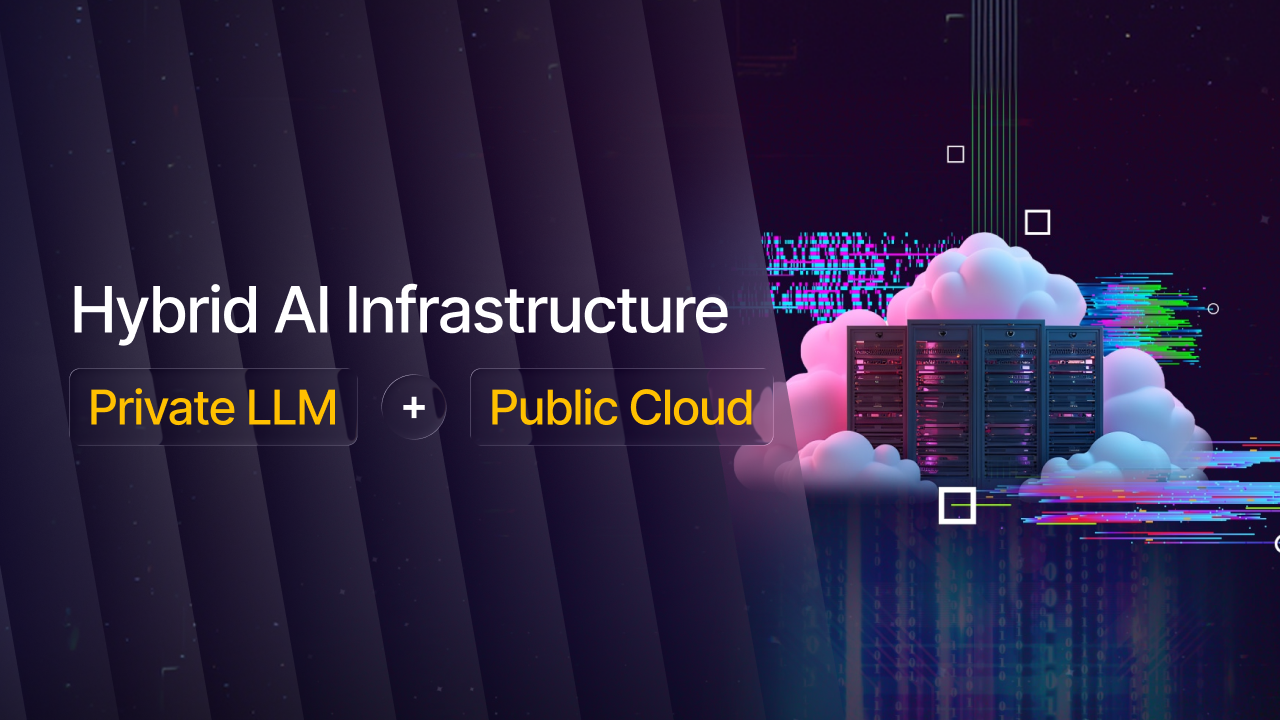
Featured Snippet / AEO Answer : Hybrid AI infrastructure combines privately-operated AI resources on-premises GPU clusters, colocation-hosted servers, or private cloud deployments running open-weight LLMs with public cloud AI services, enabling enterprises to process sensitive or regulated data through controlled private infrastructure while using public cloud for elastic capacity, new model access, and development workloads. Hybrid AI architectures allow organizations to keep sensitive workloads within controlled environments while using public cloud infrastructure for elastic or less-sensitive workloads balancing data sovereignty, security, performance, scalability, and infrastructure cost across a diverse AI workload portfolio.
|
Hybrid AI Infrastructure: Building Private LLM + Public Cloud Architecture That Actually Works in 2026
|
Quick Answer / TL;DR : Hybrid AI infrastructure is the architectural model in which an enterprise operates both private AI resources (on-premises GPU clusters, colocation-hosted servers running open-weight LLMs, or private cloud environments) and public cloud AI services simultaneously routing each AI workload to the environment that best matches its data sensitivity, utilization profile, latency requirement, and cost characteristics. The enterprises achieving the best combination of AI capability, data sovereignty, and cost efficiency in 2026 are not those who chose one extreme everything on-prem or everything in cloud but those who built deliberate hybrid architectures with defined workload placement policies that route each AI task to the right infrastructure.
|
Why Hybrid AI Infrastructure Has Emerged as the Default Enterprise Architecture in 2026
The "cloud-first" AI strategy that defined enterprise AI infrastructure thinking from 2018–2022 has evolved under the pressure of three converging realities: data sovereignty regulations that restrict what data can be processed on third-party cloud infrastructure, GPU economics that favor on-premises infrastructure for high-utilization sustained workloads, and the maturing of open-weight models that are now qualitatively competitive with cloud-only proprietary models for many enterprise use cases.
The parallel "everything on-prem" counter-narrative motivated by security concerns and cloud cost anxiety has also proven inadequate. On-premises AI infrastructure provides excellent economics for sustained, predictable workloads and strong sovereignty guarantees for regulated data. It provides poor economics for variable workloads, slow access to new model capabilities, and limited burst capacity for traffic spikes that exceed provisioned capacity.
Hybrid AI infrastructure addresses both gaps simultaneously. It is not a compromise between cloud and on-prem it is the recognition that different AI workload types have different optimal infrastructure homes, and that routing each workload to its optimal home produces better outcomes on every dimension than forcing all workloads into a single infrastructure model.
Three developments have made hybrid AI infrastructure the dominant enterprise architecture pattern in 2026:
Open-weight model quality has made private LLM deployment viable for production use cases. Llama 3.3 70B, Mistral Large, Qwen 2.5 72B, and their successors are producing inference quality competitive with GPT-4o for the majority of enterprise use cases enabling enterprises to run production AI inference on privately-controlled infrastructure without accepting a significant quality penalty compared to cloud proprietary models.
Workload placement governance has become an enterprise AI governance requirement. The EU AI Act, financial services AI governance guidance, and healthcare AI regulations increasingly require organizations to demonstrate that data classification and workload placement decisions are documented, enforced, and audited. A hybrid AI infrastructure with defined workload placement policy is the technical implementation of this governance requirement.
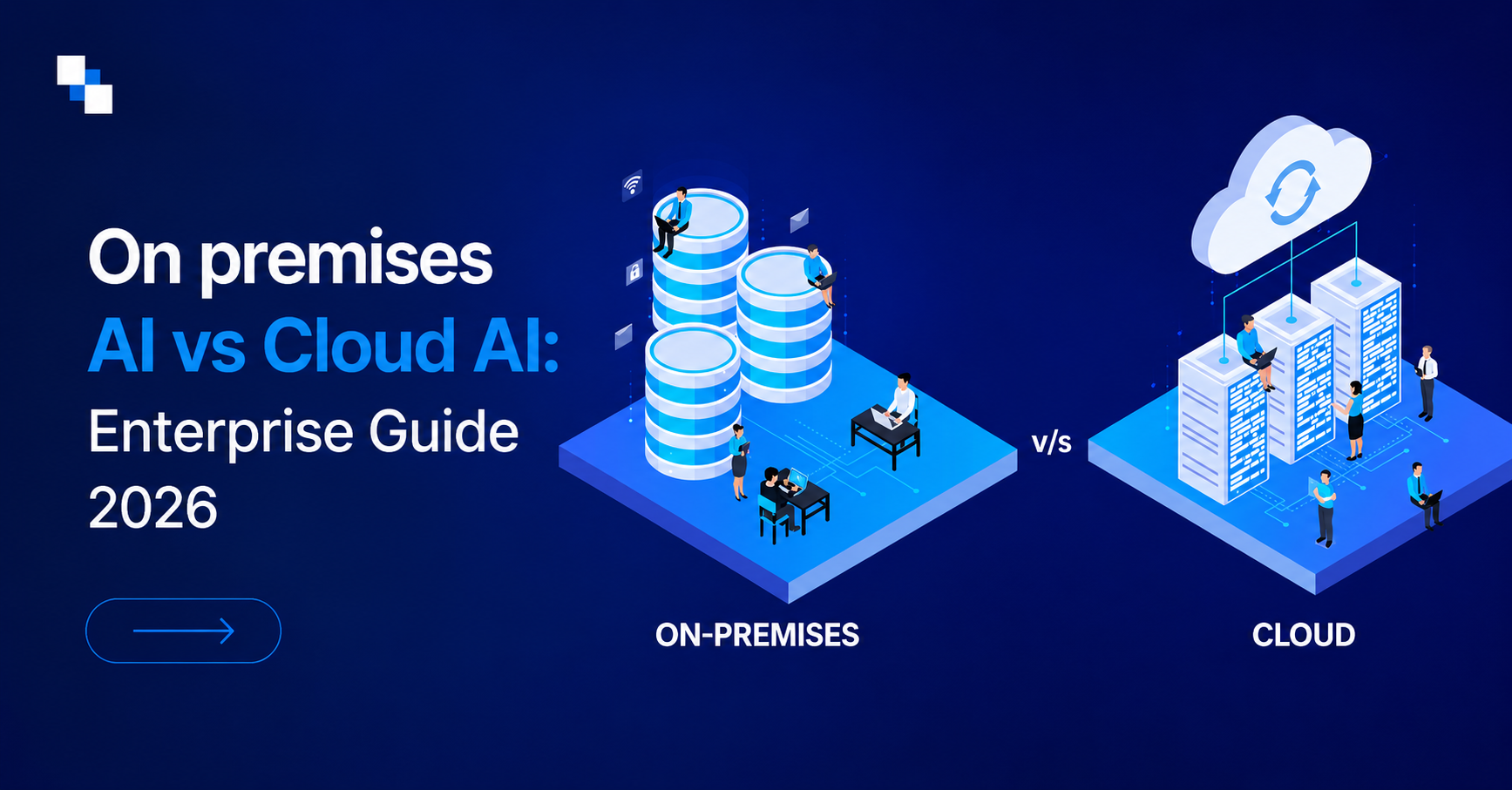
AI infrastructure cost maturity has made the hybrid TCO calculation clearly favorable over single-model approaches. As detailed in our on-prem AI vs cloud AI comparison, the GPU utilization crossover at which on-prem becomes cheaper than cloud occurs at approximately 60–70% sustained utilization. A hybrid architecture that routes high-utilization regulated workloads on-prem and variable unregulated workloads to cloud optimizes TCO simultaneously with compliance neither model alone achieves both.
What Is Hybrid AI Infrastructure, Exactly and What Does a Complete Architecture Include?
Hybrid AI infrastructure is an enterprise AI deployment model that combines two or more distinct AI infrastructure environments typically a private environment (on-premises, colocation, or private cloud) and a public cloud environment with defined data classification, workload routing, and governance policies that determine which AI workloads run in which environment.
The critical architectural element that distinguishes genuine hybrid AI infrastructure from simply having both cloud accounts and on-prem hardware is the workload placement policy the documented, enforced set of rules that determines where each AI workload runs based on its characteristics. Without a workload placement policy, "hybrid AI" is just uncoordinated infrastructure sprawl; with one, it is a managed architecture.
A complete Hybrid AI Infrastructure covers five distinct layers:
Layer 1 Private AI environment
On-premises GPU clusters, colocation-hosted servers, or private cloud deployments running open-weight LLMs for inference, fine-tuning, and embedding generation on sensitive data. This layer holds regulated data, provides the lowest inference latency for co-located applications, and delivers the best economics for high-utilization sustained workloads.
Layer 2 Public cloud AI environment
Hyperscaler cloud services (AWS, Azure, Google Cloud) and specialist GPU cloud providers (CoreWeave, Lambda Labs) for elastic inference capacity, new proprietary model access (GPT-4o, Claude, Gemini), development and testing environments, and burst capacity beyond private infrastructure limits.
Layer 3 AI gateway and routing layer
The middleware layer that receives AI inference requests from applications, applies workload placement policy to determine which environment handles each request, routes requests to the appropriate private or cloud endpoint, and provides unified authentication, logging, and observability across both environments. This is the architectural component that makes hybrid AI manageable rather than chaotic.
Layer 4 Data classification and sovereignty controls
The data governance layer that classifies enterprise data by sensitivity, maps each data class to the environments it may be processed in, enforces that mapping through technical controls (preventing regulated data from being sent to cloud endpoints), and generates the audit evidence that compliance frameworks require.
Layer 5 Unified observability and governance
Cross-environment monitoring, cost attribution, performance tracking, and governance reporting that provides a unified view of the hybrid AI estate enabling CIOs and CISOs to understand what's running where, what it's costing, and whether workload placement policy is being followed.
The Performance, Cost, and Compliance Numbers Behind Hybrid AI Architecture
Workload Placement Economics
|
Workload Type |
Private LLM (On-Prem) |
Public Cloud |
Optimal Placement |
|
Regulated data inference (GDPR, HIPAA, financial) |
Compliant, cost-competitive at >60% util |
Compliance risk or overhead |
Private LLM |
|
High-utilization production inference (>70% GPU util) |
20–40% lower cost over 3 years |
Higher ongoing cost |
Private LLM |
|
Variable/bursty inference (<40% average util) |
Overprovisioning required |
Cost-efficient elastic |
Public Cloud |
|
New model experimentation |
New models require deployment lag |
Instant access to new models |
Public Cloud |
|
Dev/test environments |
Capital waste on idle GPU |
Pay only when running |
Public Cloud |
|
Highest-sensitivity fine-tuning |
Complete data control |
Data leaves organization |
Private LLM |
Sources: Andreessen Horowitz "The Cost of Cloud" AI analysis 2025; Gartner Hybrid AI Infrastructure Survey 2025; McKinsey Enterprise AI Infrastructure Report 2025.
The Sovereignty and Compliance Case
-
Hybrid AI architectures allow organizations to keep sensitive workloads within controlled environments while using public cloud infrastructure for elastic or less-sensitive workloads organizations implementing formal workload placement policies report 45% reduction in AI-related compliance findings during regulatory examinations compared to organizations without documented workload governance (Gartner, 2025)
-
Financial institutions deploying hybrid AI with private LLM for customer data processing and public cloud for development report 60% reduction in data privacy incident risk associated with AI workloads compared to cloud-only deployments (McKinsey, 2025)
-
Healthcare organizations using hybrid AI for HIPAA-regulated patient data inference with on-prem private LLM report 30% lower total AI infrastructure cost compared to implementing equivalent HIPAA BAA compliance overhead on cloud AI APIs (HIMSS AI in Healthcare Survey, 2025)
Model Quality Parity Data
-
Llama 3.3 70B (deployable on private infrastructure) achieves MMLU scores within 3–5% of GPT-4o on enterprise task benchmarks a quality gap that is below the threshold of practical significance for the majority of enterprise use cases including document processing, internal knowledge retrieval, and structured data extraction (Meta AI benchmark data, 2025)
-
Fine-tuned private LLMs on domain-specific enterprise data consistently outperform general cloud LLMs on domain-specific tasks financial document analysis, medical coding, legal clause identification by 15–25% on task-specific accuracy metrics (Stanford HAI Enterprise AI Report, 2025)
How to Build Hybrid AI Infrastructure: A 6-Step Framework
Step 1: Define Your AI Workload Data Classification Tiers
The foundation of hybrid AI infrastructure is data classification every workload placement decision flows from knowing what data the AI workload processes:
-
Tier 1 Regulated or sovereign-restricted data: customer PII under GDPR/PDPL/UAE Federal Data Law, patient health information under HIPAA, financial customer data under GLBA or sector-specific regulations, classified government information. Required placement: private LLM only.
-
Tier 2 Sensitive but not regulated: proprietary business data, internal strategies, unreleased product information, employee performance data. Recommended placement: private LLM; cloud permitted with enhanced controls and contractual protections.
-
Tier 3 Internal operational data: standard business communications, process documentation, non-sensitive operational records. Placement: either environment; cloud typically preferred for development workloads.
-
Tier 4 Public or non-sensitive data: publicly available content, anonymized data, development mock data, general knowledge tasks. Placement: public cloud preferred for model variety and cost.
This tier structure becomes the data classification schema that the AI gateway enforces routing requests based on the classification of the data they carry, not on the application that sent them.
Step 2: Design the Private AI Environment for Your Tier 1 and Tier 2 Workloads
The private AI environment must be sized and configured before the hybrid routing architecture can be designed:
-
Inventory Tier 1 and Tier 2 AI workloads document every current and planned AI use case that processes regulated or sensitive data: inference requests per day, average token count per request, peak-to-average traffic ratio, and latency requirements
-
Size GPU infrastructure against projected Tier 1 and Tier 2 inference volume at target utilization typically provisioning for 70–80% utilization under expected peak load, with cloud burst as overflow
-
Select and configure open-weight models appropriate for your enterprise tasks 70B parameter models (Llama 3.3 70B, Qwen 2.5 72B) for complex reasoning tasks; 7B–13B models for high-volume, lower-complexity inference where inference cost per token matters more than maximum accuracy
-
Deploy vLLM or NVIDIA NIM as the inference serving layer these are not optional production convenience; they are the components that achieve the GPU utilization rates that make private LLM economically viable through efficient batching
Step 3: Establish Cloud AI Capabilities for Tier 3 and Tier 4 Workloads
Configure your public cloud AI environment with the capabilities that private infrastructure cannot cost-effectively provide:
-
Select your cloud AI providers distinct from your hyperscaler for general infrastructure, you may use different providers for AI specifically: OpenAI API or Azure OpenAI for GPT models, Anthropic API for Claude, Google Vertex AI for Gemini, CoreWeave or Lambda Labs for cloud GPU inference of self-selected models
-
Configure cloud API access through your AI gateway never allow applications to call cloud AI APIs directly with application-held credentials; all cloud AI API access should flow through the centralized AI gateway covered in our AI gateway architecture guide
-
Establish development and testing environments on cloud dev/test AI workloads that need rapid iteration on new models or model parameters should use cloud GPU (spot instances for cost efficiency) rather than consuming private inference capacity
Step 4: Deploy the AI Gateway as the Hybrid Routing Layer
The AI gateway is the architectural component that makes hybrid AI manageable without it, applications must know which environment to call, data classification is enforced application-by-application, and observability across environments is fragmented:
-
Deploy a single AI gateway endpoint that all enterprise applications call for AI inference applications do not need to know whether their request will be served by the private LLM or a cloud model
-
Implement data classification-based routing the gateway inspects request metadata (data classification tags, application identity, data tier annotation) and routes to the appropriate environment per the workload placement policy
-
Implement fallback routing when private LLM infrastructure is at capacity or unavailable, the gateway can route Tier 2 requests to cloud with enhanced controls, or hold requests in a queue, based on policy configuration
-
Implement unified authentication, logging, and cost attribution across both environments every request to every AI endpoint (private or cloud) is authenticated, logged, and attributed to the requesting application and cost center
Step 5: Implement Unified Observability Across Private and Cloud Environments
Hybrid AI infrastructure without unified observability produces a split view private LLM logs in one system, cloud API logs in another, and no consolidated view of the full hybrid AI estate's performance, cost, and compliance posture:
-
Deploy centralized log aggregation that collects inference logs from the private LLM serving layer and cloud API call logs from the AI gateway into a single observability platform
-
Implement cross-environment cost attribution every AI inference request attributed to the requesting application and environment, enabling per-application cost reporting that spans both private and cloud spend
-
Implement workload placement compliance monitoring automated alerts when AI requests carrying Tier 1 or Tier 2 data are routed to cloud endpoints, providing real-time detection of policy violations rather than discovering them in quarterly compliance reviews
-
Implement model performance monitoring across environments tracking response quality, latency, and error rates for both private and cloud endpoints, enabling quantitative comparison of private LLM versus cloud model performance on equivalent tasks
Step 6: Establish Workload Placement Governance as an Ongoing Process
Hybrid AI infrastructure governance is not a one-time configuration it requires ongoing management as the AI workload portfolio evolves:
-
Conduct quarterly workload placement reviews as new AI use cases are deployed, their data classification and workload characteristics should be assessed against the placement policy, and any workloads incorrectly placed should be migrated to the correct environment
-
Review cloud burst utilization if cloud burst is triggered frequently, the private infrastructure may be undersized and warrant capacity expansion; if cloud burst is never triggered, the private infrastructure may be oversized and reducing private capacity could reduce cost
-
Review open-weight model currency new open-weight model releases with improved capability may reduce the quality gap between private LLM and cloud proprietary models for specific tasks, enabling migration of workloads currently using cloud models to private LLM
-
Update data classification tiers as regulations evolve new regulatory requirements may reclassify data that was previously Tier 3 or 4 into Tier 1, requiring migration of workloads processing that data from cloud to private LLM environments
Which Tools Support Hybrid AI Infrastructure in 2026?
For private LLM inference serving:
vLLM (open-source) provides the highest-throughput GPU inference serving for open-weight models on private infrastructure essential for achieving the utilization efficiency that makes private LLM economically competitive. NVIDIA NIM provides enterprise-supported containerized inference optimized for NVIDIA hardware with NVIDIA-validated model configurations.
For the hybrid AI gateway:
Portkey.ai and LiteLLM Proxy both provide AI gateway capability with multi-provider routing supporting routing to both private LLM endpoints and cloud AI API endpoints from a unified gateway interface. Kong AI Gateway provides enterprise-grade gateway capability with the operational maturity of Kong's proven API management platform.
For hybrid AI observability:
Langfuse (open-source, self-hosted) provides LLM observability deployable on private infrastructure capturing inference traces from both private LLM and cloud API calls in a unified observability platform without requiring data to leave your environment. LangSmith provides comparable managed observability for organizations comfortable with cloud-hosted observability data.
For private cloud AI deployment:
Oracle Dedicated Region Cloud deploys Oracle Cloud infrastructure on-premises under organizational control providing cloud-native AI services at on-prem sovereignty. Azure Stack HCI with Azure Arc provides Azure AI services on customer-owned hardware for organizations requiring Azure-compatible private cloud AI infrastructure.
For open-weight model deployment and management:
Ollama provides accessible private LLM deployment for smaller-scale workloads. Hugging Face Text Generation Inference (TGI) provides production-grade inference serving as an alternative to vLLM with different optimization trade-offs. MLflow or Weights & Biases (self-hosted) provide model registry and versioning for private LLM deployment management.
Explore our On-Prem AI vs Cloud AI guide and Sovereign Cloud Explained for the companion analyses that complete the hybrid AI infrastructure decision framework.
What Goes Wrong With Hybrid AI Infrastructure and How to Prevent Each Failure
Failure 1: Building Hybrid Infrastructure Without a Workload Placement Policy
Hybrid AI infrastructure without a documented, enforced workload placement policy is not a hybrid architecture it is unmanaged infrastructure sprawl where developers route AI requests based on convenience rather than data sensitivity. The first year of "hybrid AI" without a placement policy consistently produces the worst outcome: regulated data in cloud (the compliance risk that on-prem was supposed to prevent), high-utilization workloads in cloud (the cost overhead that on-prem was supposed to reduce), and development workloads consuming private GPU capacity (the opposite of optimal). Build the workload placement policy before any infrastructure is deployed, and enforce it through the AI gateway before any application routes AI requests.
Failure 2: Treating the Private LLM as a Lower-Quality Fallback
Organizations that deploy private LLMs as a compliance-motivated fallback from "real AI" in cloud configuring the private LLM to handle regulated requests while routing all "important" work to cloud proprietary models consistently underutilize their private infrastructure investment and fail to develop the fine-tuning and model management capability that makes private LLMs competitive. Invest in domain-specific fine-tuning of private LLMs on enterprise data the resulting models frequently outperform general cloud models on the specific enterprise tasks that matter, converting the private LLM from a compliance accommodation to a performance advantage.
Failure 3: Fragmented Observability That Prevents Cross-Environment Performance Comparison
Hybrid AI deployments with separate observability for private and cloud environments consistently fail to surface the insights that justify the architectural complexity of hybrid AI because the data required to compare private LLM performance to cloud model performance on equivalent tasks doesn't exist in a unified accessible form. Unified observability is not a nice-to-have for hybrid AI; it is the analytical infrastructure that validates whether the hybrid architecture is delivering its intended value and guides ongoing workload placement optimization.
Failure 4: Not Planning for Private LLM Model Updates
Organizations that deploy a private LLM without defining the model update process discover the operational overhead of model management the hard way when a new open-weight model version is released that significantly outperforms the deployed version, and the process for testing, validating, and deploying the update on private infrastructure has never been defined. Establish the model update process download, evaluation against task benchmarks, staged deployment, rollback procedure as part of private LLM deployment, not as a response to the first model update event.
Frequently Asked Questions
What Is Hybrid AI Infrastructure?
Hybrid AI infrastructure is an enterprise AI deployment model that combines private AI resources on-premises GPU clusters, colocation-hosted servers, or private cloud environments running open-weight LLMs with public cloud AI services, routing each AI workload to the environment that best matches its data sensitivity, utilization profile, latency, and cost characteristics. The defining architectural element is a workload placement policy that determines where each workload runs, enforced through an AI gateway that routes requests to the appropriate private or cloud endpoint without requiring applications to know which environment serves them.
Why Combine Private AI and Public Cloud AI?
Combining private and public cloud AI addresses limitations that neither model alone resolves. Private AI alone fails for variable workloads (requiring expensive overprovisioning to handle peak demand), for new model access (open-weight deployments lag proprietary model releases), and for development environments (idle private GPU is wasted capital). Public cloud AI alone fails for regulated data workloads (creating compliance risk or overhead), for high-utilization production inference (cloud economics are worse than on-prem above 60–70% sustained utilization), and for the lowest-latency requirements. Hybrid AI infrastructure allows organizations to keep sensitive workloads within controlled environments while using public cloud infrastructure for elastic or less-sensitive workloads achieving better outcomes on compliance, cost, and capability simultaneously than either approach alone.
Is Hybrid AI Infrastructure Suitable for Regulated Industries?
Hybrid AI infrastructure is specifically well-suited for regulated industries and is increasingly the recommended architecture for financial services, healthcare, legal services, and government organizations deploying AI at scale. The hybrid model addresses the core regulated industry AI infrastructure challenge: regulated data must stay within controlled environments, but enterprises also need access to elastic cloud capacity for non-regulated workloads. Financial institutions using hybrid AI route customer data inference to private LLMs while using cloud for market research and development workloads. Healthcare organizations run HIPAA-regulated patient data inference on private infrastructure while using cloud for clinical research with anonymized data. The workload placement policy and AI gateway components of hybrid AI architecture are specifically designed to enforce these classifications technically, not just documentarily.
Build the Data Classification Tiers First. Deploy the AI Gateway Before Any Application Routes a Request. Invest in Private LLM Fine-Tuning to Make It a Performance Advantage, Not Just a Compliance Accommodation.
Hybrid AI infrastructure delivers its combination of data sovereignty, cost optimization, and AI capability when it is built as a deliberate architecture with enforced workload placement policy not as two separate infrastructure environments that happen to coexist within the same organization without governance connecting them.
The CIOs, CTOs, and CISOs achieving the strongest hybrid AI outcomes in 2026 made one policy decision consistently: they defined data classification tiers and workload placement policy before procuring any infrastructure, and deployed the AI gateway as the technical enforcement layer before any application was authorized to make AI inference calls. That sequencing produced hybrid AI architectures where workload placement policy was enforced from day one not discovered to be unenforced during a regulatory examination.
Define your data classification tiers this quarter using the four-tier framework in this guide. Deploy an AI gateway with routing policy enforcement before your next AI application deployment. Select an open-weight model for your Tier 1 and Tier 2 inference workloads and begin domain-specific fine-tuning on proprietary data the quality improvement from fine-tuning is what converts private LLM from a compliance requirement into a competitive infrastructure advantage.
To design a Hybrid AI Infrastructure that correctly routes each enterprise AI workload across private LLM and public cloud environments with the governance, observability, and TCO optimization your organization requires, explore our On-Prem AI vs Cloud AI guide and Sovereign Cloud Explained and connect with our team for workload-specific hybrid AI architecture support structured for CIOs, CTOs, and CISOs who need hybrid AI delivered as a governed architecture, not an ad-hoc infrastructure collection.